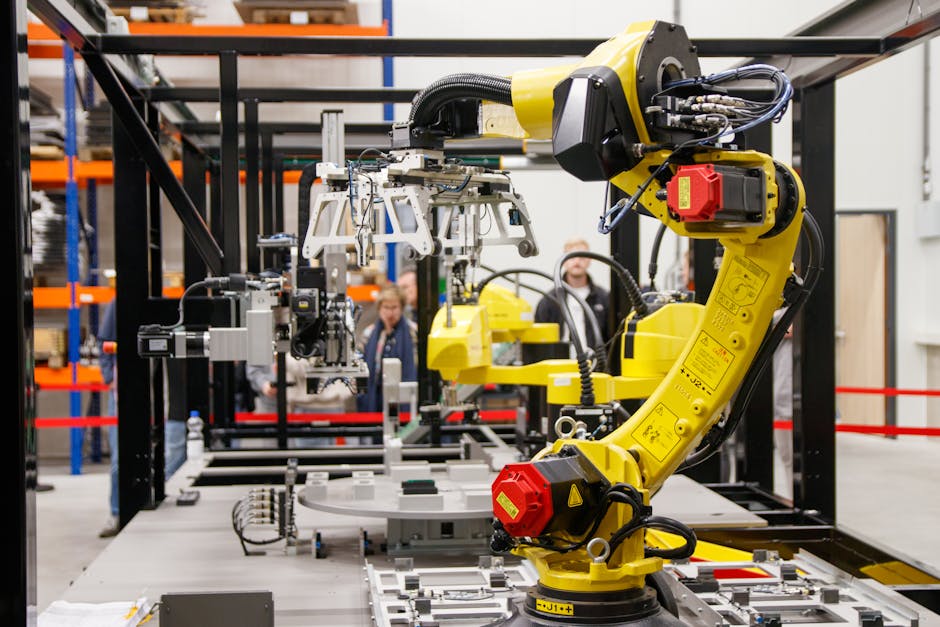
- China’s adaptable humanoid robots outperform U.S. counterparts in real-world manufacturing environments due to prioritizing flexibility over spectacle.
- The U.S. robotics sector focuses on high-profile demonstrations emphasizing agility, speed, or novelty, neglecting resilience in unpredictable industrial settings.
- Chinese manufacturers integrate humanoid robots into live production lines, adapting to changing conditions such as supply chain shifts and workforce changes.
- The International Federation of Robotics reports a significant gap between Chinese and North American humanoid robot deployments, with 42% vs. 18% in new robot deployments.
- Adaptability will determine global manufacturing leadership in the coming decades, not raw technical performance in staged demos.
The United States is investing heavily in humanoid robotics—but in the wrong direction, according to Dr. Scott Ambrose, former chief of NASA’s Robotics Division. While American firms showcase robots performing backflips or precision tasks in controlled labs, China is deploying adaptable, low-cost humanoid systems across real-world manufacturing environments. This strategic divergence, emerging in 2025–2026, prioritizes flexibility over spectacle, positioning China to dominate next-generation industrial automation. The shift matters because adaptability—measured by a robot’s ability to handle unexpected variables in unstructured settings—will determine which nation leads global manufacturing in the coming decades, not raw technical performance in staged demos.
Why Adaptability Beats Performance

Dr. Ambrose argues that the U.S. robotics sector has become fixated on high-profile demonstrations that emphasize agility, speed, or novelty—such as parkour moves or object manipulation under ideal conditions—rather than resilience in unpredictable industrial settings. In contrast, Chinese manufacturers are integrating humanoid robots into live production lines where conditions vary hourly due to supply chain shifts, equipment wear, or workforce changes. According to a 2025 report from the International Federation of Robotics, over 42% of new humanoid robot deployments occurred in Chinese factories, compared to just 18% in North America. This gap reflects a deeper strategic difference: American robotics startups often optimize for investor appeal and media attention, while Chinese firms collaborate closely with state-backed industrial planners to solve immediate labor shortages and supply chain bottlenecks.
China’s Pragmatic Robotics Push

The rapid deployment of humanoid robots in China is driven by a coordinated effort between private firms like UBTECH and state-backed initiatives under the Made in China 2025 program. Unlike U.S. counterparts that spend years refining prototypes before limited pilot tests, Chinese companies are iterating in real time on factory floors. For example, UBTECH’s Walker S robot, deployed in Guangdong electronics plants, adjusts its grip strength and movement patterns based on sensor feedback from damaged components or misaligned trays—capabilities that matter more in daily operations than acrobatic feats. These robots are also significantly cheaper, with some models costing under $30,000, making large-scale adoption feasible. Meanwhile, many American robots remain above $100,000 and are still confined to research labs or corporate showrooms.
The Data Behind the Divergence

Recent data from the International Federation of Robotics highlights the widening gap: China installed 285,000 industrial robots in 2025 alone, a 27% year-over-year increase, while the U.S. added just 68,000. More telling is the shift toward humanoid systems designed for general-purpose tasks rather than fixed automation. Analysts at MIT Technology Review note that Chinese factories now treat humanoid robots as modular labor units—deployed, reprogrammed, and redeployed within days—while American manufacturers wait for perfection before deployment. Dr. Ambrose warns this “pilot paralysis” risks ceding not just manufacturing dominance but also the standards and software ecosystems that will define Industry 4.0. As he stated in a recent address at the IEEE Robotics Conference, “You don’t win the future by building the best robot in a lab. You win by building the robot that keeps working when everything goes wrong.”
Implications for Global Industry

If current trends hold, the U.S. could face long-term disadvantages in both cost efficiency and innovation cycles. As China accumulates real-world data from millions of operational hours, its robotics firms gain insights into maintenance, human-robot collaboration, and error recovery—knowledge that feeds back into better designs. American firms, lacking equivalent field data, may struggle to catch up even with superior component engineering. Workers, too, will feel the impact: in China, humanoid robots are increasingly seen as co-workers that augment labor, while in the U.S., their delayed deployment fuels anxiety about sudden job displacement once they finally arrive. Moreover, countries aligning with Chinese industrial standards may adopt compatible robotics platforms, extending Beijing’s influence beyond manufacturing into global supply chains and technical governance.
Expert Perspectives
Not all experts agree on the immediacy of the threat. Some U.S. robotics researchers argue that American innovation in AI, actuators, and perception systems will eventually translate into more capable machines. “China wins on deployment speed,” said Dr. Lydia Chen of Stanford’s AI Lab, “but the U.S. still leads in foundational breakthroughs.” Others, like Dr. Ambrose, counter that without real-world testing, those breakthroughs risk becoming technological dead ends. He draws parallels to the early space race, where the Soviet Union’s rapid satellite launches pressured the U.S. to reorganize its approach—culminating in NASA’s creation. “We need a similar wake-up call,” he said, “not to copy China, but to rethink what success looks like in robotics.”
Looking ahead, the critical metric will be not how many backflips a robot can perform, but how quickly it adapts when a conveyor belt jams or a part arrives damaged. U.S. policymakers and investors now face a choice: continue funding lab-bound marvels or accelerate real-world trials through public-private partnerships and regulatory sandboxes. The outcome could determine whether America remains a leader in advanced manufacturing—or becomes a spectator to a new industrial revolution unfolding in Shenzhen and Shanghai.
Source: Fortune