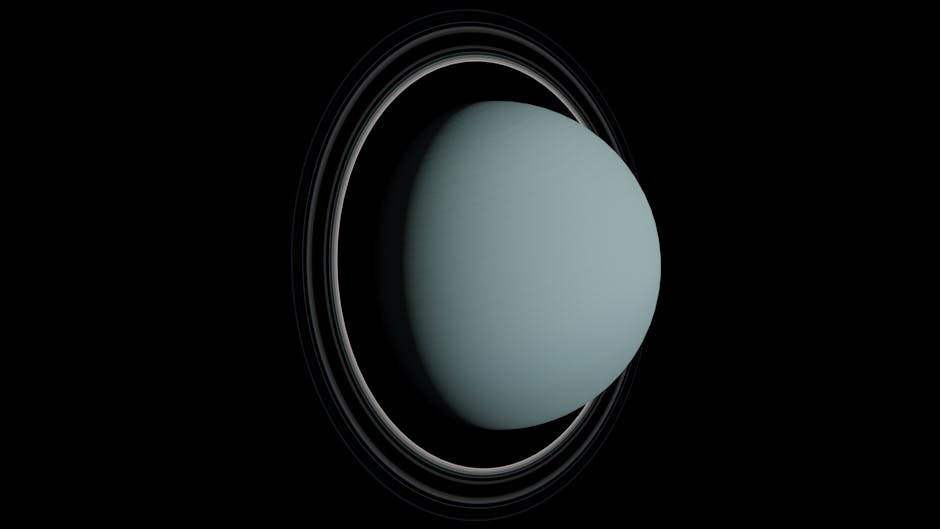
- Uranus’s two outermost rings, epsilon and delta, exhibit stark contrasts in brightness, particle size, and composition.
- The epsilon ring is narrow, bright, and dominated by larger particles, while the delta ring is broader, dimmer, and composed mostly of fine dust.
- Tiny, unseen moons or moonlets may be responsible for sculpting the differences between Uranus’s outermost rings.
- The findings raise deeper questions about how ring systems evolve in the outer solar system.
- Advanced observations using the Keck Observatory and the Hubble Space Telescope revealed the surprising divergence between the two rings.
Why are Uranus’s two outermost rings, which orbit just 2,000 kilometers apart, so dramatically different? This is the question puzzling planetary scientists after new data revealed that the planet’s epsilon and delta rings—despite their proximity—exhibit stark contrasts in brightness, particle size, and composition. Unlike Saturn’s broad, icy, and relatively uniform rings, Uranus hosts a narrow set of dark, clumpy rings whose origins have long been mysterious. Now, findings suggest that tiny, unseen moons or moonlets may be responsible for sculpting these differences, raising deeper questions about how ring systems evolve in the outer solar system and what unseen objects might be lurking just beyond our current view.
What Makes Uranus’s Epsilon and Delta Rings So Different?

The epsilon and delta rings, the two outermost of Uranus’s 13 known rings, were long assumed to be similar in makeup due to their close orbital spacing. However, recent reanalysis of data from the Voyager 2 flyby in 1986, combined with advanced ground-based observations using the Keck Observatory and the Hubble Space Telescope, has revealed a surprising divergence. The epsilon ring is narrow, bright, and dominated by larger particles—some up to several meters across—while the delta ring is broader, dimmer, and composed mostly of fine dust. This contrast defies conventional ring formation models, which expect neighboring rings to share similar characteristics due to common origins, such as the debris from shattered moons. The differences imply distinct formation histories or ongoing external influences, likely from small shepherd moons that confine and shape the rings but remain undetected.
What Evidence Supports This Ring Asymmetry?

Detailed photometric studies show that the epsilon ring reflects significantly more light than the delta ring, indicating a higher concentration of macroscopic particles. In contrast, the delta ring’s diffuse glow suggests it is sustained by constant micrometeoroid bombardment producing fine dust. According to a 2023 study published in Nature Astronomy, this discrepancy cannot be explained by seasonal lighting changes or observational bias alone. Researchers used adaptive optics to track how starlight dimmed as it passed through each ring, revealing stark differences in particle distribution. The epsilon ring’s sharp edges suggest gravitational confinement by nearby moonlets, while the delta ring’s fuzziness points to weaker or absent shepherding forces. These findings align with models where small, embedded moons—or even temporary clumps of debris—act as dynamic architects of ring structure.
Are There Alternative Explanations for These Differences?

While moonlets are the leading explanation, some scientists caution against over-attributing ring features to unseen objects. Dr. Imke de Pater, a planetary astronomer at UC Berkeley, notes that electromagnetic forces in Uranus’s tilted magnetosphere could selectively push charged dust particles out of certain orbits, potentially explaining the delta ring’s diffuse nature without requiring moonlets. Others suggest that the rings may have formed from different parent bodies—perhaps one a shattered moon and the other the debris of a captured comet. There’s also the possibility that the epsilon ring is temporarily stabilized and will eventually disperse, while the delta ring is in a replenishment phase. These counter-perspectives highlight the limitations of current data: without a dedicated orbiter mission to Uranus, many hypotheses remain speculative.
What Are the Real-World Implications of This Discovery?

This discovery reshapes how scientists understand ring dynamics not just at Uranus, but across the solar system. If tiny moons can create such pronounced differences in neighboring rings, similar processes may be at work around Neptune and even Saturn. The findings also influence upcoming mission planning: NASA’s 2023 Planetary Science Decadal Survey identified a Uranus orbiter as a top priority, in part to investigate its enigmatic rings and moons. Understanding how small bodies shape ring systems could also inform models of planet formation, where dust and debris coalesce under gravitational and electromagnetic forces. Moreover, detecting these elusive moonlets may require next-generation telescopes capable of resolving objects just a few kilometers wide at a distance of 2.8 billion kilometers.
What This Means For You
While Uranus may seem distant and irrelevant to daily life, its rings offer insights into the fundamental forces that shape our solar system. The discovery that tiny, unseen objects can create large-scale structural differences reminds us that much of the universe remains hidden—not because it’s too vast, but because it’s too small to see with current tools. It underscores the value of sustained investment in space observation and exploration, which not only satisfy scientific curiosity but also drive technological innovation. As we refine our understanding of ringed planets, we also improve models used in astrophysics, satellite navigation, and even climate prediction through comparative planetology.
Now that we know Uranus’s rings are more complex than previously thought, the next big question is: What other unseen structures or objects might be shaping planetary systems across the cosmos? Could similar asymmetries exist in exoplanetary rings, invisible to today’s telescopes? And if moonlets are indeed the architects of these rings, how do they form, evolve, and interact over millions of years? Answering these questions may require a new era of deep-space exploration—one that begins with a closer look at the ice giant itself.
Source: New Scientist