- WildSeque proposes burying 1 million burnt trees annually by 2030 to lock carbon away for hundreds of years.
- Current post-fire practices release up to 15% of total fire-related emissions back into the atmosphere.
- Wildfires in California’s 2023 season left 2.5 million acres of forest scorched, releasing massive amounts of stored carbon dioxide.
- The method could transform post-fire landscapes from carbon emitters into long-term carbon sinks.
- Burying burnt trees underground could offer a new frontier in climate mitigation strategies.
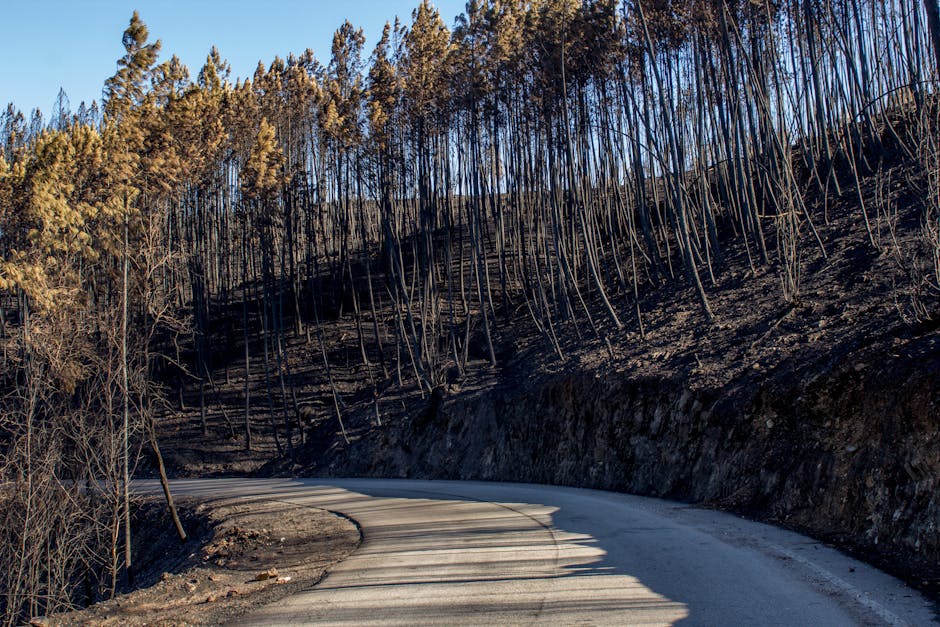
In the aftermath of California’s 2023 wildfire season, over 2.5 million acres of forest were left scorched, with millions of partially burned trees standing as carbon time bombs. When these trees decompose or are intentionally burned, they release vast amounts of stored carbon dioxide back into the atmosphere—equivalent to the annual emissions of nearly 2 million cars. Now, a Silicon Valley startup, WildSeque, is proposing a radical solution: bury the dead trees deep underground to lock their carbon away for hundreds, possibly thousands, of years. The company argues that this method could transform post-fire landscapes from carbon emitters into long-term carbon sinks, offering a new frontier in climate mitigation.
The Problem With Current Post-Fire Practices

Today, standard forest management after wildfires involves felling dead or dying trees and conducting controlled burns to reduce fuel loads and prevent future fires. However, this practice releases nearly all the carbon stored in the biomass back into the atmosphere within months. According to a 2022 study published in Nature Climate Change, post-fire salvage logging and burning account for up to 15% of total fire-related emissions. With wildfire frequency and intensity increasing due to climate change—a trend documented by the U.S. Forest Service—this cycle threatens to become a self-reinforcing feedback loop. WildSeque contends that instead of accelerating carbon release, we should treat dead trees as carbon vaults, leveraging natural processes to keep emissions out of the atmosphere.
Burying Biomass to Build a Carbon Sink

WildSeque’s method involves using heavy machinery to dig trenches up to 15 feet deep in fire-affected areas, placing whole or segmented trees inside, and sealing them with soil and clay to limit oxygen exposure. The lack of oxygen slows microbial decomposition, effectively halting the conversion of organic carbon into CO₂. The startup has piloted the technique in Mendocino County, burying over 500 tonnes of fire-killed conifers, and claims monitoring shows less than 5% carbon loss over two years. Partnering with Native American tribes and federal land managers, the company is scaling operations and seeking carbon credit certification through the American Carbon Registry. If successful, each buried tree could sequester 0.5 to 1 tonne of CO₂-equivalent over 100 years, potentially making forests a net carbon drawdown system post-fire.
Scientific Basis and Environmental Trade-offs

The science behind anaerobic carbon preservation is not new—peat bogs and permafrost naturally store carbon for millennia under low-oxygen conditions. WildSeque’s innovation lies in applying this principle deliberately and at scale. Dr. Margaret Torn, a biogeochemist at Lawrence Berkeley National Laboratory, notes that “anaerobic decomposition can reduce carbon mineralization rates by over 90% compared to surface decay.” However, critics warn of unintended consequences. Soil disturbance from trenching could release stored soil carbon, and improperly sealed sites might produce methane, a potent greenhouse gas. Additionally, burying large volumes of biomass could alter local hydrology and nutrient cycling. The U.S. Forest Service has called for rigorous environmental impact assessments before widespread adoption.
Implications for Climate Policy and Forest Management

If proven effective and scalable, tree burial could reshape national wildfire recovery strategies and carbon accounting frameworks. Federal land agencies spend over $300 million annually on post-fire rehabilitation, much of it on fuel reduction burns. Redirecting even a fraction of that funding toward carbon burial could yield climate dividends. Tribes like the Yurok and Karuk, who have co-led pilot projects, see potential for cultural restoration and economic development through carbon credit revenue. Yet, the approach challenges conventional ecological wisdom that views dead wood as essential for forest regeneration, providing habitat and nutrients. Balancing carbon sequestration goals with ecosystem health will be critical, especially in biodiverse regions where decomposition supports complex food webs.
Expert Perspectives
Opinions among scientists are divided. Dr. Beverly Law, a forest ecologist at Oregon State University, supports innovation: “We need all hands on deck for climate solutions—this could be a valuable tool in fire-prone regions.” Others remain skeptical. Dr. Gabriel Senay of the U.S. Geological Survey cautions, “Carbon accounting must include full lifecycle impacts. If trenching releases more carbon than it saves, it’s counterproductive.” Some experts also question permanence: what happens if future erosion or human activity exposes the wood? While WildSeque uses GPS tagging and remote sensing to monitor sites, long-term guarantees remain unproven.
As climate pressures intensify, the debate over how to manage fire-ravaged forests will only grow. WildSeque plans to expand operations across the western U.S. by 2026 and is exploring international partnerships in Australia and Canada. The success of this approach hinges not just on technical feasibility, but on regulatory acceptance, ecological monitoring, and public trust. With the world racing to close the emissions gap, unconventional ideas like carbon burial may no longer be fringe—they could become essential. The question remains: can we bury our way out of the climate crisis, or are we simply delaying nature’s carbon reckoning?
Source: New Scientist