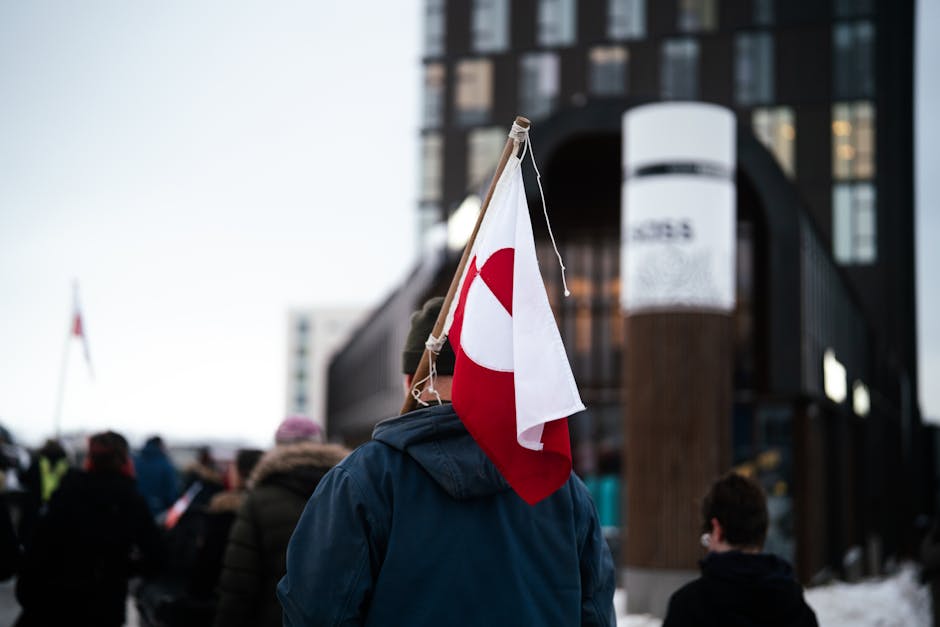
- The US has reopened its consulate in Greenland for the first time in over 70 years, sparking protests from locals demanding sovereignty.
- The consulate will focus on climate research, scientific cooperation, and economic development in the region.
- Greenland is home to vast mineral reserves, making it a key location for global resource competition.
- The US reopening of the consulate marks a strategic pivot in American Arctic policy.
- The move reflects growing US interest in a region increasingly central to global security and resource competition.
Under a slate-gray Arctic sky, the air in Nuuk crackled with tension. Outside a newly renovated colonial-era building adorned with the American flag, a crowd of several hundred Greenlanders gathered, their voices rising in unison. “Go home!” they chanted, fists clenched, signs aloft. Some wore traditional Inuit garments, others hoodies stamped with Greenlandic pride. The target of their protest was not a local politician or corporate executive, but the ceremonial opening of the United States’ first consulate in Greenland in over seven decades. Diplomats in suits stood stiffly at the entrance, smiling through the moment as Danish and American officials exchanged pleasantries. Yet behind the diplomatic pageantry, a deeper current surged — a defiant assertion of sovereignty from a people long caught between great powers, now demanding to speak for themselves.
US Reestablishes Diplomatic Presence Amid Arctic Rivalry

The reopening of the U.S. Consulate in Nuuk marks a strategic pivot in American Arctic policy, signaling renewed interest in a region increasingly central to global security and resource competition. The consulate, operating for the first time since its closure in 1953, will focus on climate research, scientific cooperation, and economic development, according to State Department officials. However, its symbolic weight far exceeds its administrative function. Located just 900 miles from the North Pole, Greenland sits atop vast mineral reserves — including rare earth elements critical for green technology — and growing shipping routes unlocked by melting ice. The United States, under both the Trump and Biden administrations, has sought to counter expanding Chinese and Russian influence in the region. Yet this geopolitical calculus has collided with local sentiment, as many Greenlanders view the consulate not as an offering of partnership, but as an encroachment on their hard-won autonomy.
From Cold War Outpost to Modern Geopolitical Flashpoint

The history of American interest in Greenland is long and often paternalistic. During World War II and the Cold War, the U.S. operated Thule Air Base — now Pituffik Space Base — under an agreement with Denmark, which still governs Greenland’s foreign and defense policies. The base became a cornerstone of early-warning missile detection, but its construction displaced Inughuit communities and left behind environmental contamination. The original U.S. consulate in Nuuk, closed in 1953, reflected a time when Greenland’s strategic value outweighed its political agency. Decades later, as climate change accelerates Arctic accessibility, global powers are returning. China has invested in Greenlandic mining projects, while Russia has modernized its Arctic military presence. In 2019, then-President Donald Trump reportedly offered to buy Greenland, a suggestion met with ridicule and offense in both Nuuk and Copenhagen. That episode, though dismissed, revealed a troubling disregard for Greenlandic self-determination — a wound still raw today.
Greenlanders Assert Voice Against Outside Powers

The protest in Nuuk was organized by local activists, students, and indigenous rights advocates who see the consulate as part of a broader pattern of external interference. “This is not about rejecting dialogue,” said Aqqaluk Lynge, a cultural advocate and former president of the Inuit Circumpolar Council. “It’s about demanding respect. We are not a bargaining chip between superpowers.” Greenland’s government, led by Prime Minister Múte Bourup Egede of the pro-independence Inuit Ataqatigiit party, has cautiously welcomed scientific collaboration but insists that any foreign presence must align with Greenlandic interests. Egede has repeatedly stressed that Greenland “owns its resources and its future.” Meanwhile, younger generations, fluent in both Inuit traditions and global activism, are mobilizing through social media and grassroots networks to challenge narratives that treat their homeland as a strategic prize. Their message is clear: engagement is welcome, but ownership is non-negotiable.
Implications for Sovereignty and Arctic Diplomacy

The backlash in Nuuk underscores the fragility of diplomatic initiatives that overlook local consent. For the United States, the consulate’s success hinges not on infrastructure or staffing, but on trust — a commodity in short supply. If Washington hopes to position itself as a responsible Arctic actor, it must navigate the delicate balance between strategic interest and respect for self-determination. For Greenland, the moment presents both risk and opportunity: increased attention could bring investment and climate partnerships, but also renewed pressure from powers eager to exploit its geography. The Danish government, caught between ally commitments and colonial legacies, faces mounting scrutiny over its continued control of Greenland’s foreign affairs. As the ice melts and the world watches, the question is no longer whether Greenland will play a role on the global stage — but whether it will do so on its own terms.
The Bigger Picture
The protest in Nuuk is not an isolated incident, but a symptom of a broader shift in the postcolonial Arctic. Across the circumpolar North, Indigenous communities are demanding agency in decisions that affect their lands and futures. From Alaska to Sápmi, the era of top-down resource extraction and military basing is being challenged by movements grounded in sovereignty, sustainability, and cultural survival. Greenland’s stance reflects a global awakening: that geopolitical strategy cannot be divorced from human dignity. As climate change redraws the map, the Arctic will remain a crucible of competing visions — between domination and partnership, between extraction and stewardship.
What comes next may depend on whether distant capitals can listen. The chants of “Go home” were not merely hostile — they were a call for recognition. If the United States and other powers wish to engage meaningfully in the Arctic, they must do so not as patrons or purchasers, but as humble partners. Greenland’s future is not for sale. It is, as its people insist, theirs to shape.
Source: Thehill