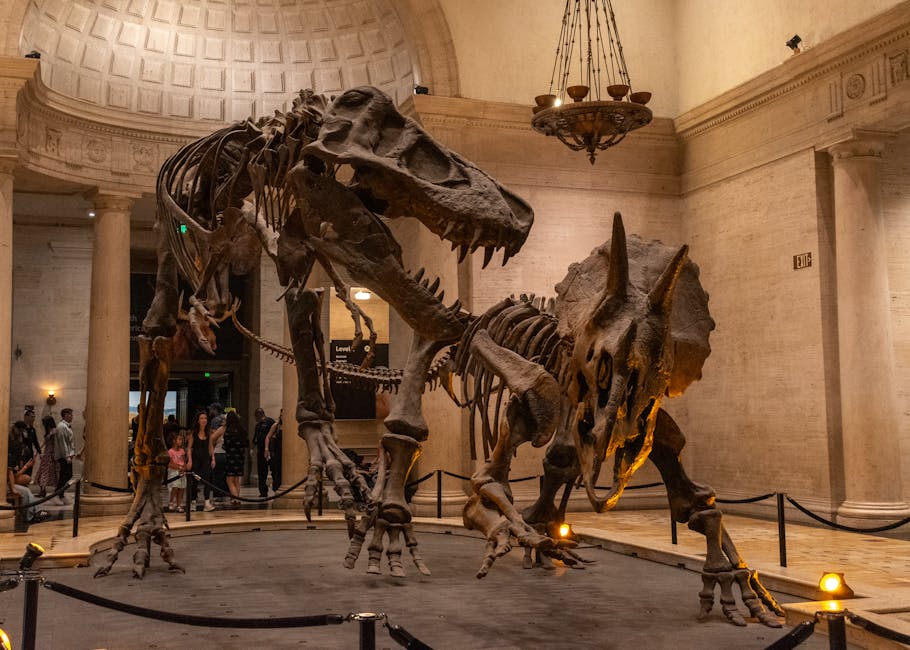
- A study reveals that the evolution of the Tyrannosaurus rex’s devastating bite may have driven its arms to shrink.
- The research found a consistent pattern in theropod dinosaurs where skulls grew larger and arms regressed as jaws became more powerful.
- The inverse relationship suggests that the arms were no longer necessary once the head became the primary killing tool.
- The study highlights a trade-off between jaws and arms in dinosaurs, where one trait improves at the expense of the other.
- The findings shed new light on the evolution of apex predators, particularly the Tyrannosaurus rex, and its iconic yet comically short arms.
One of the most iconic dinosaurs in history, Tyrannosaurus rex, wielded a bite force exceeding 8,000 pounds—enough to crush bone. Yet, this apex predator also sported comically short arms, barely longer than a human’s. For over a century, this mismatch has puzzled paleontologists. Now, new research suggests a startling answer: the very evolution of T. rex’s devastating bite may have driven its arms to shrink. Across multiple theropod lineages, scientists have identified a consistent evolutionary pattern—skulls grew larger and more robust, jaws became bone-crushing instruments, and forelimbs simultaneously regressed. This inverse relationship suggests that once the head became the primary killing tool, the arms were no longer necessary, leading to their reduction through natural selection.
Why the Trade-Off Between Jaws and Arms Matters

The paradox of T. rex’s arms has fueled scientific debate since the first fossils were unearthed. Early theories ranged from mating grips to assistance in rising from a prone position—yet none fully explained the extreme reduction. Recent comparative studies, however, have shifted focus to broader evolutionary trends among theropod dinosaurs. Researchers analyzing skull and limb proportions across dozens of species found a strong negative correlation: as cranial strength and bite force increased, arm length and functionality decreased. This pattern is especially pronounced in apex predators like Carnotaurus, Allosaurus, and especially Tyrannosaurus. The implication is that natural selection favored investment in the head at the expense of the forelimbs. When a predator can immobilize and dismember prey with a single bite, arms become redundant—and energetically costly to maintain.
Evolutionary Arms Race in Prehistoric Predators

The trend isn’t isolated to T. rex. Across diverse theropod groups, shrinking forelimbs coincide with the emergence of hyper-specialized skulls. For example, abelisaurids like Carnotaurus developed massively reinforced skulls capable of withstanding high-impact blows, while their arms became vestigial—mere stubs with no apparent function. Similarly, tyrannosaurids evolved fused nasals and deep, robust jaws allowing them to deliver devastating puncture-pull attacks. A 2024 study published in Nature Ecology & Evolution analyzed over 40 theropod species and found that skull robustness and arm reduction were tightly linked, particularly in lineages targeting large, struggling prey. This suggests that the evolutionary pressure to subdue massive herbivores—like Triceratops or Edmontosaurus—favored cranial weaponry over manual dexterity, effectively making arms obsolete.
Biomechanics Behind the Bite

Modern biomechanical modeling has revealed just how dominant the tyrannosaur bite was. Using CT scans and finite element analysis, researchers have reconstructed the stress distribution in T. rex’s skull during biting. These simulations, detailed in studies from Ohio University’s paleontology lab, show that the skull could withstand forces exceeding 12,800 newtons—among the highest of any terrestrial animal. This allowed T. rex to perform ‘puncture-pull feeding,’ where it would bite down, hold fast, and rip flesh with sheer power. In such a system, forelimbs would contribute little to prey capture or restraint. Moreover, the massive neck muscles required for such biting may have altered shoulder anatomy, further constraining arm development. Evolution, it seems, optimized T. rex for power over precision.
Implications for Dinosaur Evolution and Adaptation

This shift from manual to cranial predation has profound implications for how we understand dinosaur evolution. It suggests that evolutionary pathways are often constrained by trade-offs—investing in one trait can come at the cost of another. For large theropods, the head became the ultimate weapon, rendering arms vestigial. This principle may also explain why birds, descendants of small, agile theropods with long arms, evolved differently—retaining forelimbs for flight rather than bite specialization. The T. rex model highlights how ecological niches shape morphology: in the role of apex bone-crusher, arms simply didn’t matter. This insight reshapes how paleontologists interpret fossil anatomy, urging a functional, rather than aesthetic, understanding of extinct species.
Expert Perspectives
While the jaw-arm trade-off hypothesis is gaining traction, not all experts agree. Dr. Julia Clarke of the University of Texas cautions that correlation does not imply causation: “Just because arms shrink as skulls grow doesn’t mean one caused the other. Both could be responses to a third factor, like overall body size or hunting behavior.” Others, like Dr. Steve Brusatte of the University of Edinburgh, support the theory, noting, “The biomechanics are clear—T. rex didn’t need arms. Its head did all the work.” Such debates underscore the complexity of interpreting evolutionary trends from fossil data, where soft tissue and behavior are inferred, not observed.
Going forward, researchers aim to refine this model using broader datasets and developmental biology. By studying how limb and skull growth are regulated in modern reptiles and birds, scientists hope to uncover genetic and developmental constraints that may have influenced dinosaur evolution. The mystery of T. rex’s arms, once seen as a curious oddity, now serves as a window into deeper evolutionary principles—how form follows function, and how nature often discards what no longer serves survival.
Source: ScienceDaily