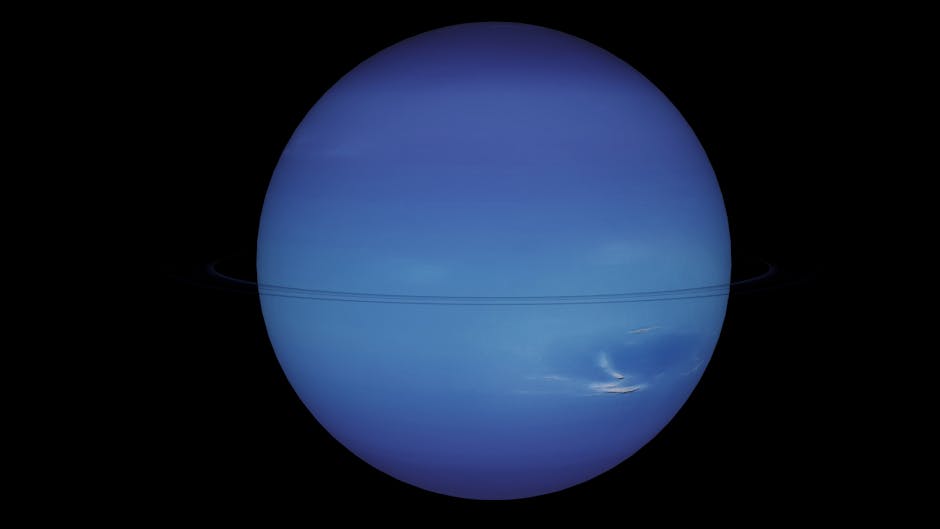
- Triton, Neptune’s largest moon, may have survived a cataclysmic collision that destroyed most of Neptune’s original moons.
- Scientists estimate the odds of Triton’s survival at less than 1%, making it a rare relic of the solar system’s chaotic infancy.
- New research challenges long-standing theories about moon formation and orbital dynamics, suggesting that some celestial bodies can withstand extreme conditions.
- The study’s findings offer insights into planetary evolution and the resilience of icy moons across the galaxy.
- Triton’s survival is a significant discovery, providing a rare glimpse into the solar system’s violent early history.
Neptune’s largest moon, Triton, may be a cosmic survivor of one of the most violent episodes in the early solar system. While most of Neptune’s original moons were likely obliterated in a cataclysmic event over four billion years ago, new research suggests Triton endured—either by sheer luck or through a complex reassembly process. Scientists estimate the odds of such survival at less than 1%, making Triton a rare relic of the solar system’s chaotic infancy. This challenges long-standing theories about moon formation and orbital dynamics, suggesting that some celestial bodies can withstand conditions once thought unsurvivable. The implications stretch beyond Neptune, offering insights into planetary evolution and the resilience of icy moons across the galaxy.
The Ancient Upheaval at Neptune

For decades, astronomers have puzzled over the unusual configuration of Neptune’s moon system. Unlike other gas giants, Neptune has relatively few moons, and they follow irregular, often tilted orbits. This asymmetry has led scientists to hypothesize that Neptune’s original satellite system was destroyed early in the solar system’s history—likely due to the capture of Triton, which is believed to have originated in the Kuiper Belt. When Triton was pulled into Neptune’s gravitational field, its initial orbit would have been highly elliptical, generating intense tidal forces that destabilized and ultimately destroyed neighboring moons. A new simulation-led study published in Nature Astronomy now proposes that Triton didn’t just arrive—it may have directly collided with or swept through existing moons, causing a cascading series of impacts. This event, occurring roughly 4 billion years ago, would have turned Neptune’s once-stable moon system into a high-velocity demolition zone.
Triton’s Unlikely Survival Story

What makes the new findings remarkable is the suggestion that Triton not only survived this chaos but may have reformed from the debris of moons it destroyed. The study, conducted by a team at the Southwest Research Institute, used high-resolution simulations to model the gravitational and physical interactions in Neptune’s vicinity after Triton’s capture. Their models show that while most moons would have been shattered into fragments, some material could have coalesced back into larger bodies—possibly including Triton itself. This process, known as re-accretion, has been observed in smaller-scale impact events, but never modeled on such a planetary scale. Triton’s current geological activity, including cryovolcanism and a relatively young surface with few craters, supports the idea of a major resurfacing event in its past. Its retrograde orbit—moving opposite to Neptune’s rotation—remains the strongest evidence of its outsider origin, but now scientists must also consider that it may be part-Neptune moon by assimilation.
Gravitational Chaos and Moon Dynamics

The mechanics of Triton’s capture and its aftermath hinge on complex gravitational interactions. When a large object like Triton enters a planetary system from deep space, it carries significant kinetic energy. Slowing it down enough to be captured requires energy dissipation—often through collisions or tidal friction. In Neptune’s case, the gravitational tugs from its original moons would have played a critical role in braking Triton’s orbit, but at a cost: orbital resonances would have amplified instabilities, leading to collisions. The study’s simulations reveal that within just a few million years—brief in astronomical terms—Neptune’s inner moons would have been either ejected, absorbed, or turned into rings of debris. Triton, meanwhile, spiraled inward due to tidal forces, eventually settling into its current near-circular but tilted orbit. The survival of any moon through such a process was deemed nearly impossible—until now. The possibility that Triton absorbed fragments of its destroyed counterparts introduces a new category of moon: not just captured, but reconstructed.
Implications for Icy Moon Evolution

If Triton indeed reformed from a mix of original Neptunian moons and its own disrupted material, it reshapes how scientists view moon formation in the outer solar system. Moons are no longer seen as static bodies but as dynamic participants in planetary evolution, capable of destruction and rebirth. This has direct relevance to missions like NASA’s upcoming Trident mission, which aims to study Triton’s surface and subsurface ocean. Understanding whether Triton contains remnants of ancient Neptunian moons could inform the search for organic materials and even potential habitability. Furthermore, similar processes might have occurred at Uranus or even around exoplanets with large captured moons. The discovery also raises questions about whether other moons in the solar system—such as Saturn’s Phoebe or Jupiter’s irregular satellites—might have similarly violent histories masked by time and ice.
Expert Perspectives
“Triton has always been an outlier, but this study makes it a revolutionary case study in moon dynamics,” says Dr. Emily Lakdawalla, planetary scientist and editor at The Planetary Society. Other experts urge caution. “While the simulations are compelling, we’re still missing direct observational evidence,” notes Dr. Francis Nimmo of UC Santa Cruz, who specializes in icy body geophysics. “Triton’s surface could have been renewed by internal heating, not just impacts.” Still, there is broad agreement that Triton’s history is far more complex than previously assumed, and that our models of moon formation must evolve to account for violent reconfigurations.
Looking ahead, the real test will come with closer observation. The Trident mission, proposed for launch in the 2030s, could provide high-resolution imagery and compositional data to determine whether Triton’s crust contains materials foreign to its original Kuiper Belt makeup. If so, it would strongly support the collision-and-reassembly theory. For now, Triton stands as a celestial survivor—a moon that may have lived through the destruction of an entire satellite system and emerged, transformed, as Neptune’s enigmatic crown.
Source: The New York Times