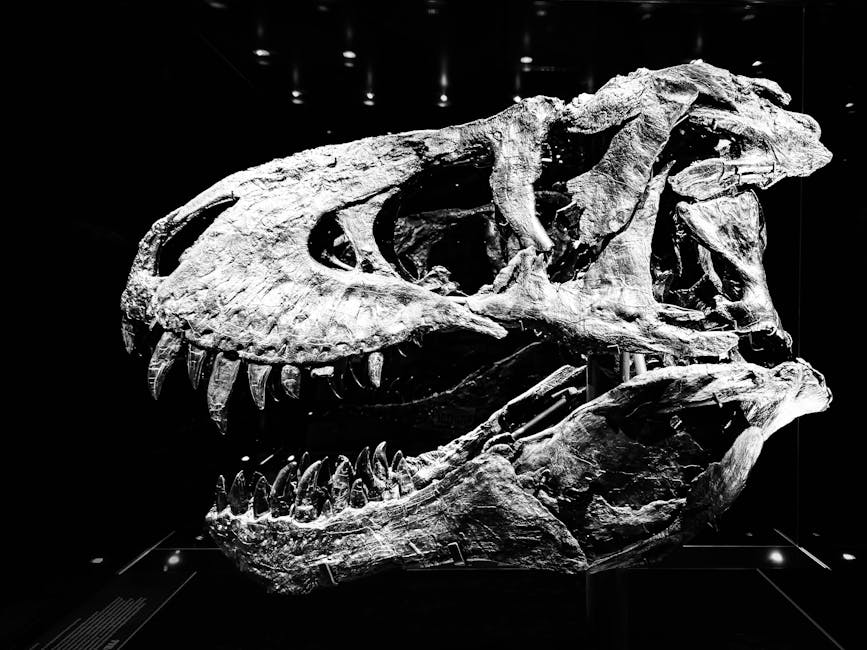
- New research suggests that T. Rex’s tiny arms evolved due to its massive, hyper-specialized head.
- A 2024 study analyzed limb proportions across 5 major lineages of large-bodied theropod dinosaurs.
- The study found an inverse relationship between arm size and skull size, suggesting a functional trade-off.
- Tyrannosaurus rex’s skull could exceed 5 feet in length, equipped with teeth for crushing.
- The development of massive heads may have come at the expense of forelimb utility.
Imagine a world where shadows stretch long across fern-covered floodplains, where the ground trembles beneath the footsteps of colossal predators whose very presence alters the rhythm of life. In the Late Cretaceous, Tyrannosaurus rex ruled with an almost mythic ferocity, its banana-sized teeth capable of pulverizing bone, its skull a biomechanical marvel of power and precision. Yet, one feature has long baffled scientists and captivated the public alike: its absurdly small arms. For over a century, paleontologists have debated whether those two-fingered limbs were vestigial, functional, or evolutionary flukes. Now, new research suggests that the answer lies not in the arms themselves, but in the tyrant king’s most fearsome weapon—its head.
Arms Shrank as Heads Grew

A 2024 study published in Nature Communications analyzed limb proportions across five major lineages of large-bodied theropod dinosaurs, including tyrannosaurids, allosaurids, and carcharodontosaurids. The findings reveal a striking evolutionary pattern: in each group, arm size decreased as skull size and bite force increased. This inverse relationship suggests a functional trade-off—natural selection favored the development of massive, hyper-specialized heads at the expense of forelimb utility. In tyrannosaurs, for example, the skull could exceed five feet in length, equipped with teeth designed for crushing, while the arms rarely reached past the elbow of the adjacent leg. The study’s biomechanical models indicate that once the head became the primary tool for hunting and feeding, the arms were no longer under selective pressure to remain large, leading to their progressive reduction over millions of years.
The Evolutionary Path to Diminutive Limbs

This phenomenon did not originate with T. rex. The trend stretches back over 100 million years, appearing convergently in distantly related predatory lineages. Early theropods like Herrerasaurus and Coelophysis had long, agile arms useful for grasping prey. But as apex predators grew larger and faced increasing competition, evolutionary pressures shifted toward maximizing predatory efficiency. In the Jurassic, allosaurs like Allosaurus fragilis began showing reduced arm proportions relative to body size. By the Cretaceous, carcharodontosaurids and megalosaurids followed suit. Tyrannosaurs, evolving later, represent the extreme end of this trajectory. Fossils of early tyrannosauroids like Guanlong show proportionally longer arms, but as the lineage progressed toward Tyrannosaurus rex, arm length diminished dramatically. This repeated pattern across independent clades points to a broader evolutionary principle: when the head becomes the dominant weapon, the arms pay the price.
The Scientists Behind the Discovery

The study was led by Dr. Steve Brusatte, a paleontologist at the University of Edinburgh, and Dr. Jonah Choiniere of the University of the Witwatersrand in South Africa, both renowned for their work on theropod evolution. Their team compiled data from over 50 fossil specimens, using 3D scans and phylogenetic comparative methods to map changes in limb and skull proportions across time. Brusatte emphasized that the findings challenge long-held assumptions about evolutionary ‘dead ends.’ ‘We used to think tiny arms were a weird quirk,’ he said in an interview with ScienceDaily, ‘but now we see it’s a repeated solution to the same problem: how to become the most effective predator possible.’ The researchers stress that the arms weren’t useless—prior studies suggest T. rex’s forelimbs were muscular and may have played roles in mating or rising from rest—but their reduction was not a flaw, but a calculated adaptation.
Implications for Evolutionary Biology

This discovery reshapes how scientists understand evolutionary trade-offs in large predators. The repeated convergence across geographically and temporally separated lineages suggests that physical constraints and ecological pressures can drive remarkably similar outcomes, even in unrelated species. For paleontologists, it underscores the importance of studying whole-body proportions rather than isolated features. For evolutionary biologists, it offers a textbook case of functional redundancy leading to morphological reduction. Moreover, the study highlights how extreme specializations—like the tyrannosaur’s skull—can redefine an organism’s entire anatomy. While the tiny arms of T. rex remain a cultural punchline, they are now understood as a signature of evolutionary success, not failure.
The Bigger Picture
Beyond dinosaurs, this research illustrates a fundamental principle in evolutionary biology: adaptation is often about loss as much as gain. Organisms streamline their forms in response to environmental demands, shedding traits that no longer serve a purpose. The story of the tyrannosaur’s arms is not one of degeneration, but of refinement. As predators evolved to dominate their ecosystems through cranial power, their bodies followed suit, optimizing for efficiency. This mirrors other evolutionary reductions, such as the loss of eyes in cave-dwelling species or hind limbs in whales. In each case, less becomes more.
What comes next is a deeper exploration of how such trade-offs unfold at the genetic and developmental levels. Future studies may examine the embryonic growth patterns in birds—modern theropods—to see if the same developmental constraints that shaped T. rex’s arms still linger in their descendants. For now, the mystery of the tiny arms is no longer a joke, but a testament to the precision of natural selection. The reign of the tyrant king was not diminished by short arms—it was defined by them.
Source: New Scientist