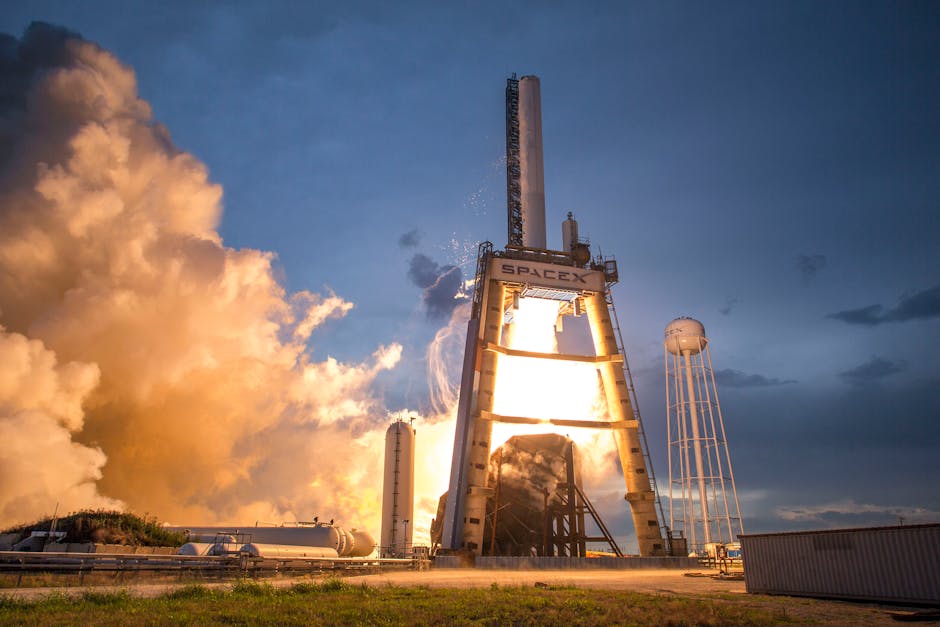
- SpaceX’s Starship rocket has a smaller footprint than expected, with a team of under 12,000 employees
- The company has completed over 90 missions in a single year, a record unmatched by any other launch provider
- SpaceX employs a fraction of the workers of legacy aerospace giants, such as United Launch Alliance and NASA
- Despite its small workforce, SpaceX remains the dominant force in orbital launch services
- The company’s lean machine has allowed it to maintain an impressive operational tempo
At the edge of Boca Chica Beach in South Texas, just beyond the dunes where sea turtles nest and coyotes roam, a stainless-steel colossus rises against the Gulf Coast sky. Starship, SpaceX’s next-generation rocket, looms like a futuristic obelisk—394 feet tall, designed to carry humans to Mars. Around it, a flurry of engineers in blue jumpsuits and hard hats move with urgency, choreographing tests, fueling tanks, and refining systems. The scene evokes an industrial revolution on the edge of the sea, yet what’s most striking isn’t the scale of the hardware—it’s the modest size of the team behind it. For all its ambition, SpaceX isn’t the corporate titan many assume. In fact, with fewer than 12,000 employees globally, it operates with a workforce smaller than that of many mid-tier tech companies, let alone legacy aerospace giants.
SpaceX’s Lean Machine in Full Orbit

As of 2024, SpaceX remains the dominant force in orbital launch services, completing over 90 missions in a single year—a record unmatched by any other launch provider. Despite this operational tempo, the company employs approximately 11,500 people, according to internal reports and federal filings. By comparison, United Launch Alliance (ULA), a joint venture of Boeing and Lockheed Martin, employs over 3,000 workers with a fraction of the launch cadence. Even NASA, with its sprawling network of centers and contractors, relies heavily on SpaceX for crew and cargo transport to the International Space Station. The company’s vertical integration—designing and manufacturing nearly all components in-house—and relentless automation allow it to achieve high output with minimal labor. This efficiency has enabled rapid development of Starship, the Starlink satellite constellation, and next-gen Raptor engines, all while maintaining a payroll far leaner than industry norms.
How SpaceX Rewrote Aerospace Rules

The roots of SpaceX’s efficiency trace back to its founding in 2002 by Elon Musk, who sought to disrupt an aerospace industry long criticized for cost overruns and glacial innovation. At the time, government contracts dominated space access, with major programs like the Space Shuttle costing billions per launch and requiring tens of thousands of workers. Musk envisioned a company that prioritized speed, iteration, and cost efficiency—principles borrowed from Silicon Valley, not traditional aerospace. Early struggles, including three failed Falcon 1 launches, nearly bankrupted the firm. But the 2008 success of Falcon 1’s fourth flight secured a NASA contract, providing lifeline funding. From there, SpaceX embraced a culture of rapid prototyping, famously summarized by Musk’s “move fast, break things” ethos—unusual in a field where failure can mean catastrophic loss. This mindset, combined with in-house manufacturing and reusable rockets, allowed SpaceX to slash costs and accelerate timelines.
The Engineers Driving the Revolution

Behind SpaceX’s achievements are thousands of engineers, technicians, and software developers—many drawn by the company’s mission to make humanity multiplanetary. Employees often work long hours under intense pressure, a trade-off they accept for the chance to shape the future of spaceflight. Gwynne Shotwell, President and COO, plays a crucial role in bridging technical ambition with operational reality, managing contracts, logistics, and government relations. Elon Musk, while controversial for his management style, remains deeply involved in engineering decisions, famously sleeping on the factory floor during critical deadlines. The company recruits heavily from top engineering schools and values problem-solving agility over hierarchical experience. This culture fosters innovation but also demands resilience—turnover is high, yet SpaceX continues to attract top talent driven by purpose rather than perks.
Implications for Industry and Innovation

SpaceX’s lean model has forced competitors to rethink their structures. Legacy aerospace firms like Boeing and Lockheed Martin now face pressure to modernize, adopt reusable technology, and reduce reliance on subcontractors. Startups such as Rocket Lab and Relativity Space have mirrored SpaceX’s vertical integration and rapid iteration strategies. Governments, too, are adjusting: the U.S. Space Force has awarded SpaceX national security launches, once reserved for established defense contractors. Meanwhile, the success of Starlink—a satellite internet network with over 5,000 operational units—demonstrates how a focused team can scale global infrastructure faster than traditional models allow. For investors and policymakers, SpaceX proves that transformative impact doesn’t always require massive employment footprints.
The Bigger Picture
SpaceX’s trajectory challenges a long-held assumption: that monumental technological progress requires monumental organizations. In an era where agility often trumps size, SpaceX exemplifies how mission-driven culture, vertical integration, and relentless iteration can outpace bureaucracy. Its influence extends beyond rockets—it’s reshaping how we think about innovation in high-stakes, capital-intensive fields. From climate monitoring to global internet access, the tools being built by this relatively small team have outsized implications. If humanity does reach Mars, it may owe less to national programs than to a company that proved doing more with less isn’t just possible—it’s transformative.
What comes next may be even more ambitious. SpaceX is preparing for orbital Starship tests, aiming for crewed missions in the coming decade. As development accelerates, the company faces regulatory hurdles, environmental concerns, and technical risks. Yet its ability to innovate with a fraction of the workforce once deemed necessary suggests that the future of exploration might not be measured in headcount, but in velocity—of ideas, prototypes, and launches. The rocket may be massive, but the team behind it proves that vision, not volume, powers progress.
Source: Axios