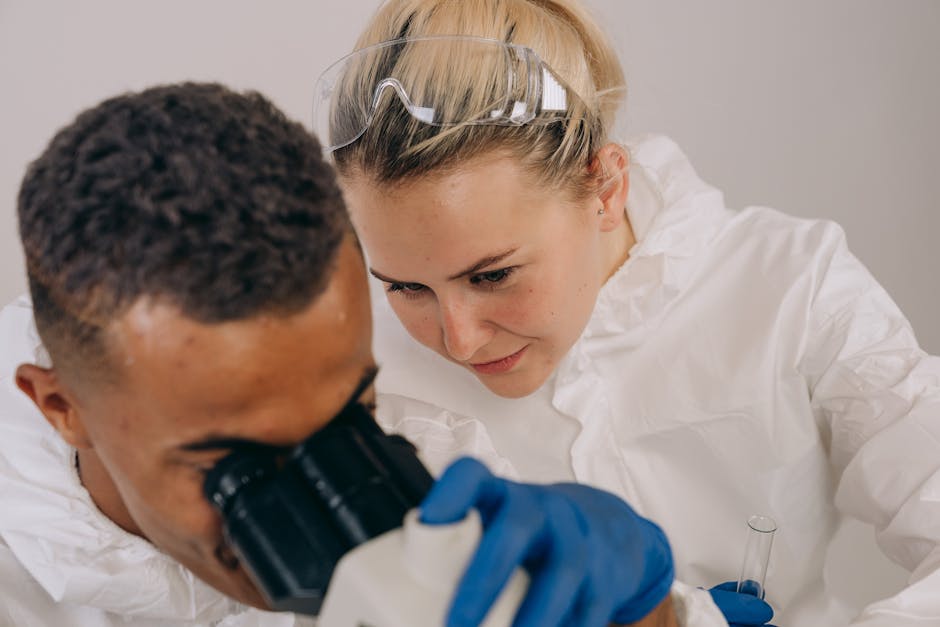
- Biophysicists have successfully demonstrated quantum superposition in a purified protein, a breakthrough in the quest to harness quantum effects in living cells.
- Researchers are exploring the potential of quantum biology to transform healthcare, leveraging mechanisms like quantum coherence and entanglement.
- Recent studies have uncovered quantum signatures in biological processes, such as photosynthesis, where energy transfer occurs via quantum coherence.
- Quantum effects, previously thought too fragile for living cells, may be exploited by biology itself to improve efficiency and navigation in various living systems.
- The intersection of quantum physics and biology could lead to groundbreaking medical applications by 2030, revolutionizing the way we approach healthcare.
In a dimly lit laboratory at the University of Surrey, a team of biophysicists cools a strand of purified protein to near absolute zero, then fires a pulse of laser light at it. What they’re watching isn’t visible to the naked eye, but the data streams reveal something extraordinary: electrons within the protein appear to be occupying multiple states at once, a hallmark of quantum superposition. This isn’t a physics experiment gone astray—it’s part of a growing effort to understand how quantum effects, long thought to be too fragile for the warm, wet chaos of living cells, might actually be harnessed by biology itself. From the navigation of migratory birds to the efficiency of cellular respiration, evidence is mounting that life doesn’t just obey the laws of classical physics—it may exploit the eerie rules of the quantum world. Now, researchers are asking a daring question: can we tap into these quantum biological mechanisms to transform healthcare?
Quantum Signatures in Living Systems

Recent experiments have uncovered compelling signs of quantum phenomena in biological processes once considered purely biochemical. One of the most well-documented examples is in photosynthesis, where plants and certain bacteria convert sunlight into energy with near-perfect efficiency. Studies at institutions like MIT and the University of California, Berkeley, have shown that energy transfer in photosynthetic complexes occurs via quantum coherence—where excitons (energy packets) explore multiple pathways simultaneously to find the most efficient route. This quantum ‘walk’ allows near-instantaneous energy transfer, minimizing loss as heat. More surprisingly, similar quantum effects have been observed in human enzymes, such as those involved in cellular respiration. In 2016, researchers at University College London detected quantum tunneling in the enzyme lysozyme, where protons ‘jump’ through energy barriers rather than over them—a process impossible under classical physics. These findings suggest that evolution may have fine-tuned certain biomolecules to exploit quantum mechanics for functional advantage.
The Road from Theory to Discovery

For decades, the idea that quantum mechanics could play a functional role in biology was dismissed as implausible. The warm, noisy environment of living cells was thought to destroy delicate quantum states—like trying to hear a whisper in a thunderstorm. This view began to shift in the early 2000s, when advances in ultrafast spectroscopy allowed scientists to observe quantum effects on femtosecond timescales. The breakthrough came in 2007, when a team led by Graham Fleming at Berkeley used 2D electronic spectroscopy to detect quantum coherence in photosynthetic complexes of green sulfur bacteria. The discovery sparked a new field: quantum biology. Since then, researchers have probed quantum effects in olfaction, where some scientists argue that our sense of smell may rely on electron tunneling to detect molecular vibrations. Even the avian compass—how birds like the European robin navigate using Earth’s magnetic field—has been linked to quantum entanglement in cryptochrome proteins in their eyes. Each finding chips away at the classical view of biology, suggesting life may be a far more quantum phenomenon than previously imagined.
The Scientists Bridging Two Worlds

Leading this interdisciplinary charge are researchers like Sir Roger Penrose and anesthesiologist Stuart Hameroff, who controversially proposed that consciousness arises from quantum processes in microtubules within neurons—though this theory remains hotly debated. More mainstream figures include Jennifer Brookes at Harvard, whose work on quantum effects in olfaction has provided testable models, and Lloyd Rutledge at Oxford, who investigates quantum tunneling in DNA mutation. These scientists often straddle physics, biology, and chemistry, working in labs equipped with both cryogenic traps and cell cultures. Their motivation is not just academic curiosity, but the potential for medical transformation. If quantum effects regulate enzyme activity or cellular signaling, then diseases like cancer, neurodegeneration, or mitochondrial disorders might stem in part from quantum dysregulation. As Brookes puts it, “We’re not just looking at molecules—we’re looking at the quantum choreography inside them.”
Implications for Diagnosis and Therapy

If quantum biology proves clinically relevant, it could reshape medicine. One promising avenue is in understanding anesthesia. Despite over 170 years of use, the mechanism of how anesthetic gases render patients unconscious remains unclear. Some researchers, including Hameroff, suggest these gases may disrupt quantum vibrations in microtubules, effectively ‘switching off’ consciousness at a quantum level. If true, this could lead to more targeted anesthetics with fewer side effects. Another area is in cancer treatment: if certain enzymes rely on quantum tunneling for DNA repair, then radiation therapy could be optimized to disrupt or enhance these processes. Early-stage quantum sensors, such as nitrogen-vacancy centers in diamonds, are already being tested to detect magnetic fields in single neurons, potentially enabling non-invasive brain imaging at unprecedented resolution. These tools may one day diagnose neurological diseases long before symptoms appear.
The Bigger Picture
Quantum biology challenges a fundamental assumption: that life operates solely on classical rules. If organisms have evolved to harness quantum mechanics, then medicine must evolve too. This isn’t about building quantum computers to model biology—it’s about recognizing that biology may already be quantum computing. As our tools improve, we may uncover a hidden layer of biological regulation, as significant as the discovery of DNA or the microbiome. The implications extend beyond health to our understanding of life itself: if quantum effects are integral to living systems, then the boundary between physics and biology blurs in profound ways.
What comes next is a new era of experimentation. Labs around the world are now designing studies to test whether quantum effects can be modulated to enhance healing or disrupt disease. While much remains speculative, the convergence of quantum physics and biology is no longer fringe—it’s a frontier. As researchers continue to probe the quantum heartbeat of life, they may not only explain long-standing medical mysteries but also unlock therapies that work not just with our cells, but with the very fabric of reality.
Source: New Scientist