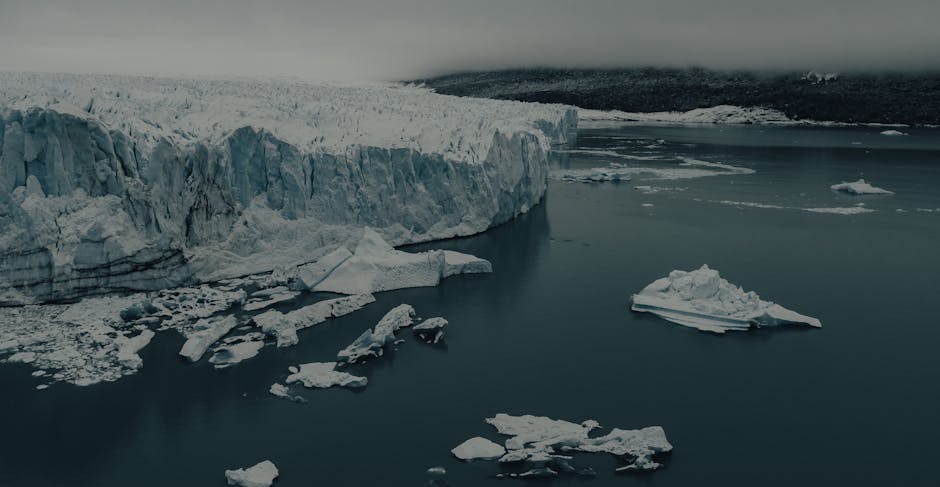
- The Thwaites Ice Shelf in Antarctica is at risk of breaking apart within 3 years due to warm ocean water.
- The ice shelf’s collapse could trigger a chain reaction of ice loss, accelerating sea-level rise.
- Thwaites Glacier, also known as the ‘Doomsday Glacier’, plays a crucial role in stabilizing the West Antarctic Ice Sheet.
- The floating ice shelf is losing structural integrity due to large rifts and surface fractures.
- Climate models previously underestimated the speed of the ice shelf’s weakening and potential collapse.
What happens when the linchpin holding back one of Antarctica’s largest glaciers begins to fail? Scientists are now confronting that very question as new satellite observations reveal that the floating ice shelf of Thwaites Glacier — often dubbed the ‘Doomsday Glacier’ — is on the verge of breaking apart. Spanning roughly 74,000 square miles and holding enough ice to raise global sea levels by over two feet on its own, Thwaites plays a critical role in stabilizing the West Antarctic Ice Sheet. If its ice shelf detaches prematurely, it could remove a crucial brake on glacial flow, triggering a chain reaction of ice loss that accelerates sea-level rise far sooner than previously projected. The world is watching as a natural dam begins to fracture in slow motion.
Is Thwaites Glacier’s Ice Shelf About to Collapse?

Yes — and possibly within just a few years. The floating extension of Thwaites Glacier, which acts like a buttress slowing the glacier’s movement into the ocean, is rapidly weakening due to warm ocean water melting it from below and increasing surface fractures. According to recent research from the International Thwaites Glacier Collaboration, large rifts have formed across the ice shelf, indicating it is losing structural integrity. While complete disintegration won’t happen overnight, the process is advancing faster than climate models predicted just a decade ago. Once the shelf detaches, the grounded ice behind it will flow more freely into the Amundsen Sea, significantly increasing the rate of sea-level rise. This transition could mark a tipping point in Antarctica’s contribution to global ocean rise.
What Evidence Shows the Ice Shelf Is Failing?

Satellite imagery from NASA and the European Space Agency reveals an accelerating pattern of crevasses and rifts spreading across the ice shelf, particularly in its eastern shear margin — the region that holds it in place against adjacent ice. Data collected between 2018 and 2023 show that the shelf’s flow speed has increased, and its connection to the bedrock and surrounding ice is deteriorating. In a 2022 study published in Nature Geoscience, researchers found that warm Circumpolar Deep Water is intruding beneath the shelf, causing melt rates up to ten times higher than previously estimated. ‘We’re seeing the early stages of disintegration,’ said Dr. Erin Pettit, a glaciologist at Oregon State University and member of the Thwaites research team. ‘The ice shelf is being eaten away from below while being pulled apart from above.’
Are Scientists Overstating the Risk?

Some experts caution against alarmism, noting that ice shelf collapse doesn’t automatically mean immediate, catastrophic sea-level rise. Ice shelves themselves don’t contribute to sea-level rise when they melt — because they’re already floating — but their removal can dramatically accelerate the flow of land-based ice into the ocean. Skeptics argue that models still have significant uncertainty in projecting the exact timing and magnitude of Thwaites’ contribution. Others point to natural variability in ice dynamics, suggesting that short-term acceleration might not indicate irreversible collapse. However, the consensus among glaciologists is that while the timeline may vary, the direction is clear: Thwaites is becoming increasingly unstable. As Dr. Ted Scambos of the University of Colorado noted, ‘We’re not crying wolf — we’re watching the wolf cross the field.’
What Are the Real-World Consequences?

If Thwaites accelerates its ice discharge, the effects will ripple across the globe. A rapid influx of freshwater from West Antarctica could disrupt ocean circulation patterns, including the Atlantic Meridional Overturning Circulation, which influences weather systems across Europe and North America. More immediately, coastal cities like Miami, Jakarta, and Mumbai would face higher flood risks, with even modest sea-level increases exacerbating storm surges and high-tide flooding. A 2021 report by the Intergovernmental Panel on Climate Change projected that global sea levels could rise by up to one meter by 2100 under high-emission scenarios — a forecast that may now be conservative if Thwaites and neighboring glaciers like Pine Island destabilize faster than expected.
What This Means For You
While Thwaites Glacier is thousands of miles away, its fate is tied to the stability of coastlines worldwide. Communities in low-lying areas may need to accelerate adaptation plans — including seawalls, managed retreat, and updated flood insurance policies — as new data suggest sea-level rise could outpace previous estimates. The glacier’s decline also underscores the long-term consequences of greenhouse gas emissions, even in remote regions. Monitoring Thwaites is no longer just a scientific endeavor; it’s a necessity for future urban planning, disaster preparedness, and climate policy.
But critical questions remain: Can we slow the warming of deep ocean waters reaching Thwaites? And if the ice shelf does collapse, how quickly will the glacier respond? Ongoing missions, including autonomous underwater drones and seismic surveys, are working to answer these questions — but time may be running short. As Earth’s cryosphere enters uncharted territory, Thwaites stands as a sentinel, warning of changes already in motion.
Source: New Scientist