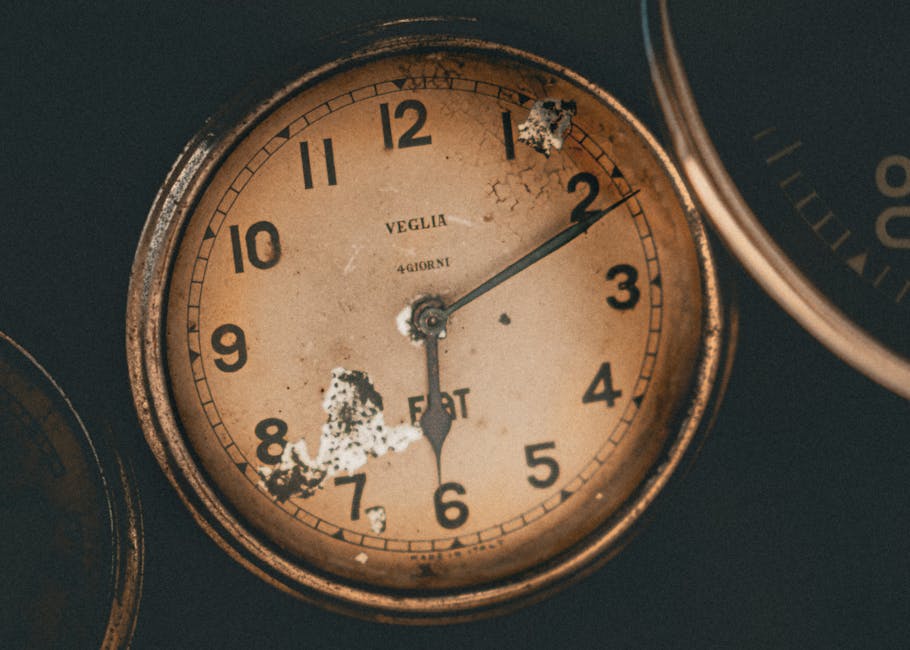
- Scientists are testing the concept of time existing in multiple states at once, blurring the boundary between time and quantum possibility.
- Atomic clocks, known for their precision, are being used to probe the idea of time in a quantum superposition.
- The experiment aims to see if a single clock can simultaneously tick fast and slow, like Schrödinger’s cat, due to differing gravitational potentials.
- Quantum superposition, where particles exist in multiple states, is the principle behind this paradoxical time experiment.
- The study could revolutionize our understanding of time and its relationship to the universe, pushing the boundaries of modern physics.
Deep inside a vibration-damped laboratory in Boulder, Colorado, a cloud of ytterbium atoms hovers in a vacuum chamber, cooled to within a sliver of absolute zero. Laser beams crisscross the space, manipulating the atoms with such precision that they serve as the most accurate timekeepers on Earth. These aren’t ordinary clocks—they are atomic clocks, devices so sensitive they can detect the difference in time flow between the top and bottom of a millimeter-tall staircase. But now, physicists are pushing them further, probing a concept so strange it borders on science fiction: that time itself might not be fixed, linear, or singular. Instead, time could be quantum—existing in multiple states at once, with a single clock simultaneously ticking fast and slow, like a temporal version of Schrödinger’s cat. In the dim blue glow of the lab, the boundary between time and quantum possibility begins to blur.
Quantum Superposition Meets the Flow of Time

For the first time in history, scientists are preparing to test whether time can exist in a quantum superposition. This means that a clock—a physical system that marks the passage of time—could be in two different temporal states simultaneously: one ticking rapidly due to being in a lower gravitational potential, and another ticking slowly as if elevated, even though it’s the same device. This paradox hinges on the principles of quantum superposition, where particles can exist in multiple states until measured. According to general relativity, time slows down in stronger gravitational fields; atomic clocks at sea level run slightly slower than those on a mountain. But if a quantum system could be placed in superposition across two gravitational potentials, time itself might split. Researchers at the National Institute of Standards and Technology (NIST) and the University of Vienna are now combining atomic clock precision with quantum control to see if such a dual rhythm of time can be observed. The experiment hinges on placing a single atom in superposition—both slightly higher and lower in the chamber—so that its internal clock runs at two rates at once.
From Einstein to Quantum Gravity

The roots of this experiment stretch back to 1915, when Albert Einstein published his general theory of relativity, revealing that gravity is not a force but a curvature of spacetime caused by mass and energy. Clocks near massive objects tick slower—a phenomenon confirmed by GPS satellites, which must adjust for time dilation to maintain accuracy. Meanwhile, quantum mechanics, developed in the early 20th century, describes particles existing in multiple states simultaneously. Yet the two theories have never been fully reconciled. While relativity treats spacetime as smooth and continuous, quantum mechanics demands uncertainty and discreteness. For decades, physicists have sought a theory of quantum gravity to bridge the gap. Proposals like string theory and loop quantum gravity remain untested, but tabletop experiments using atomic clocks now offer a new path. In 2017, theoretical physicists Časlav Brukner and Magdalena Zych proposed that quantum clocks in superposition could test how time behaves when both relativity and quantum rules apply—a scenario previously confined to thought experiments.
The Minds Behind the Quantum Clock

The team pushing this frontier includes Nobel laureate David Wineland, whose pioneering work on ion traps laid the foundation for modern atomic clocks, and Nobel-caliber experimentalist Jun Ye at JILA, a joint institute of NIST and the University of Colorado. At the theoretical helm is Brukner, a quantum foundations physicist at the Austrian Academy of Sciences, who has long explored the interplay between quantum mechanics and relativity. These researchers are not merely chasing exotic physics—they aim to answer whether time is fundamentally classical or quantum. For Zych, a physicist at the University of Queensland, the motivation is deeply philosophical: “If time can be in superposition, then our everyday experience of a single, flowing time is an illusion,” she says. Their shared goal is to see whether a clock can lose its definite ticking rate, becoming entangled with its own spacetime path. This isn’t just about measuring time more precisely; it’s about redefining what time is.
What It Means for Physics and Reality

If successful, the experiment would shake the foundations of physics. It would demonstrate that time, like position or momentum, can be quantum-mechanical—subject to uncertainty and superposition. This could rule out certain models of quantum gravity that assume time remains classical. For engineers, the implications may seem distant, but for cosmology, the stakes are high: understanding quantum time could illuminate the nature of black holes and the Big Bang, where both gravity and quantum effects dominate. Moreover, quantum clocks in superposition might one day serve as ultra-sensitive detectors for dark matter or gravitational waves. Philosophically, the result could challenge our most basic intuitions: if time doesn’t flow uniformly, what does it mean to age, to remember, to cause an effect? The notion that reality lacks a single timeline echoes debates from quantum foundations, but now grounded in measurable science.
The Bigger Picture
This experiment represents a shift in how we explore the universe—not only through massive particle colliders or space telescopes, but with tabletop precision. As quantum technologies advance, laboratories are becoming testing grounds for once-inaccessible theories. The merging of quantum mechanics and relativity at human scales could mark the beginning of experimental quantum gravity. As Nature Physics noted, these efforts are turning philosophy into laboratory science. If time can be two things at once, then our understanding of reality must expand to accommodate it—not as a flaw in perception, but as a feature of nature.
What comes next is a delicate dance of cooling, trapping, and measuring atoms with near-impossible precision. The first definitive results could emerge within the next three years. If a clock is found to tick at two rates simultaneously, it won’t just be a triumph of engineering—it will be a revelation: time, in its essence, might be quantum. And in that quantum haze, the past, present, and future may not be as distinct as we’ve always believed.
Source: ScienceDaily