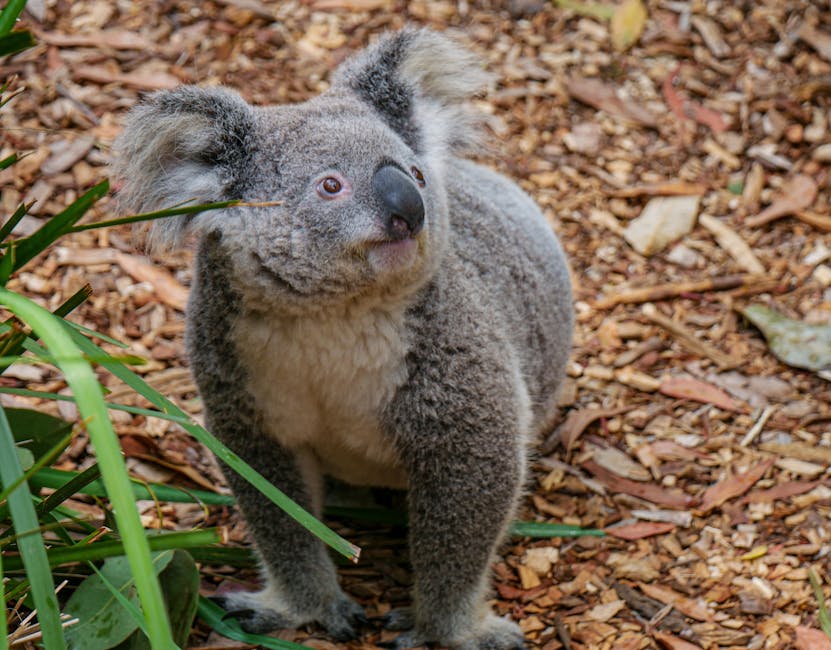
- Fossils of an ancient koala species, Phascolarctos maris, were discovered in Western Australia’s Cuddie Springs, dating back 30,000 years.
- The extinct koala species lived in southern and western Australia during the late Pleistocene era, before the climate became drier.
- Phascolarctos maris exhibited differences in dental structure and cranial morphology, indicating adaptations to changing forest conditions.
- The ancient koala species vanished around 30,000 years ago, well before the end of the last Ice Age.
- The discovery highlights the fragility of iconic lineages, even in the face of a changing climate.
In the rust-colored earth of Western Australia’s Cuddie Springs, where ancient riverbeds have long since turned to dust, paleontologists uncovered a quiet remnant of a forgotten world: a fragmented skull, a few molars, and a humerus no larger than a human thumb. These fragments, buried for over 30,000 years, belonged not to the familiar koala clinging to eucalyptus trees today, but to a close relative now lost to time. The discovery paints a vivid picture of a continent in ecological flux—where two koala species once coexisted, sharing the same forests and feeding on the same tough leaves, until one succumbed to a drying climate and vanished from the evolutionary record. This ghost of Australia’s deep past is more than a scientific curiosity; it is a warning etched in bone, revealing how fragile even the most iconic lineages can be.
Ancient Koala Species Identified in Fossil Find

Analysis of recently unearthed fossils has confirmed the existence of a previously unrecognized koala species, named Phascolarctos maris, which lived across southern and western Australia during the late Pleistocene. Unlike the modern koala (Phascolarctos cinereus), this extinct relative exhibited subtle but significant differences in dental structure and cranial morphology, suggesting adaptations to drier, more variable forest conditions. Radiometric dating places its disappearance around 30,000 years ago—well before the end of the last Ice Age and thousands of years prior to the widespread megafaunal extinctions that followed human arrival. The fossils, studied by a team from the University of New South Wales and the Western Australian Museum, were found in sediment layers interwoven with evidence of ancient watercourses, indicating that P. maris inhabited regions that later became arid and uninhabitable. This timing points not to human hunting or direct interference as the cause of extinction, but to climate-driven habitat loss as the western half of Australia transformed into desert.
The Climate Shift That Reshaped Australia

To understand the disappearance of Phascolarctos maris, one must look to the broader transformation of the Australian continent over the past 100,000 years. During the early Pleistocene, much of inland and western Australia was crisscrossed by rivers, lakes, and open woodlands, supporting a rich diversity of marsupials. But as global climate patterns shifted and glacial cycles intensified, rainfall in the west declined dramatically. By 40,000 years ago, monsoon systems weakened, and evaporation outpaced precipitation, turning once-lush corridors into barren expanses. The drying trend culminated around 30,000 years ago—precisely when P. maris disappears from the fossil record. While the modern koala managed to persist by retreating to the more stable, moisture-rich forests of the eastern coastline, its western cousin lacked the geographic refuge or genetic flexibility to survive. This ecological squeeze, documented in sediment cores and paleoclimate models, underscores how regional climate change can drive extinction even in adaptable species.
The Scientists Behind the Discovery

The identification of Phascolarctos maris was led by Dr. Elise Wright, a paleomammalogist at the University of New South Wales, whose team has spent over a decade mapping Pleistocene fossil sites across southern Australia. Motivated by gaps in the marsupial fossil record, Wright and her colleagues re-examined specimens long held in museum collections, applying high-resolution CT scanning and comparative morphometrics. Their findings, published in Nature Ecology & Evolution, argue that koala evolution is more complex than previously believed. Dr. Wright emphasizes that the discovery was not the result of a single eureka moment, but of meticulous cross-referencing between geology, climate data, and anatomy. Collaborators from Indigenous ranger groups also contributed local knowledge about land use and hydrology, helping to reconstruct ancient ecosystems with greater accuracy. For these researchers, the extinct koala is not merely a taxonomic addition, but a narrative thread linking deep time to the present biodiversity crisis.
Implications for Conservation and Evolutionary Biology

The extinction of Phascolarctos maris carries urgent implications for modern conservation, particularly as Australia faces another wave of climate-induced habitat loss. Today’s koalas, already classified as vulnerable due to deforestation, disease, and bushfires, may be facing conditions eerily similar to those that doomed their ancient relative. The discovery suggests that koalas have limited capacity to adapt to rapid environmental change, especially when confined to fragmented habitats. Moreover, it challenges the assumption that widespread species are inherently resilient. Conservationists now warn that without proactive measures—such as habitat corridors and assisted migration—modern koalas could follow the same path as P. maris. The fossil record, once seen as a chronicle of distant events, has become a mirror reflecting the vulnerabilities of the present.
The Bigger Picture
This discovery adds a crucial piece to the puzzle of Australia’s ecological history, revealing that extinction is not always sudden or caused by human hands. It can be a slow, silent process, driven by shifting climates and vanishing landscapes. The existence of two koala species during the late Pleistocene suggests a richer evolutionary experiment than previously imagined—one in which nature tested multiple survival strategies before settling on just one. As global temperatures rise and arid zones expand, the story of Phascolarctos maris serves as both a caution and a call: biodiversity is not static, and even the most emblematic species can disappear when the world around them changes too quickly.
What comes next is not written in stone, but in policy, preservation, and scientific vigilance. The fossils of Phascolarctos maris do not just tell us about the past—they challenge us to protect the future. As researchers continue to probe Australia’s ancient sediments, each new discovery deepens our understanding of life’s fragility and resilience. The lost koala of the west may be gone, but its legacy could yet inspire the actions needed to save its living kin.
Source: New Scientist