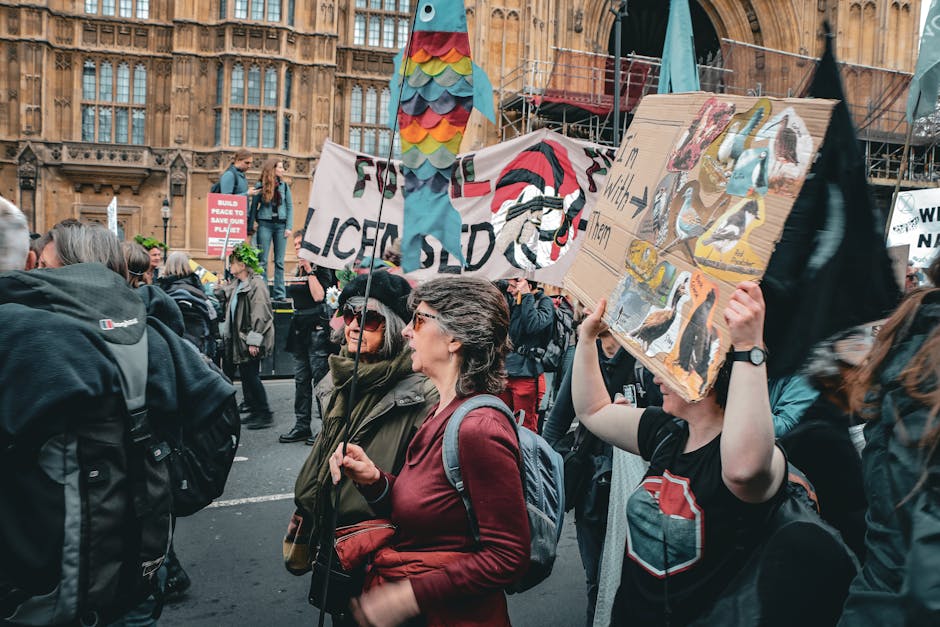
- 30,000 protesters gathered in London amidst a high-security presence and rival protests.
- A pro-Palestinian march and a far-right demonstration clashed in a tense standoff, but violence was largely avoided.
- The Metropolitan Police deployed over 5,000 officers to maintain order and keep the two marches separate.
- The event highlighted the deep divisions within the UK over foreign policy and national identity.
- The largest police deployment for a domestic protest in recent years underscores the gravity of the situation.
Central London transformed into a high-security stage on a crisp Saturday morning, the chill in the air matched only by the tension coursing through the streets. Union Jacks flapped beside Palestinian flags, symbols of identities locked in ideological combat. The Thames reflected not just the city’s skyline but also the fractured mood of a nation grappling with war abroad and division at home. From Trafalgar Square to Parliament, lines of fluorescent-jacketed officers stood shoulder to shoulder, forming human barricades between crowds whose chants often drowned one another out. Sirens wove through the urban canyon of Whitehall, underscoring the gravity of the moment. This was not just protest—it was a city holding its breath, watching for the spark that could ignite chaos. The air hummed with emotion: grief, anger, defiance, fear.
Clash Averted, Tensions Remain High

Despite the volatile mix of ideologies, the day passed without major violence, thanks to one of the largest police deployments for a domestic demonstration in recent years. London’s Metropolitan Police confirmed over 5,000 officers were on duty, strategically positioning units to keep two major marches apart: a pro-Palestinian rally organized by the Palestine Solidarity Campaign and a far-right demonstration led by groups including Britain First and the Patriotic Alternative. The pro-Palestinian march began near Park Lane and moved toward the U.S. Embassy, with participants demanding an immediate ceasefire in Gaza. The far-right counter-protest, initially planned for Trafalgar Square, was rerouted to College Green under police direction to avoid confrontation. Authorities used controlled cordons, temporary barriers, and stop-and-search powers under Section 60 of the Criminal Justice and Public Order Act to maintain order. At its peak, the combined number of demonstrators reached an estimated 30,000, according to police and organizers.
From Gaza to Greenwich: How the Conflict Went Global

The intensity of London’s protests mirrors a broader global reckoning triggered by the October 7 Hamas attacks and Israel’s subsequent military campaign in Gaza. Over 1,200 people were killed in Israel during the initial assault, and more than 30,000 Palestinians have died in Gaza, according to Palestinian health officials—a figure cited widely by demonstrators. The war has fractured public opinion across Western democracies, with younger generations and diaspora communities increasingly critical of Israeli actions. In the UK, this has manifested in weekly vigils, university encampments, and a surge in activism not seen since the Iraq War protests of 2003. The current polarization is further fueled by social media, where raw footage from Gaza circulates widely, deepening empathy and outrage. Meanwhile, far-right groups have exploited the moment to stoke anti-immigrant and anti-Muslim sentiments, framing the conflict through a nationalist lens that equates solidarity with terrorism.
Voices Behind the Marches

The people on the streets represented a mosaic of motives and memories. Among the pro-Palestinian demonstrators were medical students, trade unionists, and families carrying hand-painted signs reading “Free Palestine” and “Stop the Genocide.” Many referenced personal ties to the region or drew parallels to historical injustices. “We’re here because no one else is speaking for Gaza,” said Amina Khalil, a 28-year-old teacher from East London. On the other side, far-right marchers expressed fears of cultural displacement and accused the government of enabling what they call “anti-British” ideologies. Paul Golding, leader of Britain First, claimed the pro-Palestinian movement was infiltrated by extremists—allegations dismissed by civil liberties groups as baseless fearmongering. Still, the emotional weight was palpable on both sides, revealing how distant conflicts can become deeply personal for those far from the front lines.
What the Standoff Means for Britain

The dual protests underscore a nation at a crossroads, where foreign policy decisions reverberate domestically in unpredictable ways. For the UK government, the challenge lies in balancing free speech with public safety, especially as communities feel increasingly alienated. Jewish and Muslim leaders alike have called for dialogue, warning that unchecked rhetoric could fuel real-world violence. The Metropolitan Police’s success in preventing clashes on this day does not erase deeper concerns: over 200 hate crimes linked to the conflict were reported in London in the past three months, a 300% increase from the same period last year, according to BBC News. Schools, synagogues, and mosques have implemented new security measures. The political fallout is also mounting, with opposition parties accusing the government of failing to provide moral leadership on Gaza.
The Bigger Picture
This moment in London is not isolated. From Berlin to Sydney, cities are confronting similar tensions as global citizens demand accountability for humanitarian crises thousands of miles away. The war in Gaza has become a litmus test for how democracies handle dissent, diversity, and digital disinformation. It reveals how interconnected our world has become—not just through diplomacy or trade, but through empathy, identity, and outrage. When people march in London for Gaza, they are not just reacting to bombs and borders; they are asserting values in an age of moral ambiguity. The question is not whether such protests should occur, but how societies can transform raw emotion into constructive dialogue without sacrificing safety or solidarity.
As the crowds dispersed and police began dismantling barriers, the streets of London slowly returned to normal—yet nothing feels truly settled. The underlying currents remain: grief unprocessed, policies unchallenged, communities on edge. Future demonstrations are already being planned. What happens next will depend not only on the trajectory of the war in the Middle East but on how British institutions respond to the demands echoing through their streets. The world is watching, not just for violence, but for wisdom.
Source: The New York Times