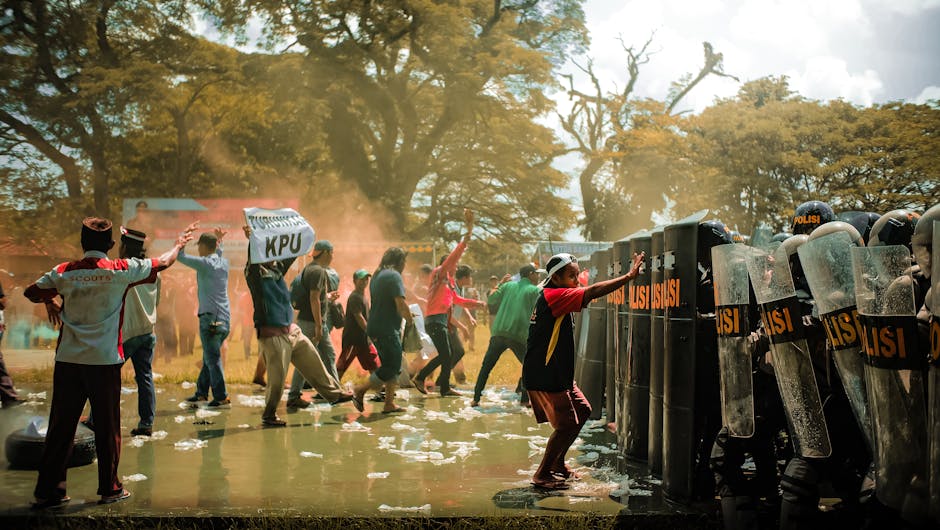
The predawn stillness of La Paz shattered with a series of sharp explosions echoing through the canyon-like streets of the administrative capital. Flames licked the façade of the Ministry of Mining as plumes of smoke curled into the cold Andean sky. Masked protesters in miner’s helmets hurled dynamite at riot police lines, while others waved the wiphala, the indigenous flag symbolizing resistance. The city awoke not to its usual rhythm of buses and market chatter, but to the staccato of tear gas canisters and the distant wail of ambulances. For residents peering through barred windows, it was a scene that felt both surreal and tragically familiar—a nation once again torn by the raw forces of economic discontent and political fracture.
Protests Turn Violent Amid Calls for Resignation

What began as a coordinated strike by cooperative mining groups has spiraled into a full-scale antigovernment uprising. Over 3,000 miners from Potosí and Oruro descended on La Paz, converging on Plaza Murillo, the symbolic heart of Bolivian governance. The demonstrators demand the immediate resignation of President Rodrigo Paz, who assumed office just 14 months ago on promises of modernizing Bolivia’s extractive economy and curbing corruption. Instead, his administration’s push to centralize mineral rights and redirect lithium revenues to state coffers has alienated powerful mining cooperatives that have operated with near-autonomy for decades. According to Reuters, at least six people have been injured in clashes, and the government has declared a temporary state of emergency in central La Paz. Multiple explosions—likely from dynamite used in mining operations—were confirmed near the presidential palace, though no senior officials were harmed.
Roots of the Mining Rebellion

The current unrest is rooted in Bolivia’s long and volatile relationship with mineral extraction. Since the nationalization of tin mines in the mid-20th century, mining has been both an economic lifeline and a flashpoint for political upheaval. The rise of informal mining cooperatives in the 1980s, particularly after the collapse of state-run COMIBOL, gave thousands of miners a precarious livelihood and outsized political influence. Under former President Evo Morales, these groups were courted as allies, receiving tax breaks and de facto control over key deposits. But President Paz’s reform agenda—crafted with IMF support—sought to reclaim state authority over strategic minerals, especially silver, zinc, and lithium. His administration’s attempts to audit cooperative permits and impose stricter environmental standards were perceived as direct threats. When a draft law proposed stripping cooperatives of export rights, it triggered a chain reaction of outrage that culminated in the current uprising.
The Miners and the Politicians

At the center of the storm are Bolivia’s mining union leaders, particularly figures like Eliseo Ponce of the National Federation of Mining Cooperatives, who has called Paz a “puppet of foreign capital.” These leaders command fierce loyalty among their ranks, drawing on a legacy of resistance dating back to the 1946 Catavi massacre. For the rank-and-file miners, many of whom live in extreme poverty despite working in mineral-rich regions, the state’s encroachment feels like betrayal. Meanwhile, President Paz remains defiant, framing the protests as an attempted coup by privileged elites resisting accountability. In a televised address, he stated, “We will not allow Bolivia’s wealth to be looted by unregulated interests.” Yet critics argue his technocratic approach lacks the political nuance needed to navigate Bolivia’s deeply entrenched power structures. Behind the scenes, military leaders are reportedly divided, with some sympathetic to the miners’ cause.
Consequences for Bolivia and Beyond

The immediate consequences are already unfolding: international investors are reassessing risk in Bolivia’s mining sector, a critical driver of GDP. The country holds nearly a quarter of the world’s lithium reserves, and any prolonged instability could disrupt global supply chains for electric vehicles. Domestically, the crisis threatens to deepen social fractures, particularly between urban reformers and rural extractive communities. Indigenous groups remain split—some support the miners’ right to self-determination, while others condemn the violence. Additionally, the government’s use of force risks alienating moderate citizens who initially backed Paz’s reform agenda. If the unrest spreads to other sectors, such as transport or agriculture, Bolivia could face a broader economic paralysis.
The Bigger Picture
This uprising is not merely about mining—it’s a symptom of a deeper crisis in post-neoliberal Latin America. Across the region, governments attempting to balance economic modernization with social equity are encountering fierce resistance from entrenched interest groups. Bolivia’s dilemma mirrors challenges in Peru, Chile, and Ecuador, where resource nationalism and democratic governance are locked in uneasy tension. The international community is watching closely, as the outcome could set a precedent for how resource-rich democracies manage reform without descending into chaos. As The Guardian has noted, “The promise of inclusive growth often founders on the rocks of historical inequality and institutional weakness.”
What comes next remains uncertain. Mediation efforts led by the Catholic Church and regional leaders are underway, but trust is in short supply. President Paz faces a stark choice: compromise with the mining bloc and risk appearing weak, or escalate security measures and risk further bloodshed. For Bolivia’s citizens, particularly those in mining zones dependent on stability, the hope is not for victory, but for peace. Yet in a country where the earth yields vast wealth but offers little security, peace has always been the rarest mineral of all.
Source: Al Jazeera