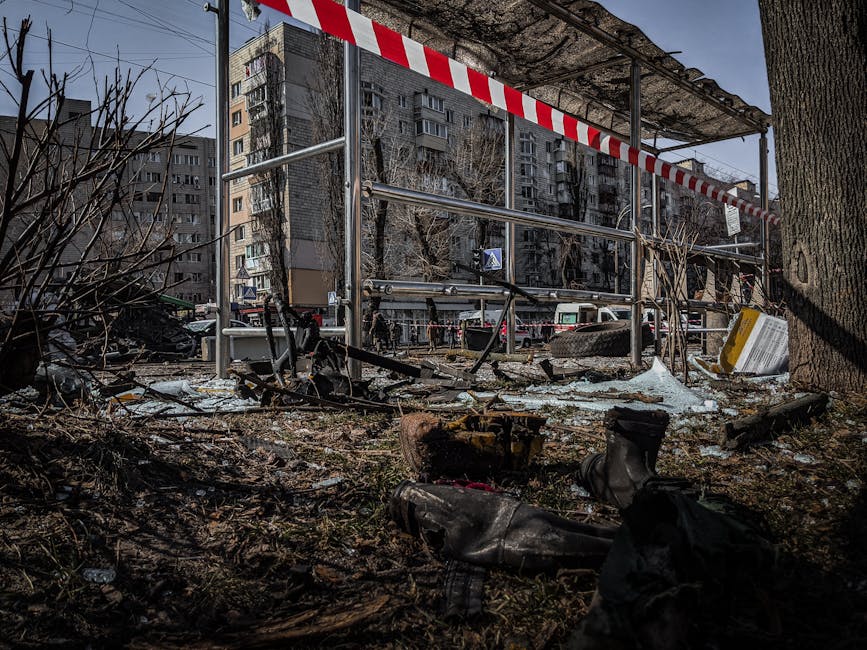
- Ukraine launched a coordinated overnight barrage on three high-value targets inside Russia, marking a major escalation of the war.
- The attacks targeted an aircraft manufacturing plant, a military airbase, and an oil refinery, demonstrating Ukraine’s enhanced long-range strike capabilities.
- The strikes signal Kyiv’s growing ability to project power deep into Russian territory, challenging Moscow’s assumption of homeland security.
- Ukraine’s targets include a production facility for advanced fighter jets and an airbase used in bombing campaigns against Ukrainian cities.
- The attacks mark a turning point in the conflict, as Ukraine shifts from defensive operations to systematically undermining Russia’s military production and energy supply.
In a major escalation of the war, Ukrainian forces launched a coordinated overnight barrage on three high-value targets inside Russia—an aircraft manufacturing plant in Komsomolsk-on-Amur, a military airbase in Crimea-adjacent southern Russia, and an oil refinery in Rostov Oblast—demonstrating enhanced long-range strike capabilities and a strategic shift toward degrading Russia’s domestic war infrastructure. The attacks, confirmed by satellite imagery and Russian state media, occurred on June 14, 2024, and signal Kyiv’s growing ability to project power deep into Russian territory. This marks a turning point in the conflict, as Ukraine moves beyond defensive operations to systematically undermine Russia’s military production and energy supply, challenging Moscow’s assumption of homeland security and raising the stakes for future retaliation.
What did Ukraine target and why do these sites matter?

Ukraine struck a production facility at the Komsomolsk-on-Amur Aircraft Plant (KnAAZ), a key site for assembling Sukhoi Su-35 and Su-57 fighter jets—aircraft central to Russia’s aerial dominance over Ukrainian battlefields. Damaging this facility could disrupt the delivery of advanced fighters to Russian forces. Simultaneously, an attack on the Millerovo airbase in Rostov Oblast targeted aircraft used in bombing campaigns against Ukrainian cities, according to defense analysts at the Royal United Services Institute (RUSI). The third strike hit the Lukoil-operated refinery in Volgodonsk, Rostov, reducing fuel processing capacity critical for military logistics. These synchronized blows suggest Ukraine is now capable of strategic interdiction—striking not just frontline assets but the industrial backbone enabling Russia’s war machine. By hitting domestic infrastructure, Kyiv is applying pressure where Russia is politically vulnerable: its perception of homeland inviolability.
What evidence supports Ukraine’s responsibility and the extent of the damage?

Satellite imagery from Planet Labs, analyzed by Reuters, shows fire damage and structural destruction at the KnAAZ facility, with one hangar partially collapsed. Russian Telegram channels associated with military bloggers posted videos of smoke plumes over Millerovo and Volgodonsk, while local officials in Rostov confirmed blackouts and temporary shutdowns at the refinery. The Ukrainian military has not officially claimed responsibility, but a senior defense official speaking anonymously to BBC News said the operations were part of a new phase of ‘asymmetric deterrence’ using domestically produced drones and modified Western missiles. The use of long-range UAVs, possibly upgraded versions of the Ukroboronprom Furia or adapted Storm Shadow missiles, indicates progress in overcoming previous range limitations that kept such deep strikes out of reach.
Are there doubts about Ukraine’s ability to sustain such attacks?

Some defense experts caution against overestimating Ukraine’s new capabilities. Michael Kofman of CNA, a U.S. defense research group, notes that while the strikes are symbolically significant, they may not severely disrupt Russian military output. “Russia has redundant production lines and vast fuel reserves,” he said in a recent interview. “These are pinpricks unless Ukraine can repeat them weekly.” Others point out that relying on drones and limited missile stocks makes sustained pressure difficult, especially as Western aid faces delays in the U.S. Congress. Additionally, Russia has begun dispersing aircraft and relocating sensitive production equipment deeper into Siberia, reducing vulnerability. There is also concern that escalation could provoke harsher Russian reprisals, including increased missile barrages on Ukrainian cities or even attacks on NATO supply lines, raising the risk of broader conflict.
What are the real-world consequences of these attacks?

The immediate impact includes localized power outages, fuel supply disruptions in southern Russia, and delays in fighter jet deliveries to active fronts. But the broader consequence is psychological and strategic: for the first time since the invasion began, Russian civilians are experiencing the reality of war on their soil. This could erode public support for the war, especially if attacks become routine. Economically, insurance costs for industrial facilities in border regions are rising, and some foreign firms are reconsidering operations in vulnerable zones. For Ukraine, the attacks boost morale and demonstrate resilience to its allies, potentially accelerating commitments of longer-range weaponry like ATACMS or F-16s. However, each strike deep inside Russia increases the risk of Russian counter-escalation, possibly including cyberattacks on European infrastructure or renewed assaults on Ukrainian nuclear facilities like Zaporizhzhia.
What This Means For You
If you follow global security, these strikes signal a transformation in Ukraine’s war strategy—from survival to active disruption of Russia’s war capacity. It shows that with the right tools and intelligence, a smaller nation can challenge a larger adversary’s strategic depth. For policymakers and citizens alike, this underscores the growing reach of drone warfare and the vulnerability of industrial infrastructure in modern conflict. As Ukraine pushes deeper into Russian territory, the risk of miscalculation rises, affecting energy markets, refugee flows, and NATO defense planning.
Going forward, the critical question is whether Ukraine can maintain this tempo of operations without overextending its resources or triggering an uncontrollable escalation. Will Western allies supply the weapons needed for sustained deep strikes, and how will Russia respond if such attacks become the new normal? The answer could determine not only the war’s outcome but the future of deterrence in Europe.
Source: Kyivpost