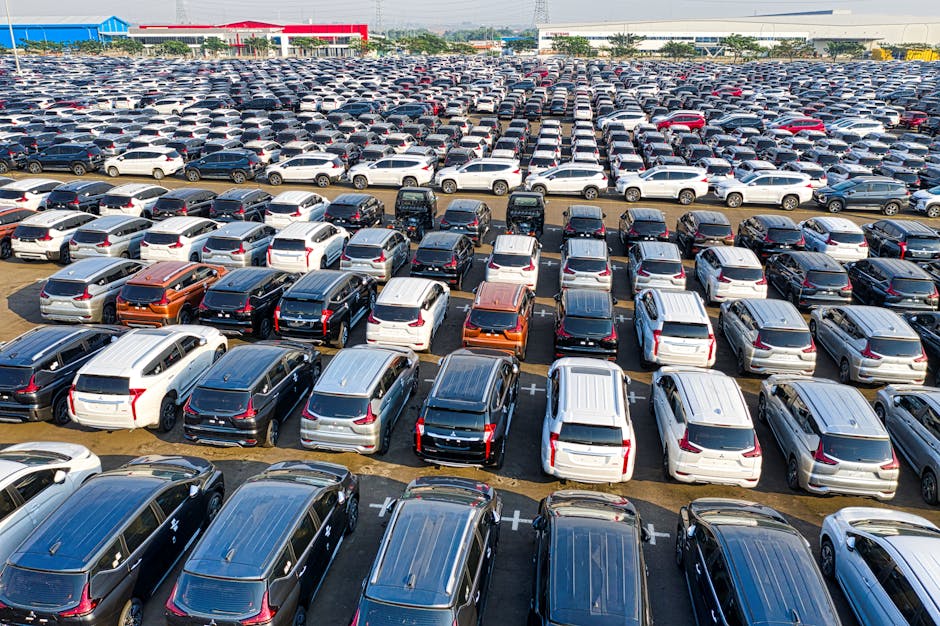
China’s electric vehicle (EV) exports soared 40% year-on-year in April 2026, reaching a record volume that underscores the country’s escalating dominance in the global green transportation sector. According to data compiled by Bloomberg, Asian markets absorbed the largest share of Chinese-made EVs, followed by Europe and Latin America, reflecting both regional demand shifts and Beijing’s strategic industrial policy. This surge marks a pivotal moment in the global auto industry, as Chinese automakers leverage cost advantages, state-backed supply chains, and aggressive pricing to capture market share from legacy Western and Japanese manufacturers—reshaping trade flows and intensifying geopolitical competition over clean technology leadership.
Regional Demand and Export Volumes

April’s export data reveals that over 120,000 Chinese-made electric vehicles were shipped globally, a 40% increase from the same month last year and a 12% rise from March 2026. Asia accounted for nearly 58% of total shipments, with Southeast Asian nations such as Thailand, Indonesia, and the Philippines emerging as key destinations due to favorable trade terms and growing middle-class demand for affordable EVs. Europe followed with 28% of exports, driven by strong sales in Germany, France, and Norway, where Chinese brands like BYD, NIO, and MG have expanded dealer networks. Latin America, particularly Chile and Mexico, absorbed 9% of shipments—tripling its share over the past two years. These figures, based on customs data analyzed by Bloomberg, suggest China is no longer just a manufacturing hub but an exporter shaping global EV adoption patterns. Notably, battery-electric vehicles made up 86% of exported models, with plug-in hybrids comprising the remainder, indicating a focus on full electrification.
Key Players and Industrial Strategy

The export boom is powered by a mix of state-supported manufacturers and private innovators, with BYD leading the charge as the world’s largest EV producer by volume. Other major players include Geely, which owns the international brand Polestar, and SAIC Motor, whose MG brand has gained traction in Europe. These companies benefit from extensive subsidies, low-cost domestic battery production—dominated by CATL—and streamlined regulatory environments that accelerate product development. The Chinese government has also prioritized EVs as a strategic industry under its “Made in China 2025” initiative, offering export incentives and investing in overseas logistics infrastructure. Meanwhile, Western automakers like Volkswagen and Stellantis have responded by forming joint ventures with Chinese firms or sourcing EV models directly from Chinese plants, a shift that highlights both the competitiveness of Chinese manufacturing and growing dependency concerns in mature markets. For more on China’s industrial policy, see BBC coverage of Made in China 2025.
Trade-offs in Global Market Penetration

While China’s EV export surge offers consumers worldwide access to lower-cost, technologically advanced vehicles, it also triggers protectionist responses and supply chain vulnerabilities. The European Union, for instance, has initiated anti-subsidy investigations into Chinese EV imports, with tariffs of up to 25% proposed on select models—a move that could escalate trade tensions. Similarly, the United States maintains high import barriers and excludes Chinese EVs from federal tax credits under the Inflation Reduction Act. On the domestic front, China’s export focus risks overheating its automotive sector, with some analysts warning of overcapacity and price wars that could undermine profitability. Yet the broader benefit lies in accelerating global decarbonization: increased availability of affordable EVs supports climate goals, particularly in developing economies. Still, concerns about data security, intellectual property, and labor standards accompany the expansion, prompting calls for stricter international regulations on EV imports.
Why the Acceleration Now?

The April surge reflects a confluence of policy maturation, production scaling, and shifting global demand. China’s EV ecosystem has matured over the past five years, with improvements in battery density, charging infrastructure, and brand recognition enabling long-distance exports. At the same time, Europe’s tightening emissions regulations and Asia’s urban air quality challenges have created fertile ground for EV adoption. The timing also aligns with post-pandemic supply chain stabilization and the rollout of new models tailored for international markets—such as the right-hand-drive BYD Atto 3 for Southeast Asia. Moreover, geopolitical realignments have pushed some countries to diversify auto imports away from traditional suppliers, opening doors for Chinese exporters. The 40% year-on-year growth is not an anomaly but a continuation of a trend: Chinese EV exports have grown at a compound annual rate of 62% since 2021, according to Reuters analysis of Chinese customs data.
Where We Go From Here
Over the next 6 to 12 months, three scenarios could unfold. First, a trade truce: the EU and China reach a negotiated quota agreement, allowing continued market access with modest tariffs, similar to past steel and solar panel deals. Second, escalation: the U.S. and EU impose broad tariffs, prompting China to retaliate with restrictions on critical mineral exports or launch state-backed marketing campaigns to build brand loyalty abroad. Third, diversification: Chinese automakers double down on building local assembly plants in Mexico, Hungary, and Thailand to bypass import barriers, mirroring Tesla’s gigafactory model. Each path carries implications for global EV affordability, climate progress, and tech sovereignty. Investors, regulators, and consumers alike will be watching how Beijing balances export ambitions with diplomatic friction.
China’s 40% EV export surge in April 2026 is not just a monthly statistic—it signals a structural shift in global automotive leadership, with Beijing’s industrial policy driving a new era of clean tech competition that will redefine mobility, trade, and environmental policy worldwide.
Source: Al Jazeera