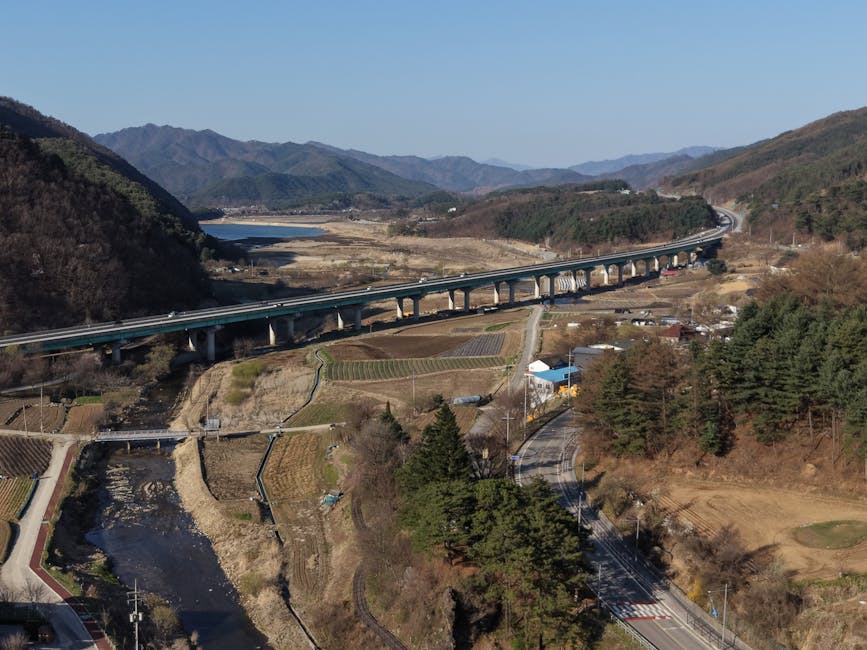
- Three people died in Busan, South Korea, after an overpass collapsed without warning onto vehicles below.
- The collapse has sparked a nationwide conversation about infrastructure integrity in South Korea.
- Many of South Korea’s transportation network were built during rapid urbanization in the 1970s and 1980s.
- Thousands of bridges and overpasses in South Korea are nearing or past their intended service life.
- Experts warn that structural upgrades and rigorous safety monitoring are needed to prevent future disasters.
Three people have died in Busan, South Korea, after a section of an overpass collapsed onto vehicles below, officials confirmed. The incident occurred on a weekday morning when a 30-meter stretch of the elevated roadway gave way without warning, crushing several cars and a bus. Emergency responders pulled survivors from the wreckage, but three occupants were pronounced dead at the scene. The collapse has triggered a nationwide conversation about infrastructure integrity, especially as much of South Korea’s transportation network was built during rapid urbanization in the 1970s and 1980s. With experts warning that thousands of bridges and overpasses are nearing or past their intended service life, this tragedy underscores the urgent need for structural upgrades and rigorous safety monitoring to prevent future disasters.
What Happened in the Busan Collapse

The overpass, part of a major arterial route in eastern Busan, buckled suddenly around 8:15 a.m. local time, sending tons of concrete and steel crashing onto six vehicles beneath. Eyewitnesses reported hearing a loud cracking sound before the structure collapsed within seconds. Among the vehicles was a public transit bus carrying 15 passengers, which sustained significant damage but avoided higher casualties due to its reinforced frame. Rescue teams from the Busan Fire Department arrived within minutes and used hydraulic cutters and cranes to extract survivors from mangled vehicles. Two men and one woman, all in their 40s and 50s, were confirmed dead at the scene. The Busan Metropolitan Government stated that no immediate signs of an explosion or collision preceded the collapse, directing early investigation efforts toward structural fatigue or material failure.
The Ageing Infrastructure Crisis in South Korea

The collapse in Busan highlights a growing national concern: much of South Korea’s critical infrastructure is aging beyond its design lifespan. The failed overpass was constructed in 1983, meaning it had operated for over 40 years—exceeding the typical 30- to 40-year service expectation for concrete structures under heavy urban use. According to data from the Korea Expressway Corporation, more than 30% of the country’s bridges and overpasses are over four decades old. While routine inspections are mandated every two to five years depending on structure type, critics argue that visual checks alone are insufficient to detect internal corrosion, rebar degradation, or microfractures. A 2022 report by the Korea Infrastructure Safety Corporation found that 12% of inspected overpasses showed signs of moderate to severe deterioration. Despite warnings, funding for preemptive repairs and replacements has lagged, especially in mid-sized cities like Busan where budgets are tighter than in Seoul.
Engineers, Officials, and Public Trust

Responsibility for the overpass’s safety falls primarily on the Busan City Government and the Korea Infrastructure Safety Corporation, the state-run agency overseeing structural inspections. Local engineers express frustration over limited resources and political pressure to maintain traffic flow rather than close roads for extensive repairs. “We know some structures are at risk, but shutting down a major overpass for months is a difficult decision for any mayor,” said Dr. Lee Min-ho, a civil engineering professor at Pusan National University. Meanwhile, families of the victims and advocacy groups are demanding accountability, calling for an independent review of inspection records. Public trust in infrastructure safety has wavered, especially after previous incidents like the 2019 partial collapse of a pedestrian bridge in Incheon and the 2021 closure of several subway viaducts due to cracking. Citizens now question whether maintenance protocols are truly prioritizing safety over cost and convenience.
Aftermath and National Repercussions

In the wake of the tragedy, South Korea’s Ministry of Land, Infrastructure and Transport has ordered emergency inspections of all overpasses built before 1990 in major cities. Transport Minister Park Sang-hyun called the collapse “a wake-up call” and announced a ₩500 billion (about $370 million) emergency fund for urgent repairs. Busan officials have temporarily closed three other overpasses with similar construction profiles for immediate evaluation. Beyond the immediate safety response, the incident may accelerate legislative efforts to modernize infrastructure oversight. A draft bill before the National Assembly proposes mandatory sensor-based monitoring systems for all high-risk bridges, using real-time data to detect stress and deformation. Families of the victims have vowed to push for stricter penalties for negligence and better transparency in inspection reports.
The Bigger Picture
This disaster in Busan is not an isolated incident but part of a global pattern: countries that underwent rapid industrialization now face the hidden costs of aging infrastructure. From the 2022 Genoa bridge collapse in Italy to recurring bridge failures in the United States, nations are confronting the long-term sustainability of 20th-century engineering. In South Korea, where economic growth once prioritized speed and scale, the challenge is to shift toward resilience and longevity. As climate change intensifies weather extremes—from heavy rains to temperature swings—the stress on concrete structures increases, making proactive maintenance even more critical. The Busan collapse serves as a sobering reminder that infrastructure safety is not just an engineering issue but a matter of public trust and national planning.
With investigations ongoing, all eyes are on whether South Korea will turn this tragedy into a catalyst for systemic reform. The families of the victims, engineers, and policymakers now face a shared responsibility: to ensure that aging infrastructure does not become a ticking time bomb in cities across the nation. As Busan mourns, the country must act—before the next overpass fails.
Source: News