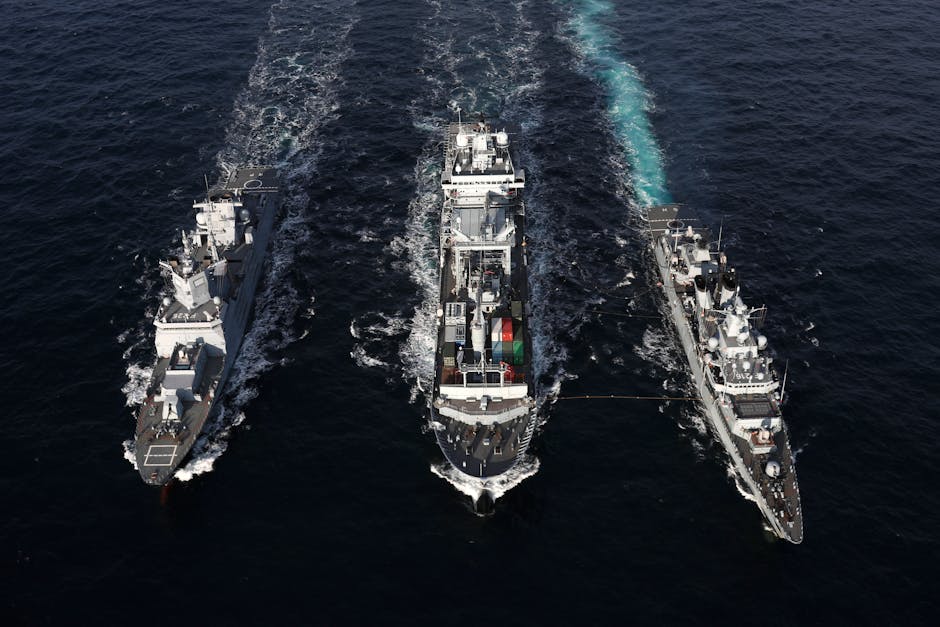
- The US has deployed three warships and F-35 fighter jets to the Persian Gulf amidst escalating tensions with Iran.
- The US military buildup is the largest in the region since the 2020 assassination of Iranian general Qasem Soleimani.
- Iran’s recent ballistic missile launches and renewed threats against American allies in the Gulf justify the deployment.
- The escalation raises fears of miscalculation or direct confrontation, especially amid heightened tensions.
- Global oil markets are already volatile, and regional allies are on high alert due to the US military buildup.
The United States has deployed three additional naval vessels and a squadron of F-35 fighter jets to the Persian Gulf in response to a series of Iranian missile tests and escalating rhetoric from Tehran, officials confirmed on May 24, 2026. The move, which brings the total U.S. carrier presence in the region to two, marks the largest military buildup near Iran since the 2020 assassination of Iranian general Qasem Soleimani. The Pentagon cited Iran’s recent ballistic missile launches—conducted within 100 miles of international shipping lanes—and renewed threats against American allies in the Gulf as justification for the deployment. With global oil markets already volatile and regional allies on high alert, the escalation raises fears of miscalculation or direct confrontation, especially amid heightened tensions during the final year of the Trump administration’s second term.
U.S. Military Reinforces Persian Gulf Presence

The U.S. Navy’s Fifth Fleet, headquartered in Bahrain, has now integrated the USS Abraham Lincoln carrier strike group with the newly arrived USS Paul Ignatius, a guided-missile destroyer, and the USS San Jacinto, a cruiser equipped with advanced Aegis radar systems. Complementing the naval surge, the U.S. Air Force has activated the 494th Fighter Squadron, deploying F-35Cs capable of both air superiority and precision strike missions from Al Dhafra Air Base in the United Arab Emirates. According to a Defense Department briefing, the deployments are classified as “precautionary and defensive,” aimed at deterring Iranian aggression and ensuring the free flow of commerce through the Strait of Hormuz, through which nearly 20% of the world’s oil passes daily. Satellite imagery from May 23 verified the movements, showing increased flight operations and security protocols across U.S. installations in Kuwait, Qatar, and Bahrain.
Roots of the Current Escalation

Tensions between the U.S. and Iran have followed a cyclical pattern of provocation and response since the 2018 U.S. withdrawal from the Joint Comprehensive Plan of Action (JCPOA), commonly known as the Iran nuclear deal. After reimposing harsh economic sanctions, the Trump administration pursued a “maximum pressure” campaign that crippled Iran’s economy but failed to force renegotiations. Iran responded by gradually exceeding uranium enrichment limits and advancing its ballistic missile program. The 2020 U.S. drone strike that killed Qasem Soleimani brought the two nations to the brink of war, with Iran launching retaliatory strikes on Iraqi bases housing U.S. troops. Since then, proxy conflicts have simmered across the region, including Houthi attacks on shipping in the Red Sea and Iranian-backed militias targeting U.S. outposts in Syria and Iraq. The current flare-up follows Iran’s test of the Kheibar Shekan missile on May 20—a solid-fuel, precision-guided system with a range of 1,450 kilometers—widely seen as a show of force.
Key Actors Driving the Crisis

On the American side, National Security Advisor Mike Waltz and Secretary of Defense Pete Hegseth have been central in shaping the administration’s hardline posture, advocating for visible military deterrence to prevent Iranian adventurism. President Donald Trump, campaigning on a platform of strength abroad, has publicly endorsed the deployments, tweeting, “Iran will pay dearly if they harm any American.” Meanwhile, Iran’s Supreme Leader Ayatollah Ali Khamenei has framed the U.S. presence as imperialist aggression, calling for “resistance” during Friday prayers in Tehran. The Islamic Revolutionary Guard Corps (IRGC), particularly its Quds Force under Esmail Ghaani, operates with significant autonomy and has long used asymmetric warfare and proxy networks to project power. Regional actors like Saudi Arabia and Israel, both wary of Iran’s growing missile capabilities, have quietly welcomed the U.S. buildup, though diplomats caution that over-militarization could backfire.
Regional and Global Consequences

The immediate impact of the military surge is being felt across the Gulf Cooperation Council (GCC) states, where governments are balancing support for U.S. security assurances with fears of becoming battlegrounds in a larger conflict. Oil prices have risen nearly 7% since May 20, with Brent crude surpassing $94 per barrel, according to Reuters. Shipping insurers have increased premiums for vessels transiting the Strait of Hormuz, and several commercial carriers have rerouted through the Cape of Good Hope. For U.S. troops stationed in Iraq and Syria, the risk of retaliatory attacks from Iranian-backed groups has spiked, prompting the State Department to issue new evacuation advisories. Diplomatically, the European Union has called for de-escalation, while China and Russia have criticized the U.S. deployments as “destabilizing,” reflecting broader geopolitical fractures.
The Bigger Picture
This escalation is not merely a bilateral crisis but a symptom of deeper structural tensions in a multipolar Middle East. The region is increasingly a theater for great power competition, with U.S. influence contested by China’s economic inroads and Russia’s military partnerships. Iran’s pursuit of advanced missile systems and near-nuclear capabilities reflects a long-term strategy of regional deterrence, while American military presence risks fueling nationalist backlash and entrenching cycles of retaliation. As non-state actors gain access to precision weapons and drone technology, the threshold for conflict is lower than ever. The absence of formal diplomatic channels between Washington and Tehran further limits crisis management options, raising the specter of an unintended war sparked by a single incident.
What happens next may hinge on behind-the-scenes diplomacy through intermediaries like Oman or Switzerland, which have historically facilitated U.S.-Iran talks. Military planners are preparing for a range of contingencies, including cyber operations and limited strikes, but emphasize that the goal remains deterrence, not war. With the 2026 midterm elections approaching, the Trump administration faces pressure to demonstrate resolve without triggering a conflict that could define its foreign policy legacy. As regional tensions remain at a boiling point, the world watches closely—one misstep could tip the balance.
Source: The New York Times