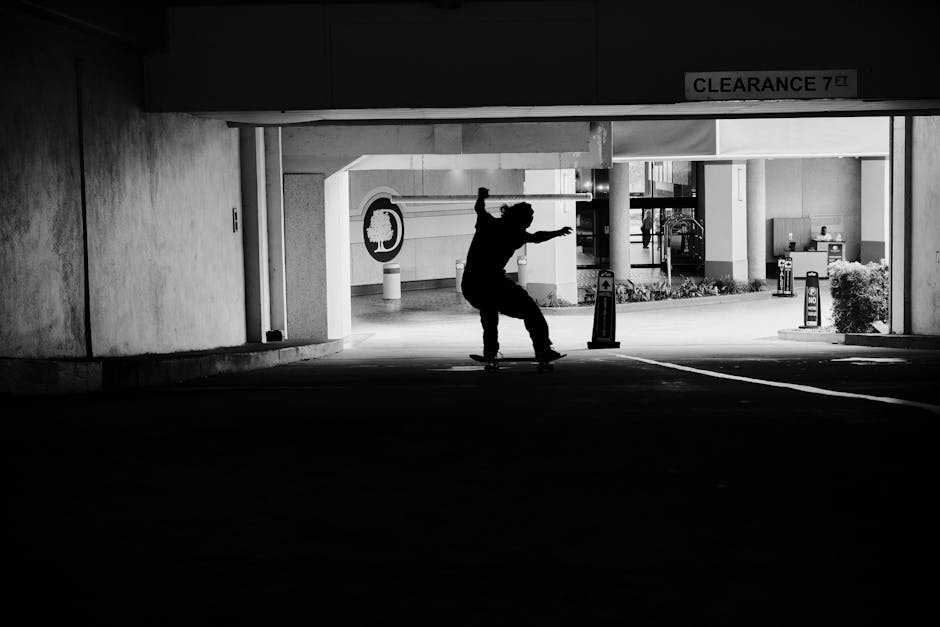
- Skateboarders gather in the Crenshaw Costco parking lot after midnight as an unofficial skatepark, seeking continuity and community.
- The group, known as ‘The Lot,’ skates not to escape grief but to move through it and acknowledge loss.
- For these skaters, grief is a shared experience that brings them together, rather than a barrier to be overcome.
- The ritual of skateboarding helps them process their emotions and find a sense of catharsis.
- This skatepark community serves as a reminder that grief is a universal human experience that can bring people together.
Under the harsh, humming fluorescence of the Crenshaw Costco parking lot, the air smells of rubber, concrete dust, and the faint tang of spilled energy drinks. It’s past midnight, and a loose circle of skateboarders—some in hoodies, others barefoot, all moving with the guarded grace of those who’ve broken bones before—watch as Julian Reyes drops in from the curb. His board clacks against the pavement, wheels catching asphalt as he leans into a kickflip. The trick lands clean. No one cheers, but a few nod. This isn’t a performance. It’s a ritual. Around them, spray-painted tributes in fading ink mark the edges of the lot: RIP MATEO. KICKFLIPS FOR LILY. ONE MORE TRICK. Names of the dead. Friends. Brothers. A silent ledger of loss, etched into the sidewalks where they once rolled.
The Ritual After Midnight

Every night after 11 p.m., the Costco in South L.A. becomes an unofficial skatepark, drawing riders from across the city who gather not for competitions or sponsorships, but for continuity. There are no judges, no cameras—just the scrape of grip tape and the occasional burst of laughter. The group, loosely organized through word of mouth and encrypted messaging apps, refers to themselves as “The Lot.” They don’t skate to escape grief, they say, but to move through it. “We’re not running from death,” explains Tasha Lin, a 27-year-old skater who lost her younger brother in a hit-and-run two years ago. “We’re skating toward it. Acknowledging it. Every time I ollie over a crack, I’m saying his name in my head.” The Costco management, aware of the gatherings, has so far tolerated the activity, citing community presence and the absence of serious incidents.
How It Began: From Tragedy to Tradition

The gatherings began in 2019 after Mateo Cruz, a 19-year-old skater known for his fearless downhill runs, died in a collision with a delivery truck near the intersection of Crenshaw and Slauson. His friends, devastated and adrift, started meeting at the nearest familiar landmark—the Costco parking lot where they’d often warmed up before heading to closed-down schools or empty pools. What began as a memorial vigil slowly evolved into a nightly practice. “Mateo always said this lot had the best street sweep,” recalled Diego Mendez, one of the founding members. “He loved how clean the concrete was.” Within months, the group began chalking names, leaving broken decks as offerings, and recording short video tributes that circulated quietly online. By 2021, the gatherings had drawn attention from local media, though the skaters resisted being labeled a movement. “We’re not activists,” one rider told the Los Angeles Times. “We’re just people who miss people. And we skate because it’s the only thing that makes silence bearable.”
The People Who Keep Riding

The core group now includes around two dozen regulars, ranging from teenagers to skaters in their forties, many of whom have lost someone to violence, addiction, or sudden illness. For them, skating isn’t just physical—it’s linguistic, emotional, almost liturgical. Moves are named after the dead; a varial heelflip might be called a “Mateo” or a “Lily,” depending on who’s remembered that night. Some carry small relics in their backpacks: a shard of a deck from a friend’s last ride, a Polaroid tucked into a sock. “There’s no grief counselor that understands what it’s like to lose your best friend mid-session,” says Jamal Ortiz, who started an informal support network called “Roll On” that meets weekly at a nearby community center. “But these people do. We don’t talk much. We just ride together. And that’s enough.”
What This Means for the Community

The significance of The Lot extends beyond personal healing. Local therapists have begun referring clients to the group, recognizing its informal but powerful role in trauma processing. Dr. Elena Ruiz, a clinical psychologist specializing in youth grief, calls it “a grassroots model of somatic mourning—where movement becomes memory.” Meanwhile, city officials have quietly discussed designating a permanent public space for the group, though no formal proposal has advanced. For now, the skaters remain in legal limbo, tolerated but not recognized. Still, their presence has altered the neighborhood’s rhythm. Residents report fewer break-ins, and nearby businesses have started leaving water bottles and snacks out after hours. “They’re not causing trouble,” says Maria Gutierrez, who runs a bodega across the street. “They’re mourning. And somehow, they’re keeping each other alive.”
The Bigger Picture
In a culture that often treats death as something to be sanitized or hidden, The Lot offers a raw, unfiltered alternative—one where loss isn’t conquered but carried. Across the U.S., similar informal memorials have emerged: murals in Chicago honoring young victims of gun violence, empty BMX bikes chained to fences in Detroit, marathon runs in New York marking overdose awareness. But few blend daily ritual with physical endurance as seamlessly as this skate crew. Theirs is a testament to the idea that healing doesn’t always happen in silence or on a therapist’s couch—it can happen mid-air, in the split second between launch and landing, when the body remembers what the mind cannot say.
Julian Reyes wipes his hands on his jeans and steps back from the curb. He doesn’t speak, but he taps his board twice against the asphalt—a signal, others say, that he’s done for the night. As he walks away, someone else steps up. The wheels roll. The lights hum. And somewhere beneath the concrete, beneath the names painted in fading ink, the echo of a single truth lingers: we’re all going to die. But first—just one more trick.
Source: The New York Times