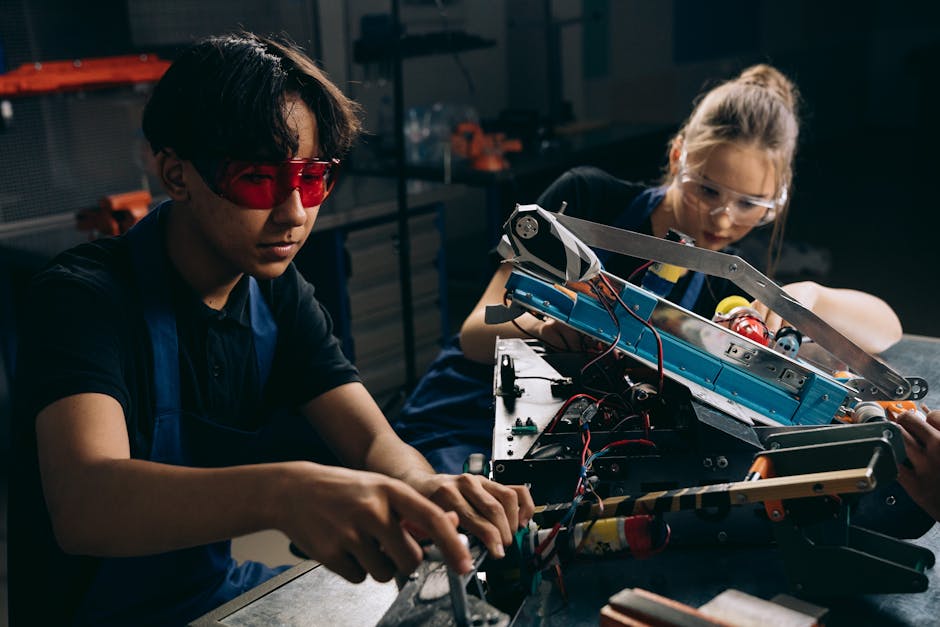
- A public high school in Huntsville, Alabama, is offering an alternative path to college by training teenagers in skilled trades and advanced manufacturing.
- The Huntsville Center for Technology is preparing students for careers that pay $40 an hour and are nearly impossible to automate.
- Students at HCOT train in fields like mechatronics, welding, robotics maintenance, and industrial automation, where human judgment and precision are irreplaceable.
- The school’s programs are developed with input from major companies like Toyota and result in industry certifications and direct job offers.
- By focusing on human expertise, HCOT is proving that workers with physical dexterity and problem-solving skills have unmatched value in the age of machines.
What happens to workers when artificial intelligence can draft legal memos, write marketing copy, and manage schedules better than humans? As AI rapidly transforms the job market, millions of white-collar workers face displacement. But in Huntsville, Alabama, a bold experiment is underway: a public high school is preparing teenagers for careers that not only pay $40 an hour but are nearly impossible to automate. Instead of pushing every student toward a four-year college, the Huntsville Center for Technology (HCOT) is offering an alternative path—immersive training in skilled trades, advanced manufacturing, and precision engineering. And with major employers like Toyota actively recruiting its graduates, the model is proving that human expertise still has unmatched value in the age of machines.
What Are the Jobs AI Can’t Replace?

The answer lies in physical dexterity, real-time problem-solving, and on-the-ground adaptability—skills that automation struggles to replicate. At HCOT, students train in fields like mechatronics, welding, robotics maintenance, and industrial automation, where human judgment and tactile precision are irreplaceable. These aren’t the shop classes of the past; they’re rigorous, industry-aligned programs developed with direct input from companies like Toyota, which operates a major engine and transmission plant nearby. Graduates often earn industry certifications before they receive their diplomas and are hired directly into roles paying between $30 and $40 per hour. According to the National Association of Manufacturers, the U.S. could face a shortage of up to 2.1 million skilled manufacturing workers by 2030—making this pipeline not just valuable, but essential.
What Evidence Shows This Model Works?

Data from Alabama’s Department of Education shows that HCOT students have a 95% graduation rate and over 80% enter either full-time employment or advanced technical education immediately after high school. Many land jobs with Toyota, Boeing, or local aerospace firms that require troubleshooting automated systems, not just operating them. Reuters has reported on Toyota’s broader push to localize its manufacturing workforce and invest in technician training as it transitions to electric vehicle production. At HCOT, students don’t just learn to run machines—they learn how to fix them when AI-powered systems fail. As Greg Miller, a lead instructor at HCOT, told The Associated Press, “These kids are becoming the immune system of modern manufacturing—when the robots go down, they’re the ones who get them back online.”
What Are the Counterarguments to This Approach?

Critics argue that tracking students into technical careers too early could limit their long-term mobility or reinforce socioeconomic divides. Some worry that focusing on skilled trades might discourage pursuit of higher education, especially for students from underrepresented backgrounds. Others point out that while today’s automation-resistant jobs are safe, future advances in robotics and AI could eventually encroach on even hands-on roles. For example, experimental robotic welders guided by computer vision are already being tested in pilot factories. Additionally, not every region has a Toyota or aerospace hub to absorb skilled graduates, raising questions about scalability. While HCOT’s model is promising, it depends heavily on regional industry partnerships that may not exist elsewhere, especially in rural or economically depressed areas.
What Is the Real-World Impact of This Training?

The impact is already visible in Huntsville’s workforce and economy. Take 18-year-old DeShawn Carter, a recent HCOT graduate who now works at Toyota’s engine plant earning $38 an hour with full benefits. He chose the mechatronics program over community college and will have earned over $300,000 by age 25—without student debt. Similarly, local companies report shorter downtime and faster response times thanks to a growing pool of trained technicians. The model is also reshaping perceptions: parents who once saw college as the only path to stability are now recognizing skilled trades as a legitimate, high-status career track. Alabama’s state government has taken notice, expanding funding for career-technical education across 50 school districts, citing HCOT as a blueprint.
What This Means For You
For families, educators, and policymakers, the HCOT model offers a practical response to the AI-driven job market: invest in skills that complement, rather than compete with, automation. If your community has manufacturing, healthcare, or infrastructure sectors, there’s likely a demand for technicians who can maintain, repair, and innovate within complex systems. This isn’t about lowering expectations—it’s about diversifying pathways to economic security. For students, it means a viable, high-paying career can begin at 18 without a mountain of debt.
But how scalable is this model beyond manufacturing hubs? Can rural schools replicate HCOT’s success without major corporate partners? And as AI evolves, which human skills will remain durable—and how should education systems adapt in real time? These questions will shape the future of work in the decades ahead.
Source: Fortune