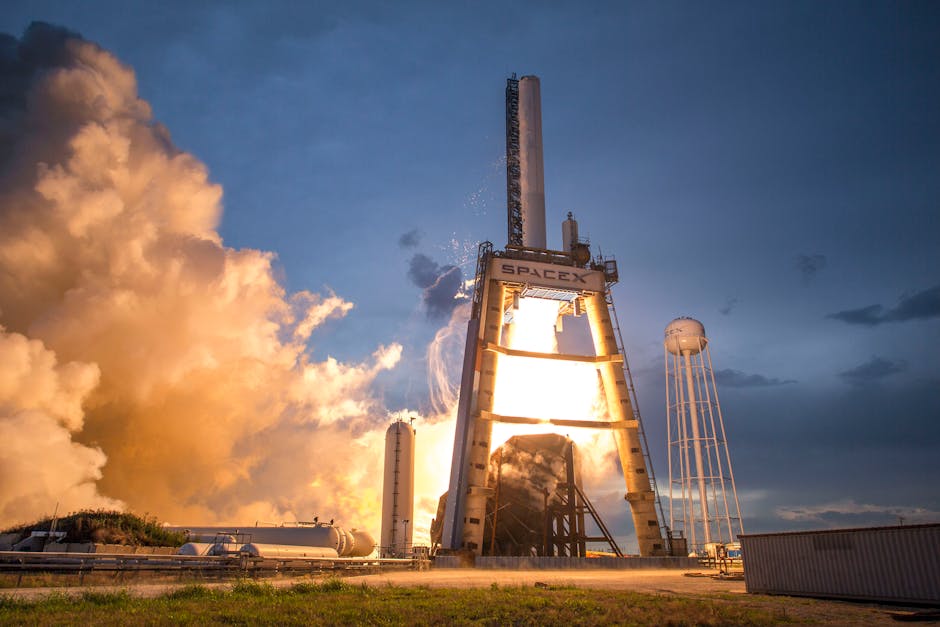
- SpaceX’s Starship successfully completed its 12th test flight, marking a significant milestone in Elon Musk’s quest to make humanity a multiplanetary species.
- The latest version of Starship features upgraded heat shielding, improved engine performance, and enhanced guidance systems designed to survive atmospheric reentry.
- The 400-foot-tall stainless-steel rocket lifted off from Starbase, SpaceX’s private launch facility, with 33 Raptor engines producing 17 million pounds of thrust.
- Both stages of the Starship system achieved stage separation, a persistent challenge in prior flights, with the Super Heavy executing a controlled descent and partial boost-back burn.
- This test flight brings SpaceX closer to its goal of developing a reusable spacecraft capable of carrying humans to the moon, Mars, and beyond.
Under a bruised dawn sky at the edge of the Gulf of Mexico, the earth trembled near Boca Chica, Texas, as SpaceX’s Starship roared to life—a 400-foot-tall stainless-steel leviathan erupting in a column of fire and smoke. The air cracked with the thunder of 33 Raptor engines, their combined 17 million pounds of thrust punching through the humid coastal air. For miles around, windows rattled and sand trembled as the largest and most powerful rocket ever flown lifted slowly, then violently, into the atmosphere. This was not just another test. It was a calibrated gamble in Elon Musk’s decade-long quest to build a reusable spacecraft capable of carrying humans to the moon, Mars, and beyond—a machine engineered not just to explore space, but to make humanity a multiplanetary species.
Starship’s 12th Test Reaches New Heights

This latest launch marks the 12th integrated test flight of the Starship system, comprising the Super Heavy booster and the Starship upper stage. Unlike earlier iterations, this version features significant upgrades: reinforced heat shielding, improved engine performance, and enhanced guidance systems designed to survive atmospheric reentry. The rocket lifted off from Starbase, SpaceX’s private launch facility, at approximately 6:30 a.m. Central Time. Both stages achieved stage separation—a persistent challenge in prior flights—with the Super Heavy executing a controlled descent and partial boost-back burn before splashing down in the Gulf. The Starship upper stage continued its ascent, reaching an altitude of over 150 kilometers before losing signal during reentry. Though the final phase ended ambiguously, SpaceX engineers hailed the mission as a major success, noting that over 90% of test objectives were met. NASA, which has committed to using Starship for the Artemis III lunar landing, closely monitored the flight’s data.
The Road to Reusability and Beyond

The roots of Starship trace back to 2016, when Elon Musk first unveiled conceptual designs at the International Astronautical Congress, sketching out a fully reusable transportation system that could ferry up to 100 people to Mars. Since then, the project has evolved through relentless prototyping and explosive setbacks—six of the first eleven test flights ended in midair detonations or loss of control. Yet each failure yielded data that shaped the next design. By 2024, SpaceX had achieved orbital velocity for the first time, and by 2025, demonstrated successful stage separation and partial booster recovery. The current iteration reflects over 8,000 design changes, including a new hot-staging mechanism that reduces ignition risks during separation. This incremental, fail-fast approach has become SpaceX’s hallmark, diverging sharply from traditional aerospace timelines and cost structures.
The Visionaries Behind the Rocket

Elon Musk remains the driving force behind Starship, often intervening in engineering decisions and setting audacious deadlines. But the rocket’s progress is the work of thousands: propulsion specialists in Hawthorne, California; thermal protection experts in Colorado; and launch crews living in trailers at Starbase. Gwynne Shotwell, SpaceX’s president and COO, has been instrumental in securing contracts and managing operational scale, while engineers like Paul Wooster and Mark Juncosa lead technical execution. Musk’s recent announcement that SpaceX will go public adds new pressure to demonstrate reliability and progress. Investors and regulators alike will scrutinize flight outcomes as the company transitions from private innovator to publicly traded entity. For the team, each launch is not just a technical milestone but a validation of their belief that interplanetary travel is within reach.
Implications for Space Exploration and Policy

The success of Starship could redefine space exploration. NASA’s Artemis program depends on it to land astronauts on the lunar surface for the first time since 1972, with Artemis III currently scheduled for no earlier than 2026. Delays in Starship’s development have already pushed back that timeline, and further setbacks could jeopardize U.S. leadership in the new space race. Meanwhile, competitors like Blue Origin and international agencies are watching closely. The rocket’s payload capacity—over 100 metric tons to low Earth orbit—also opens possibilities for space-based solar power, orbital manufacturing, and deep-space science missions. However, environmental concerns persist: the launch site disrupts local wildlife, and the carbon footprint of frequent heavy-lift launches remains unaddressed.
The Bigger Picture
Starship is more than a vehicle; it is a statement about the future of human ambition. Its sheer scale challenges the limits of engineering and imagination, echoing the Apollo era but with a private-sector engine. If perfected, it could reduce the cost of access to space by orders of magnitude, enabling missions once deemed impractical. But its ultimate test will not be technological—it will be whether humanity is ready to become a spacefaring civilization, with all the ethical, ecological, and existential questions that entails.
What comes next is a series of increasingly complex missions: orbital refueling tests, uncrewed lunar landings, and eventually, crewed flights. SpaceX aims to launch Starship dozens of times per year by 2027. Each launch, each data stream, brings the dream of Mars a little closer—or reveals how far we still have to go. As the smoke cleared over Boca Chica, the silence that followed was not empty; it was charged with possibility.
Source: The Guardian