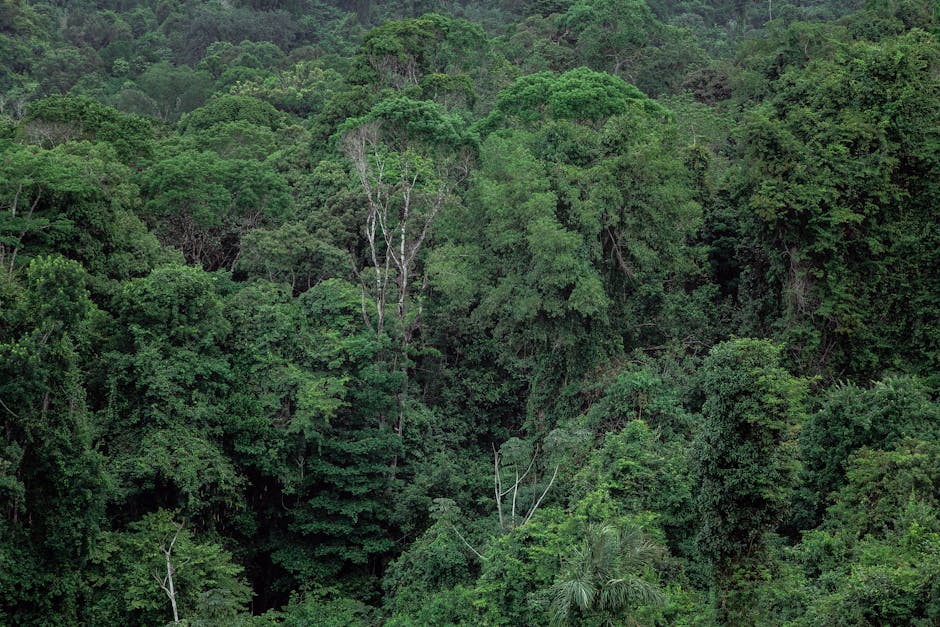
- Ancient humans thrived in rainforests 150,000 years ago, defying the long-held notion that they avoided these ecosystems.
- Archaeological findings in West Africa indicate that early humans lived in rainforests tens of thousands of years earlier than previously believed.
- New research suggests that humans were capable of surviving and thriving in dense rainforests with limited tools and technology.
- The discovery challenges the prevailing narrative of human adaptability and evolution, highlighting the need for a reevaluation of early human history.
- The Tiémassas site in Côte d’Ivoire holds significant importance as a testament to human resilience and adaptability in extreme environments.
Did early humans really avoid the world’s densest forests, or have we fundamentally misunderstood their capabilities? For decades, the scientific consensus held that ancient Homo sapiens shied away from tropical rainforests, viewing them as hostile, resource-scarce environments too difficult to inhabit without advanced tools or fire. The prevailing narrative suggested our ancestors only ventured into such zones much later in prehistory, perhaps as recently as 50,000 years ago. But a stunning archaeological discovery in West Africa is forcing a dramatic rethink. Evidence from the southeastern rainforests of present-day Côte d’Ivoire now indicates that humans not only entered these ecosystems but lived within them as far back as 150,000 years ago—tens of thousands of years earlier than previously believed. What does this mean for our understanding of human adaptability, evolution, and the spread of our species across the globe?
Could Ancient Humans Survive in Dense Rainforests?

The answer, according to new findings, is a definitive yes. Researchers analyzing stone tools and animal bone fragments from the Tiémassas site near Abidjan, Côte d’Ivoire, have dated human presence there to approximately 150,000 years ago—during a critical phase of early Homo sapiens development. These tools, crafted from locally sourced quartz and showing signs of precision flaking, were used to process animal tissues and plant materials, suggesting long-term occupation rather than fleeting visits. The surrounding paleoenvironmental data, including pollen and sediment analysis, confirms that the region was a dense tropical rainforest at the time. This directly contradicts the long-standing hypothesis that rainforests were evolutionary backwaters or barriers to human expansion. Instead, the evidence points to early humans not only surviving but adapting to one of Earth’s most biologically complex and challenging ecosystems far earlier than anyone thought possible.
What Evidence Supports Early Rainforest Habitation?

The case rests on a convergence of archaeological and environmental data. At Tiémassas, scientists unearthed over 500 stone artifacts, including scrapers and cutting tools, embedded in sediments dated using luminescence techniques that measure when quartz grains were last exposed to sunlight. These tools closely resemble those used by other early human populations, but their context within a rainforest setting is unprecedented for this time period. Equally telling are the faunal remains—bones from forest-adapted animals like primates and small ungulates, many bearing cut marks from butchery. Published in Nature, the study highlights that these findings align with emerging evidence from Sri Lanka and the Congo Basin suggesting multiple early incursions into forested zones. Dr. Khady Niang, an archaeologist at Cheikh Anta Diop University and co-author of the study, stated, “This isn’t just a temporary foray. The density and diversity of tools indicate sustained human activity in a rainforest context over generations.”
Are There Skeptics of This Rainforest Theory?

While the findings are compelling, some experts urge caution. A key concern is whether the site’s dating and environmental reconstructions are fully conclusive. Dr. Rebecca Wragg Sykes, a paleoanthropologist unaffiliated with the study, noted that “rainforest preservation conditions are notoriously poor for organic materials, which limits the certainty of long-term habitation claims.” Others point out that early humans may have exploited forest edges or riverine corridors rather than the deep interior, blurring the line between woodland and true rainforest occupation. Additionally, the absence of human fossils at Tiémassas means researchers cannot definitively link the tools to Homo sapiens rather than other hominins. While genetic studies suggest modern humans were present in West Africa around this time, the fossil record remains sparse. These caveats don’t invalidate the discovery but underscore the need for further excavation and multidisciplinary verification across the region.
How Does This Change Our View of Human Evolution?

The implications are profound. If humans were thriving in rainforests 150,000 years ago, it reshapes our understanding of early human adaptability and ecological flexibility. Rainforests offer abundant food sources—fruits, nuts, insects, and game—but require sophisticated knowledge of plant toxicity, seasonal patterns, and hunting strategies in low-visibility environments. Successfully inhabiting such zones suggests early humans possessed advanced cognitive and social skills far earlier than previously credited. This adaptability may have been a key driver in the species’ eventual global dispersal. Moreover, West Africa’s rainforests could have served as evolutionary refugia during arid climate shifts, preserving genetic diversity that contributed to modern human resilience. As ScienceDaily reported, such environments may have been crucibles of innovation rather than obstacles to survival.
What This Means For You
This discovery reminds us that human history is not a linear march from simplicity to complexity, but a story of resilience, experimentation, and adaptation across wildly different environments. The ability of our ancestors to thrive in rainforests 150,000 years ago speaks to the deep roots of human ingenuity. It challenges outdated notions of primitive humans confined to savannas and suggests that our species’ success was built on versatility, not just technology. For modern readers, it’s a lesson in humility: much of human history remains buried, waiting to be uncovered.
What other hidden chapters of human evolution lie undiscovered in the world’s most remote ecosystems? Could similar sites in Central Africa or Southeast Asia reveal even earlier forest adaptations? As archaeological methods improve and focus shifts to underexplored regions, we may be on the verge of rewriting human history once again.
Source: ScienceDaily