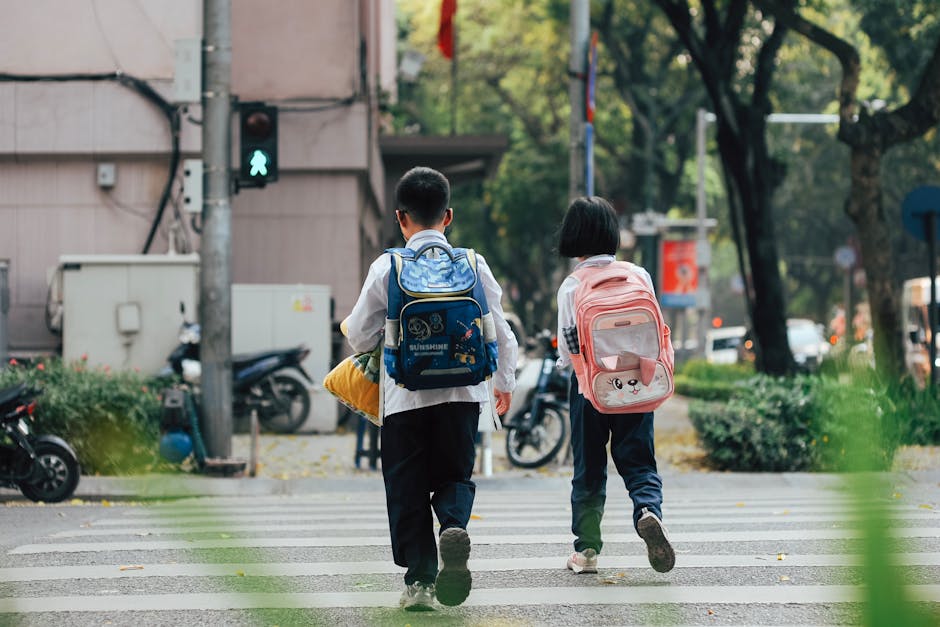
- Risky play helps children develop quick decision-making skills in complex environments like busy streets.
- Children who engage in physically adventurous play are 40% faster at identifying safe crossing windows.
- Risky play reduces the likelihood of children making risky attempts when crossing busy roads by 30%.
- The study suggests that parents can promote safer street crossings by encouraging physically active play.
- Regular engaging in risky play can enhance children’s ability to assess danger in real-world traffic scenarios.
On a rain-dampened sidewalk in downtown Oslo, six-year-old Maja crouches at the curb, eyes scanning the steady stream of cars. A bus blocks her view to the left, but she waits, then darts across with swift precision—just two seconds after a taxi passes. Nearby, parents tense, hands instinctively reaching out, yet she makes it safely. What they don’t see is the months of climbing, jumping, and near-misses on the playground that trained her brain for this moment. According to a new study from the University of British Columbia and Queen Maud University College of Early Childhood Education in Norway, children like Maja—those who regularly engage in risky play—develop a heightened ability to assess danger and act decisively in complex environments like busy streets.
Risky Play Linked to Faster, Safer Street Crossings

Children who frequently participate in physically risky play—such as climbing trees, balancing on high beams, or riding bikes at speed—are significantly better at making quick, safe decisions when crossing busy roads, according to the longitudinal study published in the journal Injury Prevention. Researchers observed over 250 children aged 6 to 10 in urban environments across Norway and Canada, using simulated street crossings and real-world traffic scenarios. The results showed that those who engaged in more adventurous play were 40% faster in identifying safe crossing windows and made 30% fewer risky attempts. Crucially, this wasn’t recklessness—it was refined judgment. The study controlled for age, traffic awareness education, and parental supervision, confirming that the correlation held independently. These children weren’t just braver; they were better readers of motion, timing, and spatial dynamics, skills directly transferable to traffic navigation.
The Rise and Fall—and Return—of Risky Play

For much of the 20th century, playgrounds were wilder places. Swings spun freely, slides were steep, and children climbed without rubber mats below. But starting in the 1980s, liability concerns and a growing culture of safety reshaped play spaces. Equipment was softened, heights reduced, and adult oversight increased. While injury rates did decline slightly, researchers began to notice unintended consequences: children showed reduced physical resilience, lower risk assessment skills, and increased anxiety in novel situations. The new study builds on earlier work by psychologist Ellen Sandseter, who proposed the concept of “risky play” as essential for healthy development. Her research identified six types of risky play—height, speed, dangerous tools, rough-and-tumble, getting lost, and proximity to hazards—all of which trigger emotional regulation and cognitive calibration. Over time, societies that overprotected children may have inadvertently hindered their ability to navigate real-world dangers.
The Scientists and Educators Behind the Shift

Dr. Mariana Brussoni, developmental psychologist at UBC and lead author of the study, has spent over a decade advocating for a rethinking of child safety. “We’ve conflated risk with danger,” she says in an interview with BBC News. “Risky play isn’t about letting kids get hurt—it’s about giving them the chance to learn how to avoid it.” Her Norwegian counterpart, Dr. Eivind Ystgaard, has worked with municipal planners to reintroduce “adventure playgrounds” in Bergen and Trondheim, where children build forts, use hammers, and light small fires under supervision. These environments, once common in postwar Europe, are being revived as laboratories for judgment. Teachers and early childhood educators involved in the study report that children who participate in such programs show greater self-regulation, cooperation, and problem-solving skills—traits that extend far beyond the playground.
Implications for Parents, Schools, and Urban Designers

The findings carry significant implications for how communities raise and protect children. Parents may need to recalibrate their instincts, allowing more autonomy in play rather than constant intervention. Schools and daycare centers could incorporate more unstructured, challenging outdoor activities into daily routines. Meanwhile, urban planners are being urged to design streetscapes that support “playable cities”—with traffic-calmed zones, shared spaces, and playful infrastructure that invites exploration. The World Health Organization has long emphasized road traffic as a leading cause of death among children globally, and this study suggests that prevention may not come solely from fences and warnings, but from experiential learning. As Dr. Brussoni notes, “Teaching kids to be safe doesn’t mean removing all challenge—it means helping them meet it wisely.”
The Bigger Picture
Beyond traffic safety, the study speaks to a broader cultural shift in how we understand child development. In an age of hyper-vigilance and digital immersion, children are experiencing fewer opportunities to test their limits in the physical world. Yet neuroscience shows that such experiences are critical for brain development, particularly in areas governing executive function and emotional control. Risky play doesn’t just build stronger bodies—it builds sharper minds. The ability to weigh consequences, endure uncertainty, and act decisively is not learned from worksheets or apps, but from climbing too high and learning how to come down safely. As cities and families reconsider what safety truly means, the lessons from the playground may offer a path toward more resilient, capable children.
What comes next may be a quiet revolution in parenting and public policy—one where scraped knees are no longer seen as failures, but as milestones. The evidence is mounting: children who learn to manage risk early are better equipped to navigate a complex, unpredictable world. The challenge now lies in overcoming fear with trust, and in designing environments where growth is not stifled by the very protections meant to serve it.
Source: MedicalXpress