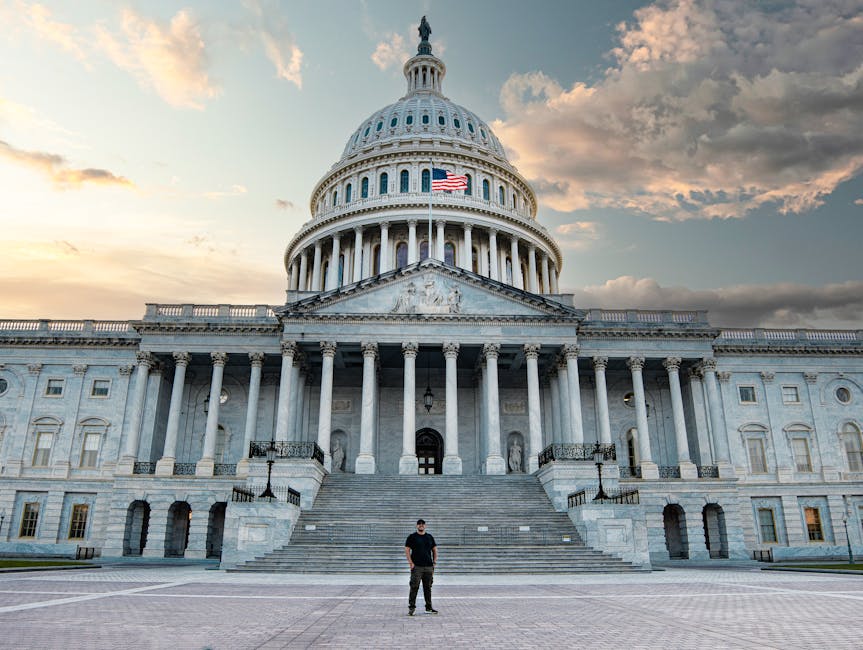
- Barney Frank became the first openly gay member of Congress in 1987, marking a historic moment in LGBTQ rights.
- Frank’s announcement shifted the political landscape, redefining what was possible for LGBTQ individuals in public life.
- Before coming out, Frank had considered the risks to his career but ultimately chose authenticity and courage.
- Frank’s decision was met with a mix of support and backlash, but it altered the perception of gay Americans in leadership.
- Frank’s legacy as a pioneer in LGBTQ rights continues to inspire future generations of leaders.
On a crisp November morning in 1987, amid the marble corridors of the U.S. Capitol, Barney Frank walked into a press conference with a quiet resolve that belied the magnitude of the moment. Reporters gathered, sensing something historic, as the Massachusetts congressman—known for his rapid-fire wit and encyclopedic knowledge of banking law—announced he was gay. There were no grand speeches, no performative drama, just a matter-of-fact declaration: \”I am a gay American.\” In that moment, the political landscape shifted. Frank, already one of the most respected voices in the House, became the first sitting member of Congress to come out voluntarily. His announcement did not end his career, as many feared—it cemented his legacy as a pioneer who redefined what was possible for LGBTQ individuals in public life.
\n
First Openly Gay Member of Congress

\n
Barney Frank’s 1987 coming out was a watershed in American political history. At a time when AIDS was stigmatized, LGBTQ rights were marginal, and few public figures dared to be open about their sexuality, Frank’s decision was both courageous and calculated. He had wrestled with the decision for years, aware that exposure could end his career. But after years of living in the shadows, he chose authenticity. His announcement was met with a mix of support and backlash, but most significantly, it altered the perception of gay Americans in leadership. As the first sitting member of Congress to come out on his own terms, Frank set a precedent that paved the way for future generations. Over the next two decades, he would become one of the most visible and influential advocates for LGBTQ rights, pushing for anti-discrimination measures, marriage equality, and the repeal of \”Don’t Ask, Don’t Tell.\” His visibility helped normalize the presence of openly gay officials in government, transforming a once-taboo identity into a legitimate and respected part of American political life.
\n
The Road to Congress and the Closet

\n
Frank’s journey to Congress was rooted in a working-class upbringing in Bayonne, New Jersey, where he was born in 1940. A scholarship to Harvard led to a PhD in political science, and by 1979, he was elected to represent Massachusetts’ 4th congressional district. In the early years of his tenure, Frank was deeply closeted, even as he rose in prominence for his sharp policy mind and acerbic humor—often voted \”brainiest,\” \”funniest,\” and \”most eloquent\” by his peers. The strain of concealment weighed on him, and the AIDS crisis of the 1980s intensified his sense of responsibility. As friends died and stigma grew, Frank realized that silence was complicity. The decision to come out followed years of internal debate and political risk assessment. He later wrote in his memoir, \”Frank: A Life in Politics from the Great Society to Same-Sex Marriage,\” that staying in the closet was \”incompatible with the kind of public service I wanted to offer.\” His evolution mirrored a broader societal shift, one he helped accelerate through sheer presence and persistence.
\n
Architect of Reform and Voice for the Marginalized

\n
Frank was more than a symbol—he was a legislative force. As chair of the House Financial Services Committee during the 2008 financial crisis, he co-authored the Dodd-Frank Wall Street Reform and Consumer Protection Act, a landmark effort to rein in reckless banking practices. Though the law faced criticism for not going far enough, it stood as one of the most comprehensive financial overhauls since the Great Depression. Beyond economics, Frank championed civil liberties, affordable housing, and immigration reform. His advocacy was deeply personal; having experienced marginalization, he was attuned to the struggles of others. In 2012, he married his longtime partner, James Ready, becoming the first member of Congress to enter a same-sex marriage while in office—a quiet but powerful statement of progress. Colleagues across the aisle acknowledged his intellect and integrity, even when they disagreed with his politics.
\n
Legacy of Visibility and Political Courage

\n
Frank’s legacy extends far beyond legislation. He proved that an openly gay man could not only survive in Washington but thrive—winning re-election repeatedly, wielding influence, and speaking with unvarnished honesty. His life challenged stereotypes and dismantled myths about LGBTQ individuals in leadership. For young queer politicians, activists, and citizens, Frank became a model of authenticity under pressure. According to the LGBTQ Victory Fund, the number of openly LGBTQ elected officials in the U.S. has grown from just a handful in the 1980s to over 1,000 today—a trajectory that traces directly back to pioneers like Frank. His career demonstrated that representation matters, not just symbolically, but structurally, in shaping policy and public perception.
\n
The Bigger Picture
\n
Barney Frank’s life reflects the arc of modern American liberalism—intellectually rigorous, morally grounded, and unafraid of transformation. He entered politics during the tail end of the New Deal era and exited amid a renaissance of LGBTQ rights, having helped steer both. His story is not just about identity, but about integrity—the choice to live openly in a system that often rewards conformity. In a political climate increasingly defined by division and fear, Frank’s example stands as a reminder that courage and competence are not mutually exclusive.
\n
As tributes pour in from across the political spectrum, one truth remains clear: Barney Frank changed what it means to be an American politician. His death marks the end of an era, but the doors he opened remain wide. The path forward for LGBTQ leaders in government is still fraught, but it is no longer unimaginable—and that, perhaps, is his most enduring contribution.
Source: The New York Times