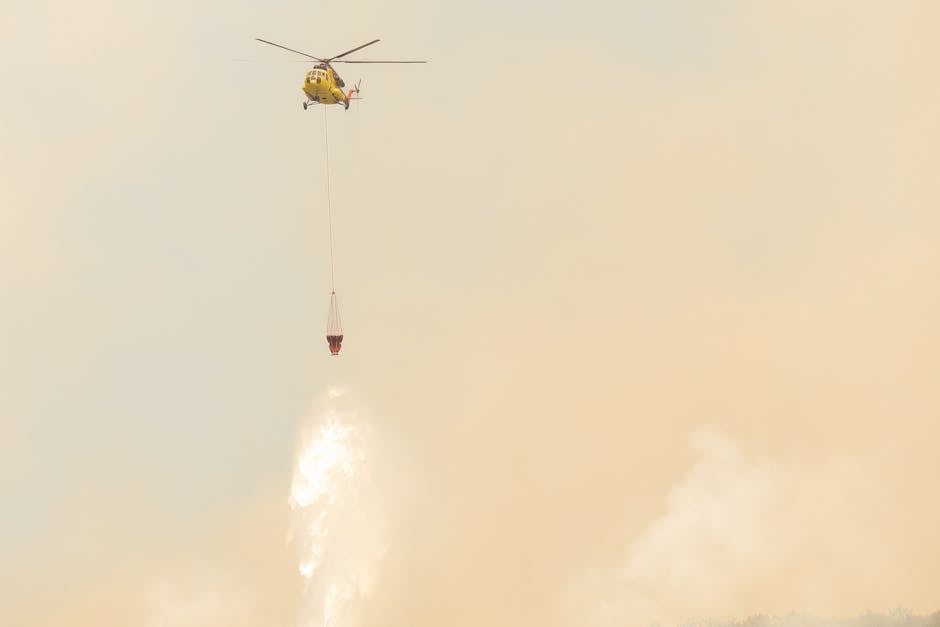
- A fast-moving wildfire erupted in Simi Valley, threatening dozens of hillside homes and forcing emergency evacuations across a 500-acre perimeter.
- Multiple air units, including S-70 Black Hawk helicopters, conducted repeated drops to slow the fire’s advance, carrying 1,000 gallons of water.
- Ground crews, numbering over 200 firefighters, worked in tandem with aerial teams to establish containment lines along steep terrain.
- The blaze, unofficially named the Ridge Fire, began near the intersection of Kuehner Road and Santa Susana Expressway and spread rapidly.
- High temperatures, low humidity, and gusty Santa Ana winds contributed to the rapid spread of the wildfire.
At dawn, the ridgeline above Simi Valley glowed an eerie amber, smoke coiling into the sky like twisted rope. Below, helicopters thumped through the haze, their bellies releasing torrents of water that shattered against the scorched earth. On the ground, flames licked at the edges of suburban cul-de-sacs, consuming dry brush and sending embers floating toward rooftops. Residents stood in driveways, watching in stunned silence as pilots made pinpoint drops just yards from homes painted in fire-retardant foam. The air tasted of ash and pine resin, and the distant wail of sirens echoed through the canyons. This was not the first fire season to test this community — but each one feels closer, hotter, more desperate than the last.
Fire Escalates in Southern California Hills

A fast-moving wildfire erupted in Simi Valley on Tuesday morning, threatening dozens of hillside homes and forcing emergency evacuations across a 500-acre perimeter. Cal Fire confirmed that multiple air units, including S-70 Black Hawk helicopters and large rotorcraft capable of carrying 1,000 gallons of water, conducted repeated drops to slow the fire’s advance. Ground crews, numbering over 200 firefighters, worked in tandem with aerial teams to establish containment lines along steep terrain. The blaze, unofficially named the Ridge Fire, began near the intersection of Kuehner Road and Santa Susana Expressway and spread rapidly due to high temperatures, low humidity, and gusty Santa Ana winds. No fatalities have been reported, but at least 12 structures sustained damage, and more than 300 homes remained under evacuation warnings as of Wednesday morning.
The Legacy of Fire in Southern California

Wildfires are not new to Simi Valley, nestled in the transition zone between the urban sprawl of Los Angeles and the rugged backcountry of Ventura County. For decades, development has crept into the wildland-urban interface, where homes meet flammable chaparral. A 1994 fire burned over 17,000 acres in the same region, destroying 83 homes and reshaping local fire policy. Since then, brush clearance mandates and defensible space requirements have been strengthened, yet climate change has intensified the risk. According to a 2023 report by The New York Times, the annual burn area in California has more than doubled since the 1970s, with fires growing faster and more unpredictable. Simi Valley’s geography — ringed by canyons and prone to wind inversions — makes it especially vulnerable to rapid fire spread.
The People on the Front Lines

The response is led by Cal Fire Incident Commander Maria Lopez, who has overseen wildfire operations across Southern California for nearly two decades. “This fire moved with shocking speed,” she said in a press briefing, citing wind gusts exceeding 40 mph that pushed flames uphill at nearly one acre per minute. Her team coordinates with local law enforcement, emergency medical services, and volunteer groups like the Community Emergency Response Team (CERT) to evacuate residents and protect infrastructure. Among the pilots is Captain James Tran, a former U.S. Army aviator now flying aerial suppression missions. “You’re not just dropping water — you’re buying time for ground crews to get in position,” he explained in a Reuters interview. For residents, the trauma is both immediate and cumulative; many recall past fires and wonder how many more seasons they can endure.
Immediate and Long-Term Consequences

The immediate impact of the Ridge Fire includes disrupted lives, air quality hazards, and strain on emergency resources. Schools in the area closed temporarily, and the South Coast Air Quality Management District issued a health advisory for particulate pollution. Insurance claims are expected to rise, particularly for homes just outside formal evacuation zones. Long-term, the fire raises questions about land-use planning and climate adaptation. As development continues in fire-prone areas, experts warn that suppression alone cannot keep pace. “We’re fighting a symptom,” said Dr. Lila Chen, a wildfire ecologist at UC Davis. “Until we address fuel buildup, housing density, and climate resilience, we’ll keep seeing these near-misses turn into disasters.”
The Bigger Picture
This fire is not an isolated incident but part of a broader pattern reshaping the American West. Across California, Arizona, and Oregon, wildfires now burn hotter and longer, fueled by prolonged drought and rising temperatures. Federal and state agencies are reevaluating strategies, from prescribed burns to forest thinning, but implementation lags behind the pace of change. The Simi Valley incident underscores a growing reality: in an era of climate-driven disasters, even well-prepared communities are just one spark away from crisis. The helicopters may have slowed the flames this time, but they cannot stop the underlying forces at work.
As the smoke clears and residents return to assess the damage, officials are already preparing for the next fire. Cal Fire has extended its staffing through September, and weather models predict continued dry conditions. The question is no longer if another blaze will come, but when — and whether the systems in place will be enough to meet it. For now, the helicopters rest on their pads, refueled and ready, their pilots watching the horizon for the next plume of smoke.
Source: Al Jazeera