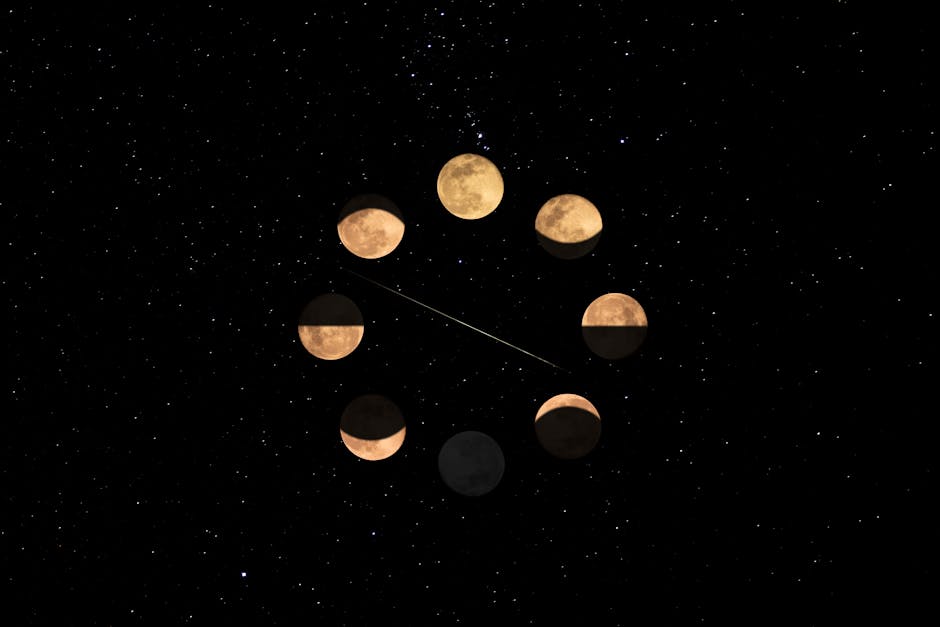
- A crescent moon is visible in the western sky after sunset this week, near the bright planets Venus and Jupiter.
- The moon is in its 2.4-day phase, with only 6.2% illumination, making it a young crescent.
- The alignment is a conjunction, where the moon appears close to Venus and Jupiter in the sky, despite being millions of kilometers apart.
- This event is visible from urban areas and is a great opportunity for casual stargazers and astronomers to observe the moon’s journey.
- The alignment will be visible for several evenings, starting around May 18, offering a chance to witness the moon’s orbital mechanics.
What are skywatchers seeing in the western sky just after sunset this week? A delicate crescent moon, barely illuminated, is gliding past two of the brightest planets in our solar system—Venus and Jupiter—offering a stunning visual reminder of the dynamic motion within our solar system. For several evenings starting around May 18, observers across much of the globe will be treated to a celestial dance that reveals not just beauty, but the precise orbital mechanics governing Earth and its planetary neighbors. As twilight fades, a slim arc of light—the moon just 2.4 days old—will appear low in the west, inching closer to Venus first and then drawing near Jupiter in the following nights. This fleeting alignment, visible even from urban areas, invites both casual stargazers and seasoned astronomers to witness the moon’s swift journey around Earth.
What Is Happening in the Night Sky?

The phenomenon unfolding this week is a conjunction series involving the moon, Venus, and Jupiter—all visible in the western sky shortly after sunset. A conjunction occurs when two or more celestial bodies appear close together in the sky from Earth’s perspective, though they may be millions of kilometers apart in space. On May 18, the moon will be just 6.2% illuminated, marking it as a young crescent in its 2.4-day phase. It will sit near Venus, the brightest planet in the night sky, which shines at a dazzling magnitude of -4.0. Over the next 24 to 48 hours, the moon’s orbital motion—moving eastward at roughly 12 degrees per day—will carry it past Venus and toward Jupiter, which will appear slightly higher and farther east. By May 19 or 20, depending on location, the crescent will hover near Jupiter, creating a second photogenic pairing. These events are predictable and rooted in orbital mechanics, but their visual impact remains awe-inspiring for skywatchers.
What Evidence Supports This Celestial Alignment?

Astronomers have long tracked such alignments using precise ephemeris data, which calculates the positions of celestial bodies over time. According to data from NASA’s Jet Propulsion Laboratory Horizons system, the moon’s position relative to Venus on May 18 at 22:00 UTC places them within 3 to 4 degrees of each other—an angular distance about the width of your three middle fingers held at arm’s length. Venus, often called the ‘evening star,’ currently dominates the twilight sky due to its proximity to Earth and highly reflective cloud cover. Jupiter, though farther away, remains prominent at magnitude -2.0. Sky charts from observatories like the Royal Observatory Greenwich confirm the sequence, noting that the moon-Venus conjunction is best viewed from mid-northern latitudes, including Europe and North America. These predictions are backed by centuries of observational astronomy and modern satellite tracking, making such events among the most reliably forecast natural phenomena.
Are There Alternative Interpretations or Challenges to Observing?

While the alignment is scientifically uncontested, actual visibility can vary significantly based on location, weather, and atmospheric conditions. From equatorial or far southern latitudes, the trio may appear lower on the horizon or set too quickly after sunset to be clearly seen. Light pollution in cities can also wash out the thin crescent, especially on the first night when only 6.2% of the moon’s surface is illuminated. Some amateur astronomers note that binoculars may be needed to spot the moon against the bright twilight, particularly for those hoping to catch the elusive ‘earthshine’—the faint glow on the moon’s dark side caused by sunlight reflected from Earth. Additionally, cultural or astrological interpretations sometimes attribute symbolic meaning to such alignments, though these lack scientific basis. Astronomers emphasize that while the visual spectacle may inspire wonder, the event is a routine result of orbital dynamics, not a harbinger of change.
What Are the Real-World Implications of This Event?

Beyond its aesthetic appeal, this celestial event offers a tangible way for the public to engage with astronomy. Schools and planetariums often use such conjunctions to teach orbital motion, phases of the moon, and planetary positions. For instance, tracking the moon’s movement night after night demonstrates its 27.3-day orbit around Earth, while the fixed positions of Venus and Jupiter relative to the stars highlight their slower orbital periods—225 and 4,333 Earth days, respectively. In some cultures, the first sighting of the crescent moon marks the beginning of lunar months, such as in the Islamic calendar, making these observations both scientific and culturally significant. Apps and sky-mapping tools like Stellarium or SkySafari have made it easier than ever for people to locate the moon and planets, turning casual glances into learning opportunities.
What This Means For You
If you’re looking up at the western sky just after sunset this week, you’re not just seeing pretty lights—you’re witnessing the solar system in motion. The moon’s swift passage near Venus and Jupiter offers a rare, real-time glimpse of celestial mechanics most people only read about. No special equipment is needed; just a clear horizon and a few minutes of attention. This event reminds us that Earth is part of a dynamic, interconnected system governed by gravity and predictable laws. Whether you’re photographing the scene or simply pausing to look, the experience fosters a deeper connection to the cosmos.
What other planetary alignments might become visible in the coming months as Earth continues its orbit? With Mars and Saturn rising earlier in the night, and Mercury making brief appearances, the stage is set for more skywatching opportunities—each one a chance to observe the silent, elegant choreography of our solar neighborhood.
Source: The Guardian