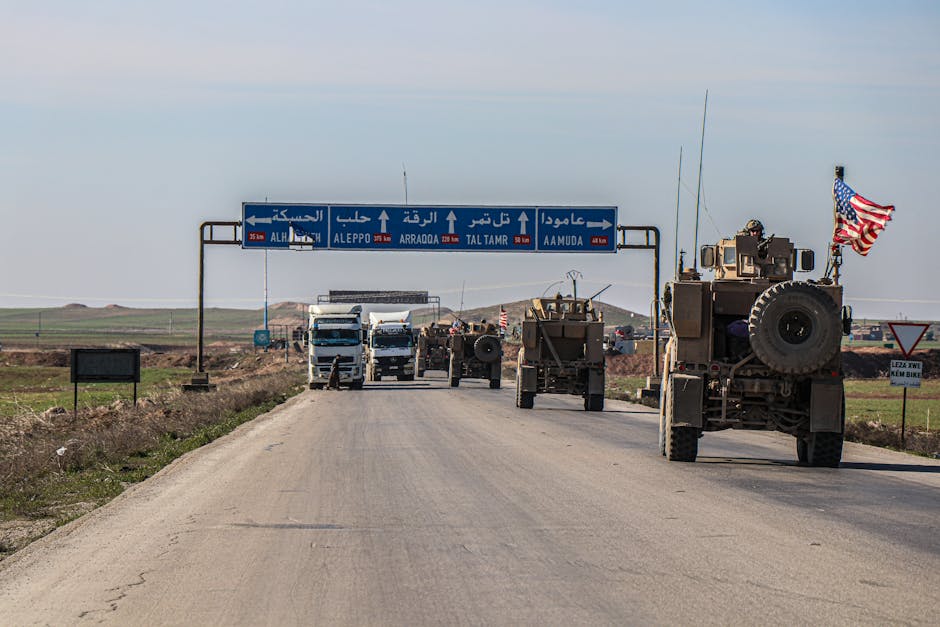
- The US has urged the UAE to prepare for potential military action against Iran to seize control of Abu Musa island.
- Abu Musa is a strategically significant island in the Persian Gulf, critical for shipping lanes and oil infrastructure.
- The US is shifting its Middle East strategy from direct military engagement to empowering regional allies to challenge Iranian dominance.
- This move aims to reconfigure Gulf security architecture and reduce US military involvement in the region.
- The US is prioritizing strategic competition with China, leading to reduced military presence in West Asia and increased reliance on allies.
The United States has formally urged the United Arab Emirates to prepare for the potential seizure of Abu Musa, a strategically significant island currently under Iranian control in the eastern Persian Gulf. According to senior defense officials briefed on the matter, the directive — delivered through backchannel diplomatic and military talks — marks a rare instance of one sovereign nation being directly encouraged by a superpower to take military action against another. Abu Musa, located near critical shipping lanes and oil infrastructure, sits astride the Strait of Hormuz, through which nearly 20% of the world’s oil passes daily. This unprecedented push underscores a broader U.S. strategy to reconfigure Gulf security architecture by empowering regional allies to challenge Iranian dominance, even at the risk of triggering wider conflict.
Strategic Shift in Gulf Alliances

The U.S. push signals a transformation in regional security doctrine, moving from direct military engagement to a proxy-empowerment model. For decades, American strategy in the Middle East relied on forward-deployed forces and direct intervention to deter Iranian aggression. But with Washington prioritizing strategic competition with China and reducing its military footprint in West Asia, it has increasingly looked to allies like the UAE to assume greater security responsibilities. The Abraham Accords of 2020, which normalized UAE-Israel relations, laid the diplomatic groundwork for this shift. Now, with Iran intensifying its regional influence through proxies in Yemen, Lebanon, and Iraq, and advancing its nuclear program, U.S. officials view the UAE as a capable and motivated partner to counterbalance Tehran. The targeting of Abu Musa is not merely about territorial control — it is a calculated effort to disrupt Iran’s maritime surveillance and missile launch capabilities in a chokepoint vital to global energy markets.
The Stakes of Abu Musa

Abu Musa, along with the nearby Greater and Lesser Tunbs, has been administered by Iran since 1971, despite longstanding Emirati claims. The island is currently home to Iranian military installations, including radar systems and missile batteries, which give Tehran the ability to monitor and threaten commercial and military vessels entering the Strait of Hormuz. The UAE has historically pursued diplomatic solutions to reclaim the islands, but frustration has grown in Abu Dhabi over what it sees as Iranian intransigence and U.S. inaction. According to a Gulf-based defense analyst speaking on condition of anonymity, American officials have now presented the UAE with detailed intelligence assessments and operational options for a potential amphibious or aerial operation to retake the island. While no formal go-ahead has been given, the discussions indicate a significant hardening of Washington’s stance toward Iran, particularly as Tehran continues to supply drones and missiles to Russian forces in Ukraine.
Escalation Risks and Military Calculations

The prospect of a UAE-led assault on Iranian-held territory raises the risk of a direct military confrontation between Iran and a U.S. partner — a scenario that could rapidly spiral into broader conflict. Iran’s Islamic Revolutionary Guard Corps (IRGC) has long viewed the Persian Gulf as its domain and has repeatedly threatened to close the Strait of Hormuz in response to perceived threats. A 2023 report by the Center for Strategic and International Studies noted that Iran has invested heavily in asymmetric naval warfare, including fast attack craft, submarines, and anti-ship missiles, all designed to counter superior naval forces. If the UAE moves against Abu Musa, Iran could respond with attacks on Emirati ports, oil infrastructure, or even U.S. bases in the region. Moreover, such an action could fracture the fragile unity among Gulf Cooperation Council states, with Oman and Kuwait likely to oppose any use of force, fearing economic and security fallout.
Geopolitical and Economic Fallout

A military operation to seize Abu Musa would have far-reaching implications beyond the immediate battlefield. Global oil markets, already sensitive to supply disruptions, could face sharp volatility. Shipping firms might reroute vessels, increasing costs and delivery times. The United Nations and international legal bodies would likely condemn any unilateral seizure of territory, challenging the UAE’s compliance with the UN Charter. Domestically, Emirati leaders would face pressure to justify such a high-stakes move to their population and foreign investors. Meanwhile, China — a major buyer of Iranian oil and a growing security partner in the Gulf — could exploit the crisis to position itself as a neutral mediator, further eroding U.S. influence. The Biden administration, despite distancing itself publicly from the Trump-era policy, has not disavowed the strategic planning, suggesting continuity in America’s long-term vision for Gulf security.
Expert Perspectives
Experts are divided on the wisdom of encouraging UAE action. Some, like Dr. Kristian Coates Ulrichsen of Rice University, warn that “empowering regional allies to take offensive action risks miscalculation and undermines diplomatic norms.” Others, such as defense analyst Bryan Clark of the Hudson Institute, argue that “the U.S. can no longer afford to police the Gulf alone and must enable capable partners to defend shared interests.” The debate reflects a deeper tension in American foreign policy: how to maintain influence without bearing the full burden of military engagement.
Looking ahead, the world will watch whether the UAE moves from planning to action — and how Iran responds. With U.S. midterm elections and regional stability hanging in the balance, the fate of a small island could reshape the geopolitics of the 21st-century Gulf.
Source: Telegraph