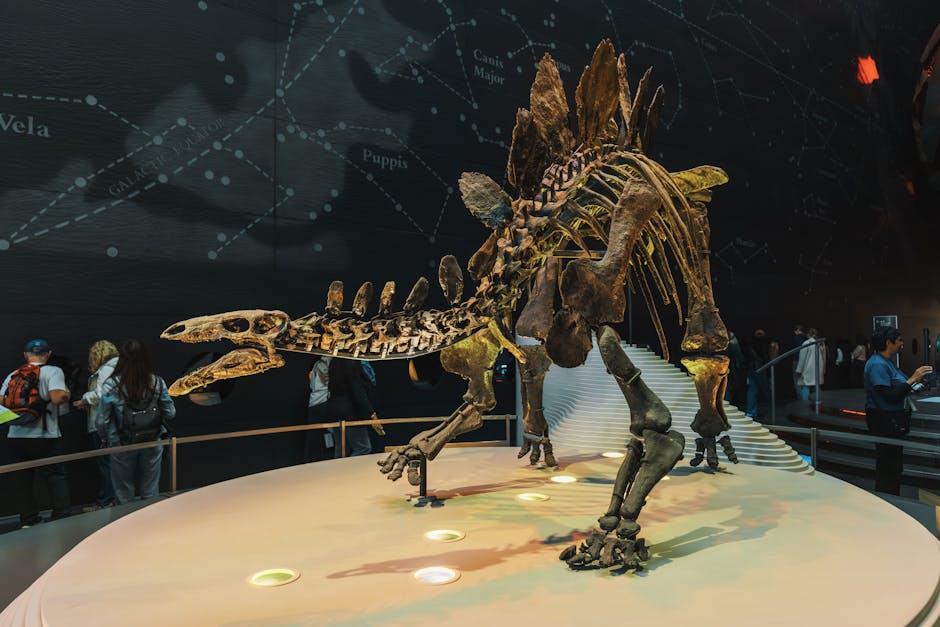
- A nearly complete stegosaur skull has been discovered in Spain’s Villar del Arzobispo Formation, offering a unique glimpse into the creature’s anatomy.
- The fossil, dated to the Late Jurassic period, is the most complete stegosaur skull ever found in Europe.
- The skull’s preservation is exceptional, with teeth, braincase, and inner ear components still intact.
- High-resolution CT scanning has revealed new details about the stegosaur’s sensory capabilities.
- This discovery marks a significant turning point in dinosaur paleontology, filling long-standing gaps in our understanding of these prehistoric creatures.
In the arid badlands of central Spain, beneath a thin crust of sun-cracked soil and scattered limestone, lies a window into a world long vanished. Here, where dry winds sweep across ancient floodplains turned to stone, paleontologists recently unearthed a fossil of staggering significance: the most complete stegosaur skull ever discovered in Europe. Encased in fine-grained sediment dating to the Late Jurassic, the fossil belongs to Dacentrurus armatus, a heavily armored herbivore known for its rows of bony plates and spiked tail. Unlike most stegosaur remains—where skulls are often crushed or missing—this specimen emerged with its delicate cranial structure nearly intact, offering a rare glimpse into the head of a creature that once roamed Earth 150 million years ago. The discovery marks a turning point in dinosaur paleontology, providing scientists with anatomical details long thought lost to time.
The Most Complete Stegosaur Skull in Europe

The fossil was discovered in the Villar del Arzobispo Formation near the town of Riodeva, a region already renowned for its rich Jurassic deposits. What sets this find apart is the skull’s extraordinary preservation: teeth, braincase, and even parts of the inner ear remain in situ, allowing researchers to examine features previously inaccessible in stegosaur specimens. Using high-resolution CT scanning, the team reconstructed the skull’s internal architecture, revealing previously unknown aspects of its sensory capabilities and feeding mechanics. The skull’s proportions suggest Dacentrurus had a more flexible jaw motion than previously assumed, possibly enabling it to process tougher vegetation. This level of cranial detail is exceptionally rare—due to their thin, fragile bones, stegosaur skulls rarely fossilize completely. According to the study published in Nature, this specimen represents the best-preserved European stegosaur skull to date, offering a benchmark for future comparative analyses.
How We Got Here: The Fossil Record Gap

For over a century, stegosaurs have fascinated both scientists and the public, yet their evolutionary history has remained frustratingly incomplete. While body fossils—especially their distinctive back plates and spiked tails—are relatively common, skulls are exceedingly rare. Most known stegosaur cranial material comes from North America and Asia, with European specimens largely fragmentary. Dacentrurus armatus, first described in 1875, was long known only from postcranial remains, leaving its head shape, brain size, and feeding behavior to speculation. The scarcity of well-preserved skulls has hindered efforts to understand how stegosaurs diversified across continents and adapted to different environments. This discovery fills a critical gap, not only confirming the presence of advanced stegosaur anatomy in Europe but also suggesting that the group was more evolutionarily diverse than previously recognized during the Late Jurassic.
The People Behind the Discovery

The excavation was led by a multidisciplinary team from the Museo Municipal de Ciencias Naturales in Valencia and the Universidad Nacional de Educación a Distancia (UNED), supported by local volunteers and fossil preparators. Dr. Susana Galera, lead paleontologist on the project, described the moment of uncovering the skull as “almost surreal—we knew we had something special, but not this complete.” The team spent over 18 months carefully extracting the fossil using micro-pneumatic tools and consolidating fragile bone elements with specialized resins. Their meticulous approach was driven by a commitment to preserving every anatomical nuance, knowing that such a specimen might not be found again in a generation. Their work exemplifies a growing trend in paleontology: patient, detail-oriented field science that prioritizes context and preservation over speed.
Consequences for Dinosaur Evolutionary Studies

This discovery has immediate implications for how scientists reconstruct stegosaur phylogeny and biology. The skull’s morphology suggests Dacentrurus may occupy a more basal position in the stegosaur family tree than previously thought, challenging existing models of armored dinosaur evolution. Additionally, the preserved inner ear structure provides clues about the animal’s balance and head posture, indicating it likely held its head lower than some reconstructions have shown. These insights affect how museums display stegosaurs and how researchers model their locomotion and behavior. For evolutionary biologists, the fossil offers a rare calibration point for molecular and morphological clocks, helping refine timelines for dinosaur diversification during the Jurassic period.
The Bigger Picture
Beyond its anatomical revelations, this fossil underscores the importance of continued field exploration in under-studied regions. Europe’s Jurassic record has often been overshadowed by the rich deposits of North America, yet discoveries like this prove its paleontological value. As climate change accelerates erosion in sedimentary basins, previously hidden fossils are being exposed—offering both opportunity and urgency for scientific discovery. Each well-preserved specimen like this stegosaur skull doesn’t just fill a gap in the fossil record; it reshapes the narrative of life on Earth, reminding us how much remains to be uncovered.
What comes next is a deeper analysis of the skull’s microstructure and isotopic composition, which could reveal details about the animal’s diet, growth rate, and even migration patterns. The fossil will also be digitized and made available to the global scientific community, fostering collaboration and further study. As new technologies and excavation techniques emerge, discoveries like this one will continue to challenge and refine our understanding of prehistoric life—proving that even in the 21st century, dinosaurs still have secrets to share.
Source: ScienceDaily