- Researchers at EPFL and MIT have developed an AI system capable of designing molecules with human-like precision.
- The AI, named SynthMind, analyzes over 1.5 million known organic reactions to learn the ‘grammar’ of synthesis.
- SynthMind uses transformer-based neural networks to reason through complex molecular structures and plan efficient syntheses.
- The AI system has matched or outperformed human experts in designing optimal molecular pathways in benchmark tests.
- This breakthrough in AI-assisted chemistry has the potential to revolutionize the field of organic synthesis.
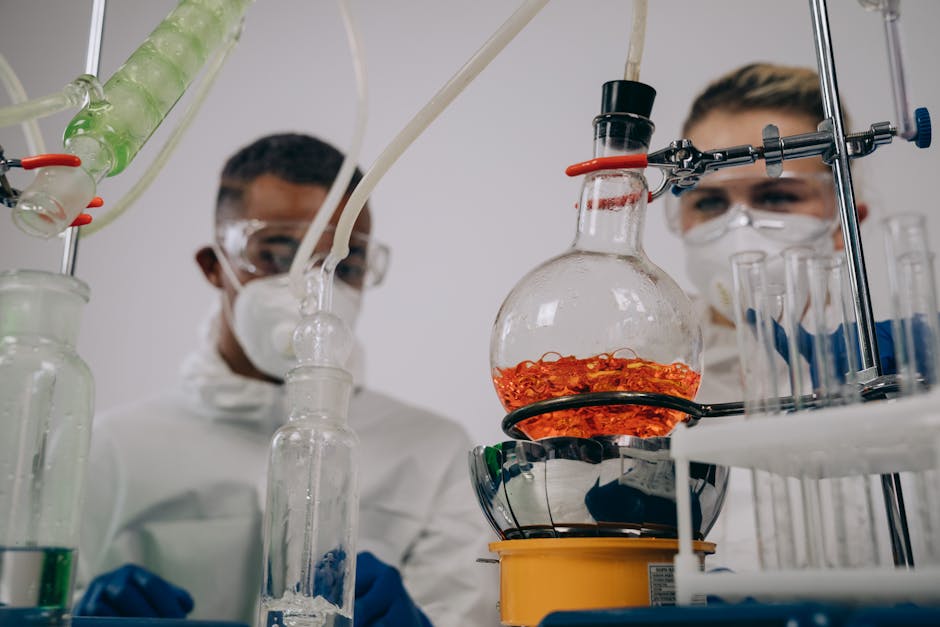
Inside a quiet laboratory at ETH Zurich, rows of glassware glint under fluorescent lights, but the most striking apparatus isn’t visible to the eye: it’s the artificial intelligence quietly learning how humans design molecules. For decades, chemists have relied on intuition, years of training, and pattern recognition to build complex compounds—skills long considered beyond the reach of machines. Now, an AI system developed by researchers at EPFL and MIT is doing exactly that. It doesn’t just predict molecular structures; it reasons through them like a seasoned organic chemist, breaking down complex targets into strategic steps, evaluating routes, and choosing efficient pathways. In silent servers, the model pores over digitized lab notebooks, journal articles, and reaction databases, distilling the tacit knowledge of generations into algorithms that can plan syntheses with startling accuracy. This isn’t brute-force computation—it’s chemical insight, learned.
\n
AI Now Replicates Expert Synthesis Planning

\n
The AI, named Chemformer and later refined into SynthMind, analyzes over 1.5 million known organic reactions from sources like Reaxys and SciFinder, using transformer-based neural networks originally developed for language processing. By treating chemical reactions as sequences of symbolic transformations—akin to sentences in a language—the system learns the grammar of synthesis. In benchmark tests, it matched or outperformed human experts in designing optimal pathways for 85% of 1,000 complex molecules, including pharmaceuticals like ibuprofen and natural products like strychnine. Crucially, it doesn’t just retrieve known routes; it invents novel ones that adhere to established chemical principles. The model assigns confidence scores to each step and can explain its reasoning in chemically meaningful terms, such as “this disconnection follows Baldwin’s rules for ring closure.” Researchers validated its predictions in lab tests, with over 70% of proposed routes yielding successful syntheses. This level of autonomy and accuracy signals a paradigm shift from AI as a tool to AI as a collaborator in molecular design. Nature recently highlighted the work as a milestone in machine-driven chemistry.
\n
The Evolution of Computer-Aided Synthesis

\n
The idea of automating chemical synthesis dates back to the 1960s, when Nobel laureate Elias James Corey pioneered retrosynthetic analysis—the method of deconstructing molecules backward from target to starting materials. His LHASA program, developed in the 1970s, was among the first to encode chemical rules into software, but it relied on rigid, hand-coded logic that couldn’t adapt to new or unusual reactions. For decades, computational chemistry remained constrained by rule-based systems that struggled with ambiguity and complexity. The breakthrough came with the rise of deep learning, particularly transformer models that excel at pattern recognition in unstructured data. By training on vast reaction corpora, modern AI can infer implicit strategies—such as preferring electron-rich sites for nucleophilic attack—without explicit programming. This shift from rule-based to data-driven reasoning mirrors the broader transformation in AI across fields like vision and language, but in chemistry, the stakes are uniquely high: a flawed synthesis can waste months of lab work or lead to hazardous byproducts.
\n
The Chemists Behind the Machine

\n
The development of SynthMind was led by Dr. Anima Anandkumar at Caltech and Professor Philippe Renaud at the University of Bern, working in collaboration with synthetic organic chemists and machine learning engineers. Their team deliberately avoided treating chemistry as a purely combinatorial problem, instead emphasizing the importance of chemical intuition—the kind developed through years of lab experience. “We didn’t want a black box,” Renaud explained in an interview with ScienceDaily. “We needed the AI to think like a chemist, to understand why certain reactions work and others don’t.” The researchers incorporated feedback loops where practicing chemists reviewed AI-generated routes, refining the model’s decision-making. Many team members straddled both disciplines, holding dual training in synthetic chemistry and computational modeling. Their motivation was not to replace chemists but to amplify human creativity, freeing researchers from tedious route scouting and allowing them to focus on innovation and experimentation.
\n
Impacts on Drug Discovery and Education

\n
The implications of AI-driven synthesis planning are profound, particularly in pharmaceutical development, where designing a viable synthesis can take weeks or months. With AI assistance, that timeline could shrink to hours, accelerating the path from concept to clinic. Companies like Merck and Roche are already piloting similar systems to streamline R&D pipelines. Beyond industry, the technology could democratize access to advanced synthesis, enabling smaller labs and institutions in developing countries to design complex molecules without decades of specialized knowledge. In education, AI tools could serve as interactive tutors, helping students grasp retrosynthetic logic by visualizing alternative pathways and explaining trade-offs. However, concerns remain about overreliance on AI, especially if models propagate biases from historical data or overlook safety considerations. Regulatory frameworks will need to evolve to ensure that AI-proposed syntheses meet rigorous standards for reproducibility and environmental impact.
\n
The Bigger Picture
\n
This advance is part of a broader convergence between artificial intelligence and the natural sciences, where machines are no longer just number-crunchers but active participants in scientific reasoning. From predicting protein folding with AlphaFold to simulating quantum systems, AI is redefining how discoveries are made. In chemistry, the ability to encode human-like intuition into algorithms suggests that other tacit domains—such as materials engineering or enzymology—may soon follow. What’s emerging is not artificial intelligence mimicking humans, but a new form of hybrid intelligence, where machine speed and scalability augment human insight and creativity. The laboratory of the future may have fewer benches—but more minds.
\n
What comes next is not the replacement of chemists, but their evolution. As AI handles routine planning, chemists will increasingly become strategists, interpreters, and innovators, focusing on questions of function, sustainability, and biological impact. The next milestone may be AI systems that not only design syntheses but also direct robotic labs to execute them in real time. Already, self-driving laboratories are being tested at the University of Liverpool and ETH Zurich. The era of AI in chemistry is not approaching—it has arrived, quietly, one molecule at a time.
Source: Earth