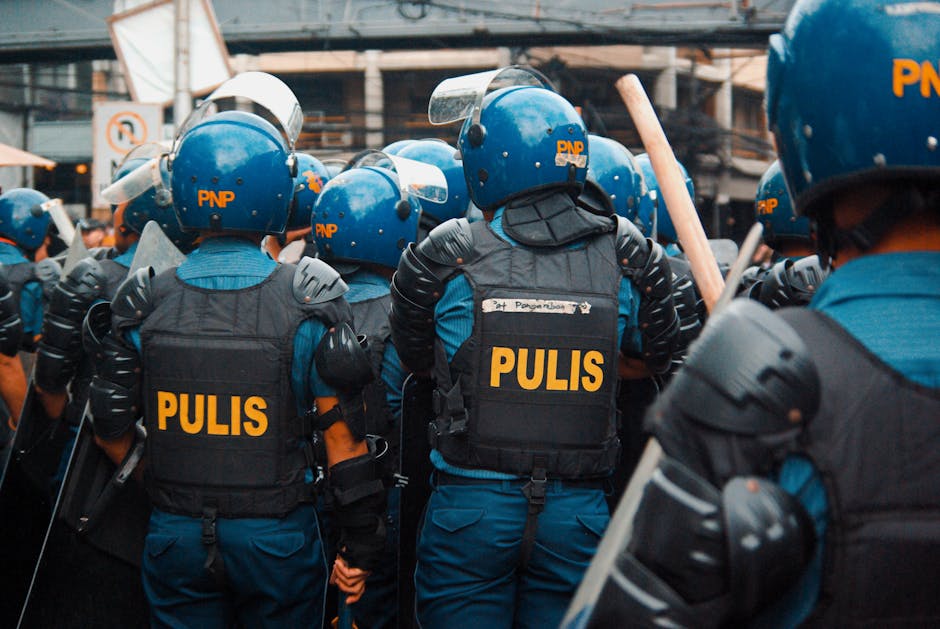
- A peaceful Nakba rally in Berlin turned violent when police confronted thousands of demonstrators with pepper spray and batons.
- The police claimed the rally violated public order regulations, despite organizers describing it as a peaceful assembly.
- Eyewitness accounts contradict the police’s claim of intelligence about potential violence, suggesting the situation escalated unnecessarily.
- At least 150 people were injured in the chaos, including journalists and medics who were pushed aside by police.
- The incident has sparked widespread criticism of the German police’s handling of the situation and their treatment of peaceful protesters.
Smoke curled from shattered glass near Potsdamer Platz as dusk settled over Berlin, casting long shadows across blood-streaked pavement. The air was thick with the acrid sting of pepper spray and the muffled cries of injured demonstrators. What had begun as a solemn march to commemorate the 78th anniversary of the Nakba—the mass displacement of Palestinians in 1948—descended into chaos as riot police in black helmets advanced in formation, batons drawn, pushing through crowds with shields locked. Journalists with press badges raised above their heads were shoved aside, while medics in fluorescent vests struggled to reach those crumpled on the ground. Amid the din, a young woman in a keffiyeh clutched her ribs and whispered, “We came for memory, not war.”
Violence Erupts at Peaceful Commemoration

On May 15, 2025, what organizers described as a peaceful assembly turned volatile when German police moved to disperse thousands gathered near Berlin’s central government district. According to reports from Reuters, officers deployed pepper spray and physical force against demonstrators who allegedly failed to disperse after an official ban on the march was enforced. The Berlin police department claimed the protest violated public order regulations, citing intelligence about potential violence. Yet eyewitness accounts and video footage widely circulated on social media show marchers chanting in unison, carrying Palestinian flags and photos of refugee camps, before being charged without clear warning. Over 150 people were injured, including 12 police officers, and at least 47 arrests were made. Human rights observers have since called for an independent investigation into the proportionality of police tactics.
Roots of the Nakba and Its Global Resonance

The term Nakba, Arabic for “catastrophe,” refers to the displacement of approximately 700,000 Palestinians during the 1948 Arab-Israeli war, a trauma that reverberates through generations. Each year on May 15, communities across the Middle East and in diasporas worldwide commemorate the event with rallies, educational events, and cultural remembrance. In Germany, where public discourse around Palestine is tightly bound to national reckoning with the Holocaust, such gatherings have long been politically sensitive. Since the outbreak of the Israel-Hamas war in October 2023, pro-Palestinian activism has intensified, often met with heightened surveillance and restrictions. Critics argue that authorities conflate legitimate criticism of Israeli policies with antisemitism, a charge the German government has repeatedly used to justify limiting certain expressions at public events. This tension reached a flashpoint in 2024 when a federal resolution declared the Boycott, Divestment, Sanctions (BDS) movement inherently antisemitic, setting a precedent for suppressing related demonstrations.
Voices from the Front Lines

The rally brought together a diverse coalition: Palestinian students, German anti-racism activists, Jewish voices critical of Israeli policy, and refugee advocates. Organizers from groups such as “Palestine Speaks” and “Berlin for Gaza” emphasized their commitment to nonviolence and historical remembrance. Yet their presence has drawn scrutiny from both state institutions and segments of the public. One organizer, a Berlin-based sociologist who requested anonymity due to fear of reprisal, stated, “We are not denying history—we are insisting it be seen in full. The fear of antisemitism is real, but weaponizing it to silence solidarity is its own form of violence.” Meanwhile, police unions defended officers’ actions, claiming they faced projectile attacks and threats. However, independent footage reviewed by BBC News shows no credible evidence of widespread aggression from the crowd prior to the police advance.
Consequences for Civil Liberties

The crackdown has ignited a fierce debate over the boundaries of free expression in Germany. Legal experts warn that preemptive bans on politically sensitive gatherings risk eroding constitutional protections for assembly and speech. The German constitution, or Grundgesetz, guarantees the right to protest, yet exceptions are frequently invoked in the name of public safety. Civil society groups, including Amnesty International Germany, have condemned the use of force as disproportionate and discriminatory, noting that other large demonstrations have been permitted with minimal intervention. The incident may also deepen mistrust among Muslim and migrant communities, who already report feeling targeted by surveillance programs. With municipal elections approaching in several German states, the political fallout could influence policies on both security and integration.
The Bigger Picture
This confrontation in Berlin is not isolated—it reflects a global pattern in which states respond to dissent over Palestine with escalating repression. From London to New York, governments have struggled to balance free speech with geopolitical sensitivities, often at the expense of marginalized voices. The Nakba is not merely a historical event but a living reality for millions of displaced people. When remembrance is met with riot gear, it signals a failure not just of policing, but of historical empathy. Democracies are tested not in moments of consensus, but in how they protect the right to mourn, resist, and remember.
As investigations unfold and injured demonstrators recover, the question lingers: Can Germany honor its commitment to human rights while confronting the complexities of modern solidarity? The answer may shape not only the future of protest in Berlin, but the soul of European democracy itself.
Source: Al Jazeera