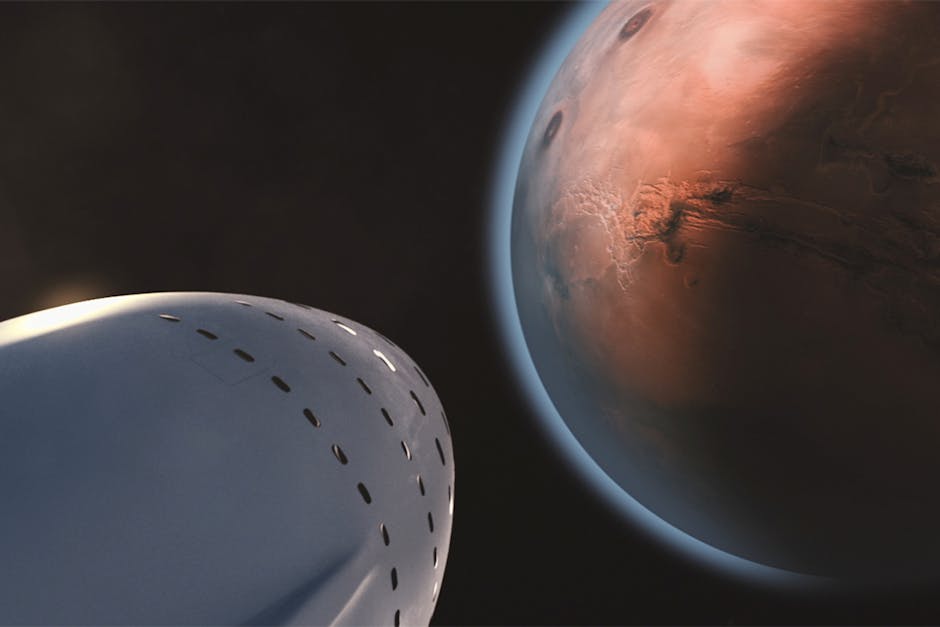
- The Psyche spacecraft is traveling at 12,000 miles per hour towards Mars for a gravity assist maneuver.
- The mission aims to explore the enigmatic metal asteroid Psyche, located between Mars and Jupiter.
- The spacecraft will skim 2,800 miles above the Martian night side, using Mars’ gravity to propel it forward.
- The gravity assist will save precious fuel, essential for reaching the asteroid over 1.5 billion miles from Earth.
- During the flyby, Psyche will collect data on dust rings and magnetic anomalies in a rarely probed region.
Under the cold, silent pull of interplanetary space, the Psyche spacecraft hurtles toward Mars at 12,000 miles per hour—a lone emissary from Earth on a mission to explore one of the solar system’s most enigmatic objects. As it approaches the rust-colored planet, it will skim just 2,800 miles above the Martian night side, close enough for Mars’ gravity to sling it forward like a stone from a celestial slingshot. This fleeting encounter, lasting mere minutes, is not just a navigational trick; it’s a carefully orchestrated scientific opportunity. Cameras will capture Mars as a shadowed crescent, instruments will awaken to scan for elusive dust rings and magnetic anomalies, and engineers will test systems vital for the probe’s ultimate destination: a 173-mile-wide asteroid composed largely of metal, orbiting the sun between Mars and Jupiter.
Mars Flyby at Breakneck Speed

The flyby marks a pivotal phase in the Psyche mission, launched in October 2023. On its current trajectory, the spacecraft will execute a gravity assist maneuver, leveraging Mars’ gravitational field to alter its velocity and direction without expending precious fuel. This propellant-saving technique is essential for reaching the asteroid Psyche, located over 1.5 billion miles from Earth. During the encounter, Psyche will pass within a fraction of the distance separating Earth from its own moon, offering a rare chance to collect data in a region of space seldom probed by orbiters. While no long-term observation is possible, the flyby allows the team to power up and calibrate the spacecraft’s multispectral imager, gamma-ray and neutron spectrometer, and magnetometer using Mars as a known reference. Scientists also hope to detect faint dust rings possibly shed by Mars’ moon Phobos, which could provide clues about the planet’s satellite system and its evolution.
The Journey to a Metallic World

The Psyche mission was conceived out of a profound mystery: asteroid 16 Psyche appears to be composed largely of iron and nickel, resembling the core of a terrestrial planet more than a typical rocky or icy body. Some scientists believe it may be the exposed remnant of a protoplanet’s core, violently stripped of its mantle through ancient collisions during the solar system’s formative years. If confirmed, studying Psyche could offer an unprecedented glimpse into the violent, hidden processes that shaped Earth and other rocky worlds. To reach it, however, requires a complex trajectory. A direct flight would demand prohibitive amounts of fuel, so NASA designed a route that includes this Mars gravity assist, followed by a three-year cruise to the asteroid belt. The flyby is not merely a pit stop—it’s a critical milestone that validates the spacecraft’s health and navigation after months in deep space.
The Minds Behind the Mission

Led by scientists at Arizona State University and engineered by NASA’s Jet Propulsion Laboratory, the Psyche team has spent over a decade refining the spacecraft’s design and mission plan. Principal investigator Lindy Elkins-Tanton has championed the mission as a window into planetary cores—regions too deep and extreme to ever be explored directly on Earth. For the engineers, the Mars flyby represents both a triumph and a nerve-wracking moment; the spacecraft must autonomously execute a precise trajectory correction maneuver just hours before closest approach, ensuring it doesn’t veer too close and risk atmospheric drag. Yet, the team also sees opportunity: the flyby allows them to stress-test instruments in a real-world environment, simulating conditions they’ll face near the asteroid. Every byte of data returned from Mars will inform how they operate the probe in the years ahead.
Implications Beyond the Flyby

The success of the Mars maneuver has far-reaching implications for deep-space navigation and planetary science. If the instruments perform as expected, they will be better calibrated for detecting subtle magnetic fields and elemental signatures around the metal-rich asteroid. Any detection of dust rings around Mars could reshape models of how planetary moons evolve and disintegrate. Moreover, the flyby demonstrates the continued utility of gravity assists in interplanetary travel—a technique used since the Voyager missions and still indispensable for reaching distant targets efficiently. For future missions aiming to explore the outer solar system or return samples from asteroids, Psyche’s trajectory offers a modern case study in orbital mechanics and mission resilience.
The Bigger Picture
Psyche’s flyby is more than an engineering milestone; it’s a symbolic leap in humanity’s effort to understand planetary origins. By probing a world that may be a shattered core, scientists hope to reconstruct the violent infancy of planets, including our own. As NASA emphasizes, this mission bridges geology and astronomy, offering insights that cannot be gleaned from Earth-based observations alone. In the broader arc of exploration, Psyche represents a shift toward targeted investigations of atypical solar system bodies—objects that challenge assumptions and expand the boundaries of planetary science.
As the spacecraft vanishes into the distance beyond Mars, its cameras turning away from the red planet’s crescent glow, the real journey begins. Over the next three years, Psyche will sail through the void, its systems monitored in quiet vigil. By 2029, it is expected to enter orbit around the metal asteroid, beginning a 26-month campaign of close-up observation. What it finds—whether a solid metal monolith, a rubble pile, or something entirely unexpected—could redefine how we understand the building blocks of worlds. For now, the Mars flyby stands as a testament to precision, patience, and the enduring drive to explore the unknown.
Source: ScienceDaily