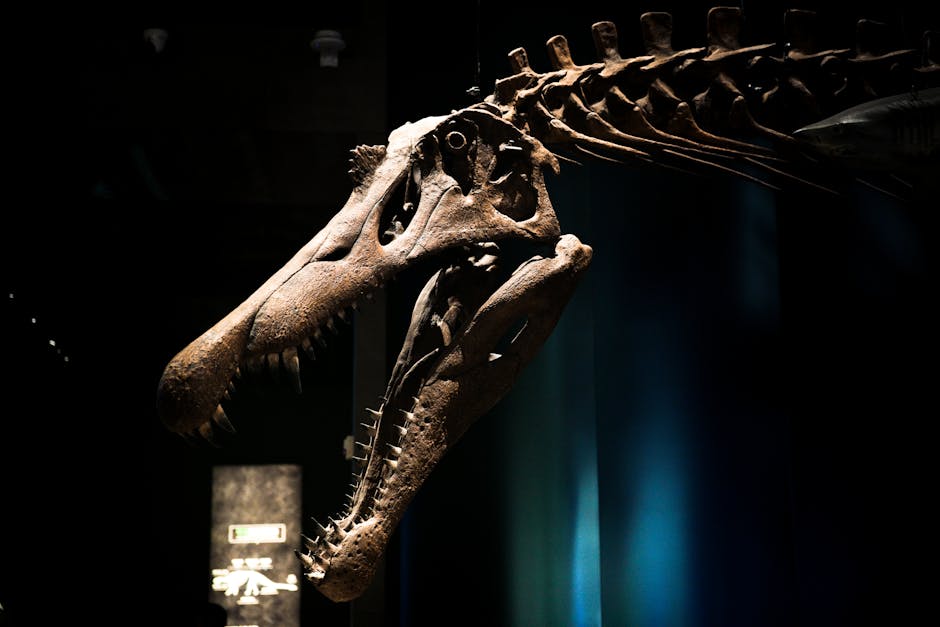
- Scientists discovered a 20-meter-long dinosaur fossil in Patagonia, Argentina, which could change our understanding of sauropod evolution.
- The Bicharracosaurus dionidei fossil displays a mix of traits from diplodocids and brachiosaurids, two distinct families of long-necked Jurassic dinosaurs.
- It’s the first definitive Jurassic-era brachiosaurid found in South America, filling a gap in the paleontological record and suggesting early dispersal of these dinosaurs.
- The fossil’s unique anatomy, including elongated cervical vertebrae and robust forelimbs, defies easy classification and reveals an evolutionary link between the two dinosaur families.
- Radiometric dating places the fossil at approximately 165 million years old, significantly older than any known brachiosaurid relative in South America.
Scientists have unearthed a remarkable dinosaur fossil in Patagonia, Argentina, that could fundamentally alter our understanding of sauropod evolution in the Southern Hemisphere. Named Bicharracosaurus dionidei, this 20-meter-long herbivore displays a mosaic of anatomical traits previously seen in both diplodocids and brachiosaurids—two distinct families of long-necked Jurassic giants. Critically, it appears to represent the first definitive Jurassic-era brachiosaurid discovered in South America, filling a significant paleontological void and suggesting early dispersal of these dinosaurs across Gondwana long before previously thought.
Unique Anatomy Points to Evolutionary Link

Detailed analysis of Bicharracosaurus’s skeletal remains, published in a recent Nature paper, reveals a blend of morphological features that defy easy classification. Its elongated cervical vertebrae and low skull resemble those of diplodocids like Diplodocus, yet its robust forelimbs, upward-angled shoulder girdle, and proportionally longer front limbs align closely with brachiosaurids such as Brachiosaurus and Giraffatitan. Radiometric dating of the surrounding rock layers places the fossil at approximately 165 million years old—mid-Jurassic—making it significantly older than any known brachiosaurid relative in South America. The discovery site, in the Cañadón Asfalto Formation, has previously yielded fragmentary sauropod remains, but none with such a complete and phylogenetically informative skeleton.
Key Players in the Discovery

The fossil was uncovered by a joint expedition led by the Museo Paleontológico Egidio Feruglio (MEF) in Argentina and the University of Bonn in Germany. Dr. Laura García, lead paleontologist on the project, emphasized the specimen’s importance during a press briefing: “Bicharracosaurus is not just another big dinosaur. It’s a transitional form that helps us understand how brachiosaurids colonized Gondwana.” The team spent over 18 months excavating and preparing the fragile bones, which include a nearly complete forelimb, partial skull, and multiple vertebrae. International collaboration was crucial, with CT scanning performed at the European Synchrotron Radiation Facility in France, enabling high-resolution 3D modeling of internal bone structures. The name Bicharracosaurus dionidei honors both the local Mapuche term “bicharraco” for “big, strange creature” and the mythological Greek messenger Dionis, symbolizing its role as a herald of evolutionary change.
Trade-Offs in Interpretation and Classification

While Bicharracosaurus presents compelling evidence for early brachiosaurid presence in South America, its mixed anatomy invites debate. Some paleontologists caution against overclassifying based on a single specimen, noting that convergent evolution could produce similar traits independently. However, phylogenetic analyses conducted by the research team place Bicharracosaurus firmly within the Brachiosauridae family, albeit as a basal member with retained primitive features. This suggests that early brachiosaurids were more morphologically flexible than previously assumed. The implications extend beyond taxonomy: if brachiosaurids were in South America by the mid-Jurassic, it challenges models of dinosaur biogeography that assumed these groups only arrived in the Cretaceous via land bridges. On the other hand, the fossil’s completeness enhances confidence in its interpretation, reducing reliance on fragmentary evidence that has plagued earlier Gondwanan sauropod studies.
Why the Timing Changes Everything

The mid-Jurassic period, roughly 174 to 163 million years ago, is notoriously underrepresented in the global fossil record—a gap paleontologists call the “Middle Jurassic Gap.” This scarcity is especially acute in the Southern Hemisphere, where sedimentary conditions and tectonic activity have limited fossil preservation. Bicharracosaurus emerges precisely from this poorly understood interval, offering a rare window into dinosaur diversification during a critical phase of Earth’s history. Its discovery coincides with renewed field efforts in Patagonia, where advanced remote sensing and dating techniques are enabling more precise stratigraphic placement. Moreover, growing recognition of Gondwana’s unique evolutionary pathways has prompted a reevaluation of Northern Hemisphere-centric models, making Bicharracosaurus not just a new species, but a catalyst for broader scientific reassessment.
Where We Go From Here
In the next 6 to 12 months, the research team plans to publish a full osteological description and expanded phylogenetic matrix incorporating Bicharracosaurus. Fieldwork will continue in the Cañadón Asfalto Formation, with ground-penetrating radar identifying at least three additional dig sites nearby. Three plausible scenarios could unfold: first, Bicharracosaurus may be confirmed as a basal brachiosaurid, rewriting the timing of sauropod dispersal across continents. Second, it could inspire the creation of a new clade linking diplodocids and brachiosaurids in Gondwana, suggesting deeper evolutionary roots. Third, if similar fossils are found in Africa or Antarctica, it could solidify a pan-Gondwanan brachiosaurid lineage predating the breakup of the supercontinent. Each path reshapes our understanding of dinosaur evolution.
Bottom line — the discovery of Bicharracosaurus dionidei provides the strongest evidence yet that brachiosaurids were present in South America during the mid-Jurassic, challenging long-held assumptions about sauropod biogeography and highlighting the Southern Hemisphere’s critical role in dinosaur evolution.
Source: ScienceDaily