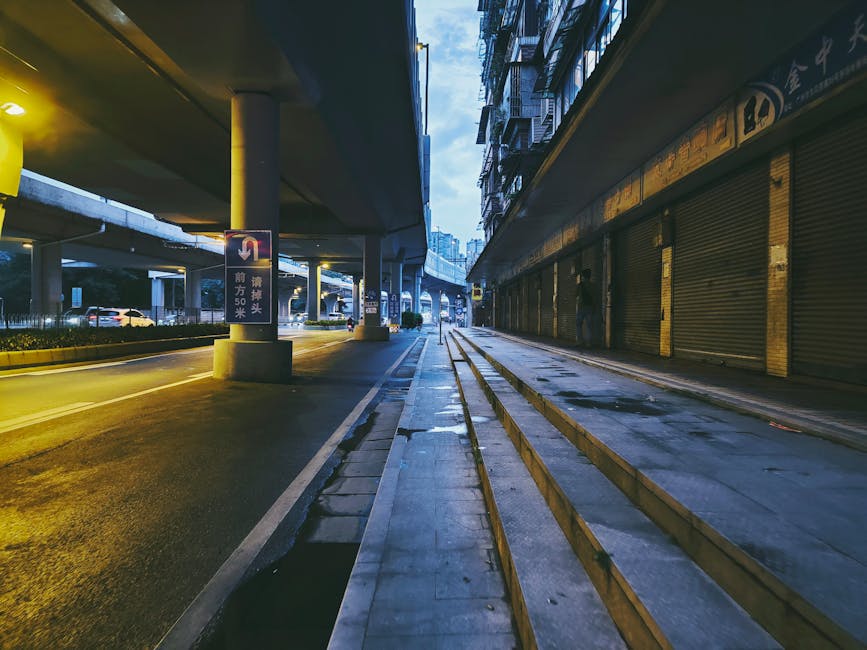
- Over 65 million vacant urban homes have been estimated in China, equivalent to housing Canada’s entire population.
- China’s urban development model is strained by overbuilding, demographic decline, and unpayable debt.
- Up to 20% of urban housing units in third- and fourth-tier cities in China remain unoccupied.
- Thousands of buildings, including apartments, malls, and office complexes, sit unfinished or unoccupied across the country.
- The phenomenon is not limited to residential spaces, with shopping centers, convention centers, and transit hubs also affected.
In the outskirts of Ordos, Inner Mongolia, a skyline rises from the Gobi Desert like a mirage — gleaming towers, broad boulevards, and ornate fountains, all immaculately constructed and entirely empty. Streetlights flicker on at dusk over silent intersections. Dust gathers on marble lobbies meant for luxury tenants. This is Kangbashi, a planned city built for over a million people, now home to fewer than 30,000. Once hailed as a monument to China’s unstoppable urban ascent, it now stands as a monument to miscalculation. Across the country, from the rusting industrial zones of the northeast to the speculative fringes of Shenzhen, thousands of buildings — apartments, malls, office complexes — sit unfinished or unoccupied. They are not just architectural oddities but symptoms of a deeper malaise: a national development model strained by overbuilding, demographic decline, and unpayable debt.
The Scale of China’s Stranded Infrastructure

Estimates suggest China has over 65 million vacant urban homes — more than enough to house Canada’s entire population. These are not just rural huts but high-rises in newly minted districts, many constructed within the past two decades. According to research from Tsinghua University and the World Bank, up to 20% of urban housing units in third- and fourth-tier cities remain unoccupied. The phenomenon extends beyond residential spaces: shopping centers, convention centers, and even entire transit hubs have been built with little to no demand. These stranded assets represent trillions of yuan in frozen capital, much of it financed by local government debt through shadow banking channels. The resource cost is staggering: steel, concrete, and energy poured into developments that generate no return. A 2023 study in Nature Sustainability calculated that the embodied carbon in China’s unused buildings exceeds the annual emissions of Germany.
How Urban Expansion Outpaced Reality

The roots of this crisis lie in China’s post-2008 stimulus strategy. After the global financial crash, Beijing unleashed a $586 billion infrastructure push, much of it funneled through local governments incentivized to boost GDP at any cost. Land sales became the engine of municipal finance, with officials rezoning farmland into urban plots and selling development rights to property firms. This created a perverse cycle: more construction meant higher land prices, which funded more projects, regardless of actual population growth. Migration to cities continued, but not fast enough to fill the artificially inflated supply. At the same time, the hukou household registration system restricted access to public services, discouraging rural migrants from settling permanently in new urban zones. The result was a disconnect between physical infrastructure and human need — cities built for a future that never arrived.
The Architects of the Empty Cities

Multiple actors shaped this outcome. Local officials, under pressure to deliver growth metrics, approved ever-larger developments. Real estate developers like Evergrande and Country Garden expanded aggressively, leveraging debt to buy land and launch projects. Many buyers, viewing apartments as speculative assets rather than homes, purchased units they never intended to occupy — further inflating demand signals. At the national level, central planners long prioritized GDP expansion over efficiency or sustainability. Even as warnings emerged — from economists like Zhang Weiying to international bodies like the IMF — the momentum of the urban machine proved difficult to slow. Today, some local leaders quietly admit miscalculation, while developers scramble to reposition projects as data centers or logistics hubs. But the human cost is borne most acutely by rural families who invested savings in distant apartments now worth a fraction of their price.
Consequences for Economy and Environment

The fallout is multidimensional. Financially, stranded assets exacerbate local government debt, now exceeding 40 trillion yuan, and threaten the stability of regional banks. Environmentally, the overuse of concrete — which accounts for 8% of global CO₂ emissions — undermines China’s climate commitments. Socially, the mismatch between housing supply and demand deepens inequality, as urban elites own multiple units while young workers face unaffordable rents in functional cities. Some vacant developments have been repurposed — a shopping mall in Zhengzhou became a quarantine center during the pandemic — but most remain static. The phenomenon also distorts land use planning, locking up valuable space that could support agriculture, renewable energy, or ecological restoration.
The Bigger Picture
China’s ghost cities are not anomalies but logical outcomes of a growth-at-all-costs paradigm now reaching its limits. They mirror patterns seen historically in Japan’s 1990s bubble and Spain’s 2008 housing crash, but at a far greater scale. What makes China’s case unique is the centralized control that enabled such vast overbuilding — and the same control that may now be required to unwind it. Urban planners and economists increasingly argue for a shift toward retrofitting existing cities, prioritizing density and sustainability over expansion. The stranded buildings are not just economic losses; they are physical evidence of a civilization grappling with the consequences of its ambitions.
What comes next may define China’s next economic era. The government has launched pilot programs to convert vacant units into affordable housing or elderly care facilities, but progress is slow. Demographic trends — with a shrinking workforce and declining birthrate — suggest demand will not catch up anytime soon. The real challenge is not just fixing broken buildings but reimagining the model that produced them. As dust settles in Kangbashi’s silent plazas, the question lingers: can a nation known for building the future learn to build less — and better?
Source: Cell