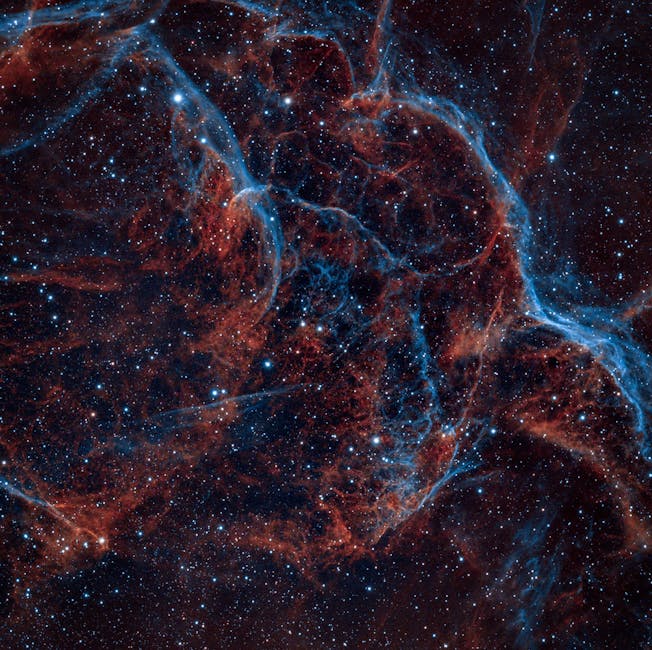
- Astronomers have captured the first direct image of a cosmic web filament spanning 3 million light-years between two galaxies.
- The cosmic web is a network of gas filaments connecting galaxies across billions of light-years, supporting galaxy growth and star formation.
- The cosmic web is primarily composed of dark matter and diffuse hydrogen gas, making it difficult to observe directly.
- Advanced imaging techniques and the Keck Observatory were used to detect ultraviolet light emitted by hydrogen gas in the filament.
- The discovery offers new insights into understanding how galaxies receive fuel for growth and star formation.
What does the skeleton of the Universe look like? For decades, cosmologists have theorized that galaxies are not scattered at random but are connected by an immense, invisible network of gas filaments known as the cosmic web. Now, for the first time, astronomers have captured a direct, high-resolution image of one of these elusive strands—revealing a glowing bridge of intergalactic gas stretching 3 million light-years between two distant galaxies formed nearly 12 billion years ago. This breakthrough provides tangible evidence of the Universe’s largest-scale structure and opens a new window into understanding how galaxies receive the fuel they need to grow and form stars.
What Is the Cosmic Web—and Why Has It Been So Hard to See?

The cosmic web is a vast, web-like structure predicted by simulations of cosmic evolution, composed primarily of dark matter and diffuse hydrogen gas that connects galaxies across billions of light-years. Despite its theoretical prominence, observing it directly has been incredibly difficult because the gas in these filaments emits extremely faint light. Most prior evidence has been indirect, inferred from how quasars’ light is absorbed by intervening gas clouds. However, using the Keck Observatory in Hawaii and advanced imaging techniques, astronomers detected ultraviolet light emitted by hydrogen gas in a filament linking two forming galaxies in the early Universe. This glow, known as Lyman-alpha emission, was amplified just enough by a nearby bright source to allow direct imaging—marking a milestone in observational cosmology and confirming that the cosmic web isn’t just theoretical, but physically real.
What Does the New Image Reveal About Cosmic Gas Flows?

The newly captured filament extends about 3 million light-years and connects two proto-galaxies at a redshift of approximately 3.1, meaning we see them as they existed when the Universe was just a quarter of its current age. According to the research team’s findings, published in Nature, the gas in the filament shows coherent motion, flowing toward the denser regions where galaxies are forming—strong evidence that these filaments act as intergalactic highways, delivering fresh hydrogen to fuel star formation. The brightness and temperature of the gas also suggest it is being heated by both gravitational compression and nearby star-forming activity. This observation supports the ‘cold flow accretion’ model, in which galaxies grow not just through mergers but by steadily drawing in cool gas from the cosmic web—a process fundamental to galaxy evolution over cosmic time.
Are There Alternative Explanations for the Observed Glow?

While the image is compelling, some astrophysicists urge caution in interpreting the filament as a pristine cosmic web structure. One concern is that the observed glow might be influenced or contaminated by nearby intense radiation from the galaxies themselves or from an unseen quasar, potentially ionizing the gas and making it appear brighter than it naturally would. Others suggest that the filament could instead be tidal debris—gas ripped from the galaxies during a close encounter—rather than a primordial intergalactic bridge. However, the research team argues that the spatial alignment, gas kinematics, and lack of disruptive interactions make such scenarios unlikely. Still, they acknowledge that further observations with next-generation instruments like the James Webb Space Telescope will be essential to confirm the filament’s origin and assess how typical this structure is across the cosmos.
How Does This Discovery Change Our Understanding of Galaxy Formation?

This discovery has profound implications for models of galaxy evolution. For years, simulations such as the IllustrisTNG and Millennium projects have predicted that the cosmic web supplies up to half of the gas needed for star formation in young galaxies. Now, with direct visual confirmation, astronomers can test these models with real data. Observing how gas flows along filaments helps explain why some galaxies grow rapidly in the early Universe while others remain small and quiescent. It also provides clues about the distribution of baryonic (normal) matter, much of which has been ‘missing’ in cosmic inventories—likely residing in these faint, hard-to-detect filaments. Future surveys targeting similar structures could map the cosmic web in greater detail, transforming our understanding of how matter moves across the Universe over billions of years.
What This Means For You
While the cosmic web may seem remote, it is fundamentally connected to our existence: the gas flowing through these filaments helped build galaxies like our Milky Way and supplied the raw material for stars, planets, and life itself. This discovery reminds us that even the most invisible parts of the Universe play a vital role in shaping the cosmos we inhabit. As observational technology improves, more of these hidden structures will come into view, deepening our cosmic perspective and revealing the dynamic processes that have governed the Universe since its infancy.
Now that we’ve seen one strand of the cosmic web, the next big question is: How common are these filaments in the early Universe, and how efficiently do they feed galaxies? Upcoming observatories like the Vera C. Rubin Observatory and the Square Kilometre Array will scan vast regions of the sky, potentially capturing hundreds of such structures. Each new image could refine our understanding of galaxy growth and bring us closer to solving the mystery of the Universe’s missing baryons—reminding us that even in the vast darkness of space, the faintest glows can illuminate the deepest truths.
Source: ScienceDaily