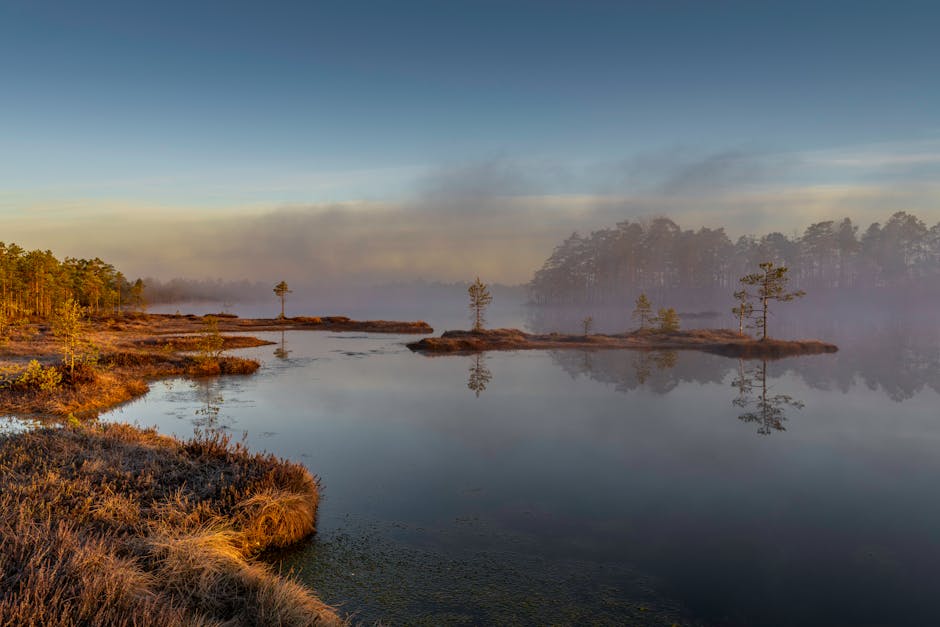
- Lithuania aims to restore 80,000 hectares of degraded peat bogs by 2030, a significant area with immense carbon sequestration potential.
- Restoring peat bogs can lock away up to 1.5 million tons of CO₂ annually, equivalent to removing 320,000 cars from roads.
- Revived peat bogs will serve as natural barriers against illegal crossings and smuggling at Lithuania’s border with Belarus.
- Peat bogs are highly efficient carbon storage systems, accumulating organic matter and trapping carbon beneath layers of moss and vegetation.
- Lithuania’s approach combines ecological and strategic foresight, addressing climate change and geopolitical instability through a single initiative.
Lithuania plans to restore over 80,000 hectares of degraded peat bogs by 2030—a land area larger than New York City—transforming these forgotten wetlands into powerful carbon sinks and unexpected tools of national defense. Once drained for agriculture and fuel, these ecosystems now emit more carbon dioxide than they absorb. But scientists estimate full restoration could lock away up to 1.5 million tons of CO₂ annually, equivalent to removing 320,000 cars from roads. Beyond climate benefits, officials say the revived bogs will act as natural barriers along the country’s porous border with Belarus, deterring illegal crossings and smuggling. In a world where climate change and geopolitical instability increasingly intersect, Lithuania’s approach offers a rare fusion of ecological and strategic foresight.
A Convergence of Climate and Security

Peat bogs, often overlooked as barren wastelands, are now gaining recognition as some of Earth’s most efficient carbon storage systems. In their natural, waterlogged state, they accumulate organic matter over millennia, trapping carbon beneath layers of moss and vegetation. When drained, however, that stored carbon oxidizes and escapes into the atmosphere. Lithuania’s bogs were heavily exploited during the Soviet era for peat fuel and converted to farmland, disrupting their hydrology. Now, with rising temperatures and increased border tensions—especially after Belarus weaponized migration in 2021—authorities are reimagining these wetlands as multifunctional landscapes. The restoration project, funded in part by the EU’s LIFE program, aims to rewet degraded bogs, halt carbon emissions, and create impassable terrain for unauthorized border crossers, all while revitalizing biodiversity.
Restoring Nature to Secure the Frontier

The initiative centers on the Švenčionys and Ignalina regions in eastern Lithuania, where the country shares a 679-kilometer border with Belarus. Here, Lithuanian officials are working with hydrologists and ecologists to reconstruct natural water flows by blocking drainage ditches and removing non-native trees like pine and spruce that were planted on dried peatlands. These trees accelerate drying and increase fire risk, undermining both ecological and security goals. By rewetting the land, authorities aim to recreate dense, water-saturated terrain that is difficult to traverse on foot or by vehicle. According to the Lithuanian Ministry of Environment, over 12,000 hectares have already been restored since 2020, with monitoring showing a 70% reduction in illegal border crossings in treated areas. This correlation has strengthened political support for expanding the program.
Science Behind the Strategy

Peatlands cover just 3% of Earth’s land surface but store twice as much carbon as all the world’s forests combined, making their restoration a high-impact climate strategy. A 2023 study published in Nature Climate Change found that rewetted peatlands can reduce emissions by 90% within five years and begin re-sequestering carbon within a decade. In Lithuania, researchers from Vytautas Magnus University have mapped historical bog extents using satellite imagery and soil cores, identifying priority zones where restoration yields both ecological and security returns. They emphasize that rewetted bogs not only emit less carbon but also reduce wildfire risk—critical as Europe faces longer, drier summers. Additionally, restored wetlands support endangered species like the European golden plover and the fen orchid, enhancing regional biodiversity.
Implications for People and Policy

The dual-purpose strategy affects local communities, border guards, and climate policy alike. For farmers who once relied on drained peatlands for grazing, the shift means lost income—though the government offers compensation for land taken out of production. Border patrol units report improved control in rewetted zones, reducing the need for costly physical barriers. Nationally, the project strengthens Lithuania’s commitment to the EU’s 2050 carbon neutrality goal while addressing a tangible security threat. Internationally, it sets a precedent for integrating environmental restoration into national defense planning, particularly in regions facing both climate stress and geopolitical instability. Countries like Finland and Poland are now studying Lithuania’s model for similar applications.
Expert Perspectives
While many praise the initiative, some experts urge caution. Dr. Erika Maurer, a wetland ecologist at the University of Greifswald, notes that “rewetting must be scientifically precise—poorly managed projects can release methane, a potent greenhouse gas.” Others, like security analyst Tomas Janeliūnas, argue that “natural barriers alone won’t stop determined actors” and must be paired with surveillance and diplomacy. Still, most agree the project represents innovative thinking. “Lithuania is showing that climate action doesn’t have to be siloed from security,” says Dr. Linas Kelpša of Vilnius University. “This could be a blueprint for the Baltic region and beyond.”
Looking ahead, the success of Lithuania’s peatland restoration will depend on sustained funding, community engagement, and transboundary cooperation. With Belarus showing no signs of easing pressure on EU borders, and global climate targets slipping further out of reach, the world will be watching whether a bog can be both a fortress and a carbon vault. If effective, this quiet revolution in wetland management may inspire a new generation of nature-based solutions where ecology and security converge.
Source: The New York Times