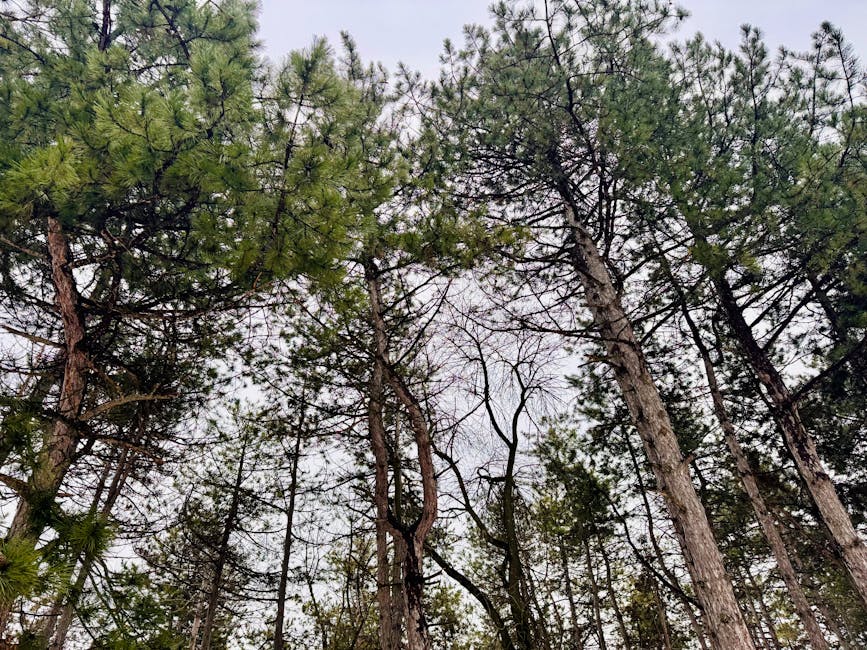
- Trees communicate through a complex network of mycorrhizal fungi, sharing resources and warning each other of threats.
- Research by forest ecologist Suzanne Simard reveals forests function like neural networks, with trees cooperating rather than competing.
- Trees form fungal highways that enable the transfer of carbon, nitrogen, water, and defense signals beneath the ground.
- Older ‘mother trees’ prioritize sending resources to their kin, challenging the conventional view of tree competition.
- Understanding the ‘Wood Wide Web’ is crucial for mitigating the impact of climate change on global ecosystems.
What if forests aren’t just collections of competing trees, but vast, cooperative communities communicating beneath our feet? That’s the radical question posed by forest ecologist Suzanne Simard, whose decades of research have upended traditional views of plant life. Standing under a centuries-old oak at Kew Gardens in London, Simard explained how trees form intricate underground networks—fungal highways that allow them to exchange nutrients, water, and even chemical warnings. Her work suggests forests function more like neural networks than isolated organisms. As climate change threatens global ecosystems, understanding these hidden connections could be key to saving them. But how solid is the science behind this so-called “Wood Wide Web,” and why has it sparked both awe and skepticism?
Do Trees Really Communicate With Each Other?

Yes—through a complex underground network of mycorrhizal fungi that link tree roots and enable the transfer of carbon, nitrogen, water, and defense signals. Simard’s pivotal experiments in the 1990s, conducted in British Columbia’s forests, demonstrated that paper birch and Douglas fir seedlings could exchange carbon through these fungal bridges, especially when one species was shaded or stressed. She found that older “mother trees” not only recognize their kin but also preferentially send resources to them. This challenges the long-dominant view in ecology that trees compete ruthlessly for light and nutrients. Instead, Simard argues forests operate as collaborative systems, where survival depends on connectivity and reciprocity. Her findings, published in Nature in 1997, laid the foundation for a new understanding of forest intelligence.
What Evidence Supports the Wood Wide Web?

Multiple studies have confirmed and expanded on Simard’s initial findings. Using radioactive and stable isotope tracers, researchers have visually mapped how carbon flows between trees via mycorrhizal networks. A 2010 study in PNAS showed that Douglas fir trees transferred carbon to paper birch during summer, then received it back in fall, suggesting a dynamic, mutually beneficial exchange. Simard’s lab further discovered that mother trees slow their own growth to funnel carbon and nutrients to younger saplings, especially their offspring. These networks also transmit warning signals: when a tree is attacked by insects, it can send defensive chemicals through the fungal web, priming neighboring trees to boost their immunity. Such findings have led some scientists to describe forests as “superorganisms,” where cooperation enhances ecosystem resilience.
Are There Skeptics of the Wood Wide Web?

While widely celebrated, Simard’s ideas have faced criticism. Some ecologists argue that the extent and intent of tree cooperation are overstated. They caution that nutrient transfer via fungi may be a byproduct of fungal metabolism rather than evidence of deliberate sharing. Critics also note that competition still dominates in many forest settings—especially in dense, resource-limited environments. Others worry that metaphors like “mother trees” or “tree talk” anthropomorphize plants and oversimplify complex ecological dynamics. In 2021, a review in Trends in Plant Science urged more rigorous testing of claims about kin recognition and intentional resource allocation. Yet even skeptics acknowledge Simard’s work has catalyzed vital research into below-ground ecology, pushing the field to explore interdependence alongside competition.
What Is the Real-World Impact of This Research?

Simard’s discoveries are influencing forestry practices worldwide. In Canada and Europe, some forest managers now preserve older trees during logging to maintain network integrity, recognizing their role as hubs in the underground web. Reforestation projects are beginning to plant mixed-species clusters rather than monocultures, mimicking natural forest structures to improve survival rates. The research also inspired James Cameron’s Avatar, where the alien forest of Pandora communicates through a planetary neural network—directly informed by Simard’s science. Beyond fiction, the concept has fueled public interest in forest conservation, with campaigns highlighting trees’ social lives to promote empathy and protection. As climate change accelerates forest die-offs, understanding these hidden connections could be critical for building resilient ecosystems.
What This Means For You
The idea that trees are social beings changes how we relate to nature. It suggests that protecting forests isn’t just about saving individual trees, but preserving the intricate relationships that sustain them. For hikers, gardeners, or city dwellers, this knowledge invites a deeper respect for the living networks beneath our feet. Practices like avoiding soil compaction, protecting fungal habitats, and planting diverse native species can support these hidden systems. On a broader level, Simard’s work reminds us that interdependence—not just competition—is a fundamental force in nature, with lessons for human societies facing shared challenges like climate change.
Still, many questions remain: How do these networks respond to rapid environmental change? Can we map them at scale using new technologies? And what might they teach us about resilience, cooperation, and survival in an interconnected world? As research advances, the forest floor may yet reveal its deepest secrets.
Source: New Scientist