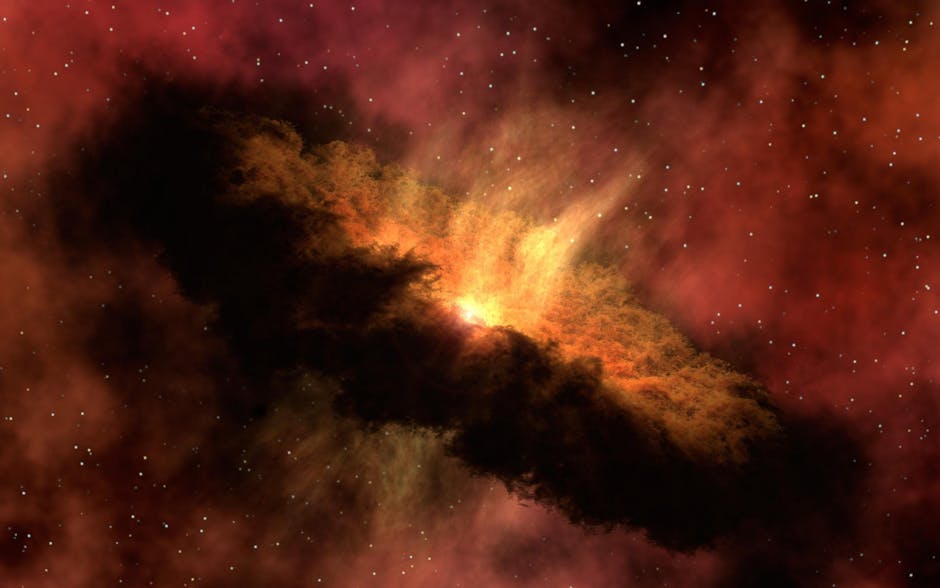
- Astronomers have observed a chaotic planet-forming disk around the young star J1604-2130 in the constellation Lupus.
- The disk, spanning 100 billion kilometers, is unlike any previously observed due to its asymmetry and towering vertical filaments.
- Recent Hubble observations have revealed a complex structure nicknamed ‘Dracula’s Chivito’ due to its monstrous appearance and layered complexity.
- The asymmetry of the disk suggests powerful, localized forces are warping the environment.
- This discovery challenges decades of assumptions about how planets are formed.
On the outskirts of the constellation Lupus, 520 light-years from Earth, a young star named J1604-2130 spins in near darkness, cocooned in a swirling maelstrom of gas and dust so vast it could forge an entire planetary system. Through the unblinking eye of the Hubble Space Telescope, astronomers have glimpsed a scene of cosmic turbulence: a disk of material stretched into towering, filament-like structures, lopsided and asymmetric, glowing faintly in scattered starlight. This is no serene cradle of planet formation. Instead, it resembles a battlefield of gravity and motion, where clumps of matter spiral inward, arcs bulge unpredictably, and one side of the disk appears violently disturbed while the other remains eerily calm. Nicknamed ‘Dracula’s Chivito’—a whimsical nod to its monstrous appearance and layered complexity—this structure is unlike any planet-forming disk previously observed, challenging decades of assumptions about how worlds are born.
A Turbulent Nursery in Unprecedented Detail

Recent Hubble observations have revealed that the disk around J1604-2130 spans roughly 100 billion kilometers—more than twice the size of our solar system’s Kuiper Belt. What shocks researchers is not its size but its asymmetry: towering vertical filaments rise dramatically from one side of the disk, while the opposite side appears smooth and compressed. These structures, visible only in polarized light, suggest powerful, localized forces are warping the environment. Scientists estimate the disk contains at least ten times the mass of Jupiter in gas and dust, enough raw material to form several giant planets. Yet rather than the orderly, rotating disks predicted by classical planet formation models, ‘Dracula’s Chivito’ shows signs of violent turbulence, likely driven by gravitational instabilities or unseen companions. NASA scientists believe the disk may be in the throes of active planet assembly, with clumps of material collapsing into embryonic giants.
How We Got Here: Rewriting Planet Formation

For decades, astronomers have operated under the nebular hypothesis: a star forms at the center of a rotating disk of gas and dust, and over millions of years, tiny particles stick together, growing into planetesimals, then protoplanets, and eventually full-fledged planets. This process assumes gradual, symmetric accretion. But observations over the past 15 years—especially from ALMA and Hubble—have revealed that nature is far less tidy. Disks like HL Tauri and Elias 2-27 showed spiral arms and gaps, hinting at hidden planets or gravitational waves. ‘Dracula’s Chivito’ takes this disruption further, presenting a system where the very geometry of planet formation appears compromised. Its lopsidedness may stem from a close stellar flyby, an embedded massive planet tugging from within, or magnetic fields interacting with ionized gas. Each scenario would leave a distinct fingerprint, and Hubble’s high-resolution imaging is helping scientists rule some out while elevating others.
The Astronomers Behind the Discovery

The team behind the discovery, led by Dr. Mihoko Konishi of Tokyo’s Institute of Astronomy, has spent years refining Hubble’s polarimetric imaging techniques to detect faint structures in dusty disks. ‘We weren’t expecting such extreme asymmetry,’ Konishi said in a recent interview. ‘It’s as if one side of the disk is screaming while the other whispers.’ Her team collaborated with researchers from the Space Telescope Science Institute and the European Southern Observatory, combining Hubble data with archival observations from Spitzer and ground-based telescopes. Their motivation is not just to catalog oddities, but to probe the fundamental physics of planet birth. ‘If systems like this are common,’ she adds, ‘then our models need a serious overhaul.’
Consequences for Planetary Science and Exoplanet Searches

The implications of ‘Dracula’s Chivito’ extend beyond one peculiar star system. If such chaotic disks are widespread, it could mean that giant planets often form rapidly through gravitational collapse rather than slow accretion. This would reshape how astronomers interpret exoplanet demographics, particularly the abundance of wide-orbit giants. Furthermore, the asymmetry suggests planet formation can be highly localized, meaning future telescopes like the Nancy Grace Roman Space Telescope may need to target specific disk regions rather than assuming uniform conditions. For astrobiology, the finding raises questions: could such violent nurseries produce stable, Earth-like worlds, or do they favor unstable, eccentric systems? The answer may lie in simulating ‘Dracula’s Chivito’ under various initial conditions.
The Bigger Picture
This discovery underscores a broader shift in astrophysics: the realization that cosmic order is often an illusion. Just as galaxy collisions and black hole mergers shape the large-scale universe, chaotic dynamics appear to dominate at the planetary scale too. ‘Dracula’s Chivito’ is not an anomaly—it may be a snapshot of a common, yet previously invisible, phase in solar system evolution. By studying such extremes, scientists gain insight into the range of possibilities that govern planet formation across the galaxy. As telescope capabilities advance, more of these hidden dramas will come into view, revealing the universe not as a clockwork mechanism but as a turbulent, improvisational artist.
What comes next is a deeper look. Upcoming observations with the James Webb Space Telescope will probe the disk’s chemical composition and temperature gradients, searching for water ice, organic molecules, and signs of active accretion. Simultaneously, radio arrays like ALMA will map the disk’s internal motions in 3D. Together, these tools may finally reveal whether ‘Dracula’s Chivito’ is birthing planets in real time—and whether our own solar system once looked just as wild.
Source: ScienceDaily