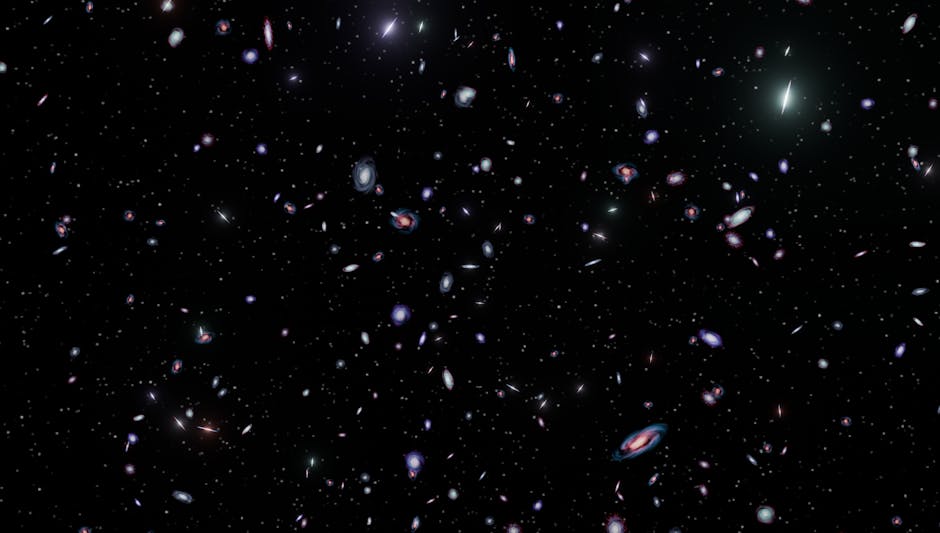
- The James Webb Space Telescope has created the clearest map yet of the cosmic web, a vast network connecting galaxies across space.
- Researchers have traced the cosmic web’s development back to when the universe was just a billion years old.
- The cosmic web is a complex structure of galaxy filaments and voids that crisscross the universe.
- The James Webb Space Telescope’s COSMOS-Web survey analyzed over 164,000 galaxies to create a detailed map of the cosmic web.
- The discovery marks a major milestone in astronomy, allowing scientists to study the cosmic web in greater detail than ever before.
As astronomers continue to unravel the mysteries of the universe, one question remains at the forefront of their inquiry: what is the nature of the vast, hidden structure that connects galaxies across space? This enigmatic network, known as the cosmic web, has long fascinated scientists, who have sought to understand its origins and evolution. Now, thanks to the groundbreaking work of researchers using NASA’s James Webb Space Telescope, we have the clearest map yet of this enormous structure, tracing its development back to when the universe was just a billion years old.
Unveiling the Cosmic Web

The James Webb Space Telescope has revolutionized our understanding of the cosmic web, providing unprecedented insights into the universe’s largest structures. By analyzing more than 164,000 galaxies through the massive COSMOS-Web survey, researchers have been able to create a detailed map of this vast network, revealing the intricate web of galaxy filaments and voids that crisscross the universe. This achievement marks a major milestone in the field of astronomy, as scientists can now study the cosmic web in greater detail than ever before, shedding light on the fundamental processes that have shaped the universe over billions of years.
Supporting Evidence from the COSMOS-Web Survey

The COSMOS-Web survey, which utilized the James Webb Space Telescope’s advanced instrumentation, has provided a wealth of data that supports the existence of the cosmic web. According to NASA, the survey has enabled researchers to trace the cosmic web’s evolution over time, observing how galaxies have formed and clustered together within this vast network. As noted by astronomers involved in the project, the COSMOS-Web survey has yielded a treasure trove of information, including detailed observations of galaxy distributions, gas content, and star formation rates, all of which have helped to refine our understanding of the cosmic web’s structure and evolution.
Counter-Perspectives and Alternative Views

While the discovery of the cosmic web has generated significant excitement within the scientific community, some researchers have raised questions about the survey’s methodology and the potential limitations of the data. For instance, some scientists have suggested that the COSMOS-Web survey may be biased towards certain types of galaxies, which could affect the accuracy of the cosmic web map. Additionally, others have proposed alternative theories to explain the observed structure of the universe, such as the idea that the cosmic web is not a single, unified network, but rather a collection of smaller, disconnected webs. These counter-perspectives highlight the ongoing debate and discussion within the field of astronomy, as scientists continue to refine their understanding of the universe’s largest structures.
Real-World Impact and Implications

The discovery of the cosmic web has significant implications for our understanding of the universe and its evolution. As researchers continue to study this vast network, they may uncover new insights into the formation and distribution of galaxies, as well as the role of dark matter and dark energy in shaping the universe’s large-scale structure. Furthermore, the James Webb Space Telescope’s observations of the cosmic web may also inform the development of new theories and models, such as the Lambda-CDM model, which seeks to explain the universe’s evolution and composition. The potential breakthroughs that may arise from this research could have far-reaching consequences, from refining our understanding of the universe’s fundamental laws to informing the search for life beyond Earth.
What This Means For You
The discovery of the cosmic web serves as a powerful reminder of the awe-inspiring complexity and beauty of the universe. As we continue to explore and understand the cosmos, we may uncover new and exciting insights into the nature of reality itself. For instance, the study of the cosmic web may inspire new generations of scientists and engineers, driving innovation and advancing our technological capabilities. Moreover, the James Webb Space Telescope’s observations of the universe may also prompt us to re-examine our place within the grand scheme of existence, encouraging us to adopt a more nuanced and humble perspective on our role within the cosmos.
As we look to the future, one question remains: what other secrets will the universe reveal to us as we continue to explore and study the cosmic web? Will we uncover new evidence of dark matter or dark energy, or perhaps discover new forms of celestial objects and phenomena? The search for answers to these questions will undoubtedly drive the next wave of astronomical research, as scientists push the boundaries of human knowledge and understanding, seeking to unravel the mysteries of the universe and our place within it.
Source: ScienceDaily