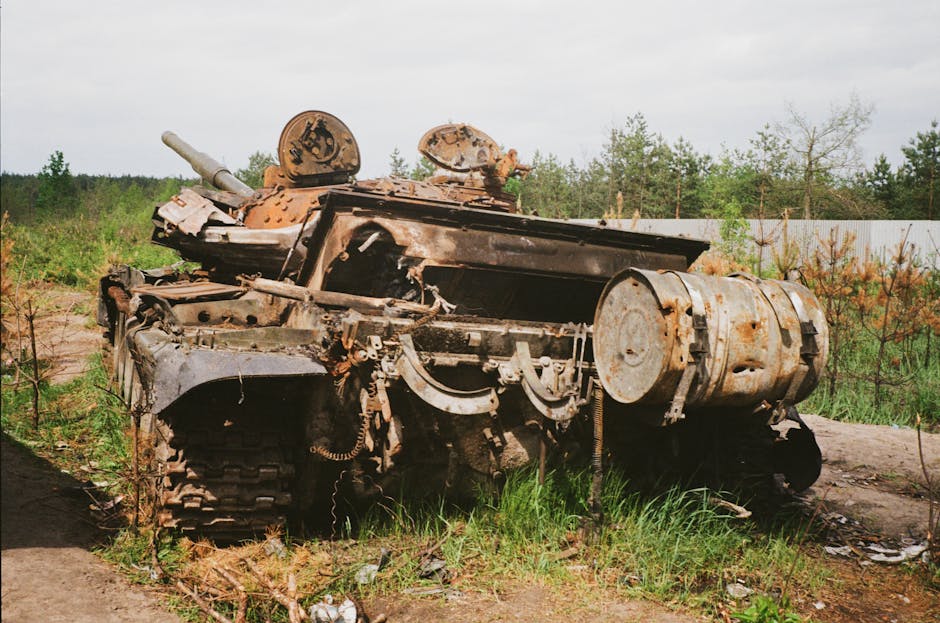
- The Donbas region in eastern Ukraine is now a battlefield, with abandoned towns and scattered people.
- Russian generals aim to capture the Donbas by fall, making it a strategic centerpiece of Moscow’s war effort.
- Ukrainian soldiers are bracing for the war’s most intense phase yet, with artillery strikes a constant threat.
- Russia’s military leadership has committed to securing the Donbas by September 2024, signaling a shift in strategy.
- Moscow is preparing for a large-scale offensive in the region, with a significant buildup of troops and artillery.
In the scorched fields outside Bakhmut, the earth is pocked with craters and littered with the rusted hulks of armored vehicles. Smoke curls into the sky from abandoned industrial sites, remnants of a once-thriving coal-mining region now reduced to rubble. The air hums with the distant thud of artillery, a constant reminder that the Donbas is no longer a region but a battlefield—its towns erased, its people scattered. Ukrainian soldiers, faces streaked with dirt and fatigue, rotate in and out of trenches, bracing for what military analysts fear will be the war’s most intense phase yet. Russian generals, emboldened by months of grinding advances and Western fatigue, have declared their intention to fully capture the Donbas by fall, turning this shattered stretch of eastern Ukraine into the symbolic and strategic centerpiece of Moscow’s war effort.
Russia’s Escalated Offensive in Eastern Ukraine

Russian military leadership, including top commanders from the Eastern Military District, has publicly committed to securing complete control over the Donbas by September 2024. This declaration, made during a series of coordinated briefings in Rostov-on-Don, signals a strategic pivot from attritional warfare to a more aggressive campaign aimed at consolidating territorial gains before winter. Satellite imagery from recent weeks shows a significant buildup of troops, artillery, and logistics hubs near Donetsk and Luhansk, suggesting Moscow is preparing for a large-scale push. Ukrainian officials report increased drone strikes and precision missile attacks on supply lines and command centers, indicating a shift toward disrupting Ukraine’s defensive coordination. Despite heavy casualties, Russian forces have made incremental advances around Chasiv Yar and Avdiivka, exploiting weaknesses in under-resourced Ukrainian brigades. The Institute for the Study of War notes that while Russian gains remain slow, they are deliberate—and increasingly backed by mobilized reservists and North Korean-supplied munitions.
From Annexation to Endless Conflict: The Donbas Timeline

The Donbas has been a flashpoint since 2014, when Russian-backed separatists seized parts of Donetsk and Luhansk following Ukraine’s Euromaidan revolution. What began as a proxy conflict escalated into open warfare, culminating in Russia’s full-scale invasion in February 2022. Despite initial setbacks, Moscow refocused its strategy on the Donbas by mid-2022, declaring it the “liberation” of historic Russian lands—a narrative pushed heavily in state media. The 2022 annexation referendums, widely condemned as illegitimate by the UN, formalized Russia’s claim over the region. Yet full control remained elusive. Since then, the war has settled into a brutal war of attrition, with cities like Mariupol and Bakhmut becoming symbols of sacrifice on both sides. The failure of peace talks in Istanbul in 2022, followed by the collapse of prisoner exchanges and backchannel diplomacy in 2023, has left little room for negotiation, allowing military objectives to dominate strategy.
The Architects of the Donbas Campaign

The current offensive is being directed by a cadre of hardline Russian generals, including General Aleksandr Lapin, commander of the Eastern Military District, and close allies of Defense Minister Sergei Shoigu. These figures operate with significant autonomy and are deeply aligned with President Vladimir Putin’s vision of restoring Russian dominance in the near abroad. Their motivations are both strategic and ideological: controlling the Donbas allows Russia to secure a land bridge to Crimea and project power into southeastern Ukraine, while also fulfilling long-standing nationalist rhetoric about protecting Russian speakers. On the Ukrainian side, commanders like General Oleksandr Syrskyi are scrambling to reinforce battered units with limited reserves and delayed Western aid. Morale remains high among frontline troops, but exhaustion and supply shortages are growing concerns, especially as U.S. military assistance faces political hurdles in Congress.
Human and Geopolitical Consequences of the Push

A successful Russian capture of the entire Donbas would mark a major, though incomplete, victory in Moscow’s war aims. For Ukraine, it would mean the loss of 18% of its territory and a devastating blow to national sovereignty. Millions of displaced civilians—many already living in Kyiv or western Ukraine—would face prolonged exile. Economically, the Donbas was once the engine of Ukraine’s industrial base; its destruction has crippled steel and coal production, with ripple effects across Europe. Internationally, a Russian victory could embolden further aggression in Moldova or the Baltic states, testing NATO’s resolve. Conversely, if Ukraine halts the offensive, it could rejuvenate diplomatic efforts and strengthen calls for increased military support. Either outcome will reshape Eastern Europe’s security architecture for decades.
The Bigger Picture
The struggle for the Donbas is no longer just a regional conflict—it has become a proxy for a broader geopolitical confrontation between autocracy and liberal democracy. The war’s outcome will influence how nations perceive the viability of territorial conquest in the 21st century and the credibility of collective security institutions like NATO and the UN. As great-power competition intensifies, the Donbas serves as a grim laboratory for modern warfare, where drones, cyber tactics, and information warfare are as critical as tanks and artillery. The world is watching not just for who wins ground, but for who wins the narrative.
What comes next may hinge less on battlefield gains than on global endurance. As winter approaches and voter fatigue grows in key Western democracies, the ability of Ukraine and its allies to sustain political and military support will be tested like never before. The Russian promise of Donbas control by fall is not just a military forecast—it is a challenge to the international order. How the world responds will define the contours of peace and power for generations to come.
Source: United24media