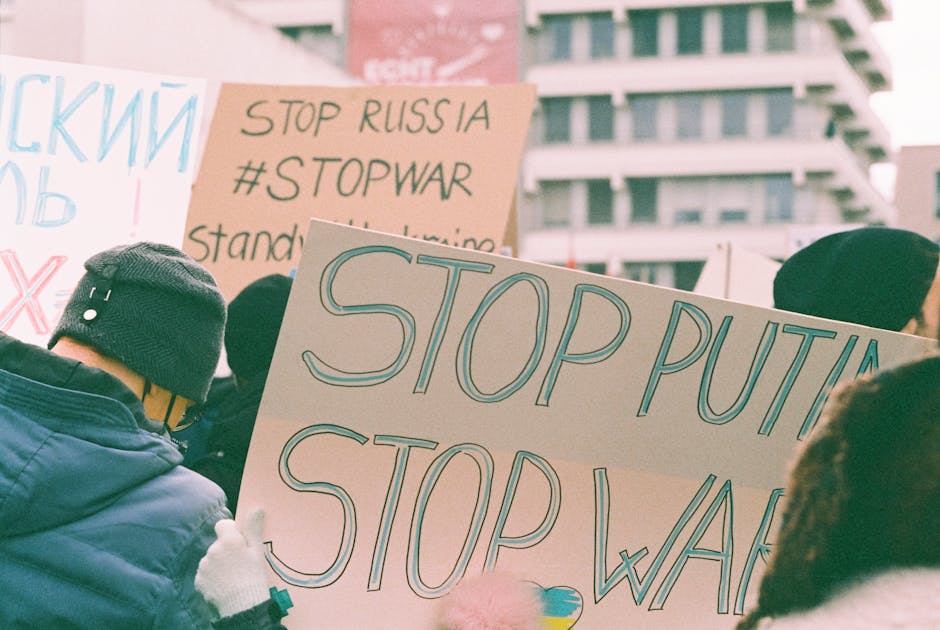
- Putin’s statement suggests a potential shift in Russia’s strategy regarding the Ukraine conflict.
- The Russian president’s comment has sparked debate about whether it signals a path toward peace or further escalation.
- Putin did not specify what he means by ‘the matter coming to an end,’ leaving analysts to interpret his words.
- The scaled-back Victory Day parade in Moscow may reflect logistical strain or a strategic recalibration by Russia.
- Diplomatic channels remain strained, and battlefield dynamics continue to shift, adding uncertainty to the conflict’s outcome.
Is the war in Ukraine really nearing its end, as Vladimir Putin now suggests? During a subdued military parade in Moscow commemorating the Soviet victory in World War Two, the Russian president made a striking statement: “I think that the matter is coming to an end.” With over two years of brutal fighting, hundreds of thousands of casualties, and geopolitical aftershocks felt worldwide, this declaration has sparked urgent questions. Is Putin signaling a potential de-escalation—or warning of a final, decisive push? As diplomatic channels remain strained and battlefield dynamics continue to shift, analysts are parsing his words for clues about Russia’s next moves and whether a path toward peace, or further escalation, lies ahead.
What Did Putin Mean by ‘Coming to an End’?

Putin’s comment, delivered to reporters after the Victory Day parade on May 9, 2024, was brief but loaded with implication. While he did not specify what “the matter” refers to—whether a negotiated settlement, Ukrainian surrender, or consolidation of occupied territories—his tone suggested a sense of culmination. The parade itself, scaled back from previous years with fewer troops and no display of intercontinental ballistic missiles, may reflect logistical strain or a strategic recalibration. Kremlin spokesperson Dmitry Peskov later clarified that Putin was referring to the “special military operation’s objectives being gradually fulfilled,” a phrase Russia has used since the 2022 invasion began. However, independent analysts note that Russia still does not control all of the territories it claims, including Donetsk, Luhansk, Zaporizhzhia, and Kherson, and Ukrainian forces continue to resist fiercely.
What Evidence Supports a War’s Endgame?

Recent military assessments suggest a war of attrition grinding toward a critical juncture. According to the Institute for the Study of War (ISW), Russian forces have made incremental gains in eastern Ukraine, particularly around Avdiivka and Bakhmut, but at immense cost. Satellite imagery from Reuters analysis of satellite images shows extensive fortifications and trench systems, indicating a shift toward static warfare. Meanwhile, Ukraine faces challenges in manpower and artillery supply, with Western aid delayed due to political gridlock in the U.S. Congress. On the diplomatic front, China and Brazil have floated peace initiatives, though both Kyiv and Moscow remain skeptical. Putin may be projecting confidence to both domestic and international audiences, aiming to solidify the narrative that Russia is prevailing despite sanctions and isolation.
What Do Skeptics Say About Putin’s Claim?

Many experts remain deeply skeptical of Putin’s assertion. Former NATO strategist Dr. Katarina Kertysova told the BBC that such statements are often “strategic theater,” designed to demoralize Ukrainian forces and erode Western support. She pointed out that Russia has previously declared victory or imminent success—such as after the annexation of four Ukrainian regions in 2022—only for the war to intensify. Ukrainian President Volodymyr Zelenskyy has consistently maintained that any talk of the war ending must involve the restoration of Ukraine’s territorial integrity, including Crimea. Moreover, the International Criminal Court has issued an arrest warrant for Putin over allegations of war crimes, complicating any potential negotiations. As BBC investigations have revealed, Russian casualties remain high, with estimates of over 300,000 troops killed or wounded, undermining claims of a swift or decisive conclusion.
What Are the Real-World Consequences of This Escalation?

The ramifications of a prolonged or intensified conflict are already evident. Millions of Ukrainians remain displaced, with over 6 million refugees registered across Europe, according to UNHCR. Agricultural exports from the Black Sea region—critical to global food security—continue to face disruptions, affecting nations in Africa and the Middle East. Within Russia, dissent is tightly suppressed; independent media outlets are shuttered, and anti-war activists face prison sentences. Economically, Russia has reoriented toward China and India, but inflation and reliance on military spending distort long-term growth. For NATO, the scenario underscores the need for sustained deterrence, with Finland’s recent accession and Sweden’s pending membership signaling a hardened northern flank. Any miscalculation in interpreting Putin’s signals could trigger further escalation, including the use of tactical nuclear weapons—a scenario U.S. intelligence agencies continue to monitor closely.
What This Means For You
For global citizens, Putin’s statement is less about peace and more about perception. It reflects an ongoing effort to shape narratives as much as battlefields. If the war does shift into a new phase—whether frozen, negotiated, or intensified—its effects will ripple through energy markets, migration flows, and international security policies. Stay informed through credible sources, understand that official statements often serve strategic purposes, and recognize that diplomatic solutions remain fragile. The path to peace, if it exists, will require transparency, accountability, and unwavering support for international law.
But what happens if neither side truly seeks an end? As military and political incentives align around continuation rather than resolution, the world must confront a troubling possibility: that for some, the conflict’s persistence serves a purpose greater than its conclusion. Can sustained international pressure and support for Ukraine alter that calculus, or are we entering a new era of protracted, hybrid warfare masked by promises of closure?
Source: BBC