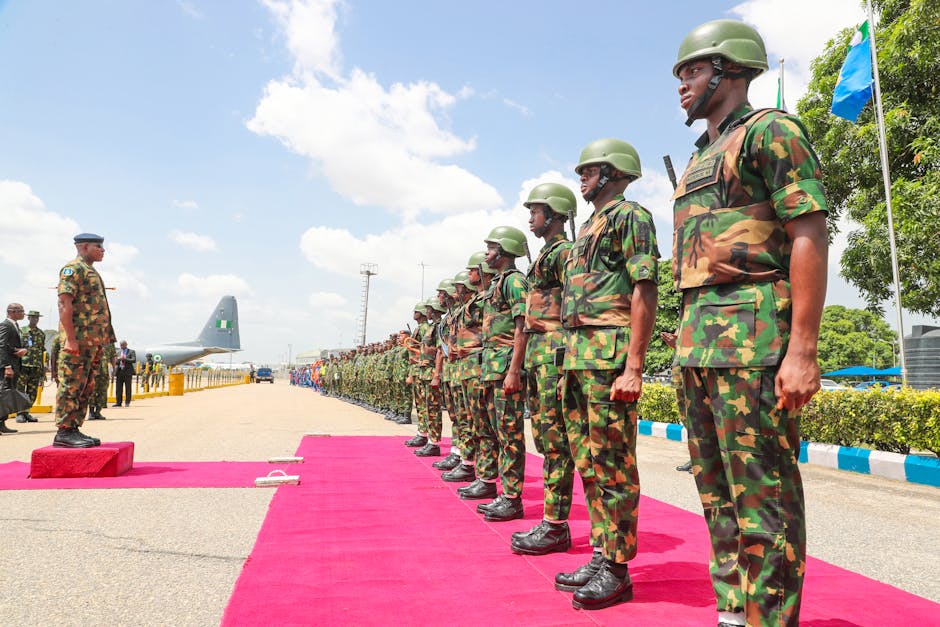
- The Nigerian army has dealt a major blow to militant forces in the region with the deadliest operation in over a year.
- The operation, dubbed ‘Operation Last Charge,’ targeted entrenched jihadist cells in the Sambisa Forest and surrounding villages.
- The Nigerian Air Force conducted precision strikes before ground troops advanced, engaging militants in close-quarters combat.
- The military reported 50 jihadists killed with no soldiers lost in the operation, a rare tactical victory in the conflict.
- The operation has marked a significant turning point in the battle against Boko Haram and ISWAP in northeastern Nigeria.
Dawn broke over the Sambisa Forest with the acrid scent of burnt tires and gunpowder still hanging in the air. Charred remnants of makeshift camps dotted the scrubland, their tattered flags—once bearing the black insignia of jihadist groups—now trampled underfoot. Nigerian army units, faces streaked with sweat and dust, moved cautiously through the wreckage, securing the area after a night of intense combat. Birds of prey circled above, drawn to the aftermath of a battle that marked one of the deadliest blows to militant forces in the region in over a year. By sunrise, the military confirmed a grim tally: 50 jihadists killed, with no soldiers lost in the operation—a rare tactical victory in a conflict that has claimed tens of thousands of lives and displaced millions across the Lake Chad Basin.
Operation Breakthrough in Borno State

Nigerian military forces launched a coordinated offensive in northeastern Borno State over the weekend, targeting entrenched jihadist cells in the Sambisa Forest and surrounding villages. According to a statement from the Defence Headquarters in Abuja, the operation—dubbed “Operation Last Charge”—involved joint air and ground assaults that dismantled multiple hideouts used by factions of Boko Haram and the Islamic State West Africa Province (ISWAP). The Nigerian Air Force conducted precision strikes before ground troops from the 7th Division in Maiduguri advanced, engaging militants in fierce close-quarters combat. No soldiers were killed, and intelligence assets recovered weapons caches, including rocket-propelled grenade launchers, explosive belts, and communication equipment. The success has been hailed as a turning point in efforts to reclaim territory long used as a sanctuary for insurgents launching attacks on civilians and security forces alike.
Decades of Insurgency and Failed Campaigns

The roots of Nigeria’s current conflict trace back to 2009, when Boko Haram launched an armed uprising against the federal government, demanding the establishment of an Islamic state in the predominantly Muslim north. Over the past 15 years, the insurgency has evolved, splintered, and regrouped, surviving military crackdowns, leadership decapitations, and international pressure. Despite the capture or death of figures like founder Mohammed Yusuf and longtime leader Abubakar Shekau, the movement fractured rather than collapsed, with ISWAP emerging as a more disciplined and strategically agile offshoot aligned with global jihadist networks. Previous military campaigns, such as Operation Lafiya Dole, achieved temporary gains but failed to hold territory or address underlying grievances like poverty, corruption, and lack of governance. As a result, militants repeatedly reoccupied rural areas, using the vast and remote Sambisa Forest as a logistical and recruitment hub.
Commanders, Militants, and Civilian Survivors

The current operation was led by Major General Obed Osuani, commander of the 7th Division, whose reputation for tactical discipline has brought cautious optimism among regional security analysts. His approach emphasizes intelligence-led raids and minimal civilian harm, a shift from earlier heavy-handed tactics that often fueled local resentment. On the other side, the slain militants included mid-level commanders responsible for coordinating suicide bombings and kidnappings, including the abduction of 276 Chibok schoolgirls in 2014. Meanwhile, displaced villagers in nearby camps, many of whom have fled multiple waves of violence, are watching developments with hope—but also deep skepticism. “Every time they say they’ve won, the fighters return,” said Amina Lawan, a mother of four in a camp outside Gwoza. “We will believe it when we can go home and stay there.”
Immediate and Regional Consequences

The elimination of 50 fighters represents a significant attrition for jihadist ranks, particularly if high-value operatives were among the dead. It may temporarily disrupt attack planning and supply lines across the Lake Chad region, which includes parts of Niger, Chad, and Cameroon—countries that have formed a multinational joint task force to combat the threat. For Nigeria’s military, the success could bolster morale and attract renewed support from international partners, including the United States and United Kingdom, which have provided training and surveillance assistance. However, experts warn that without a comprehensive strategy for stabilization, governance, and reintegration, territorial gains may prove fleeting. The risk of retaliation remains high, as extremist groups often respond to setbacks with increased brutality against soft targets.
The Bigger Picture
This operation reflects a broader shift in counterinsurgency doctrine across the Sahel, where militaries are increasingly combining precision force with efforts to win civilian trust—a lesson drawn from failures in Iraq, Afghanistan, and earlier phases of Nigeria’s own conflict. While kinetic victories make headlines, lasting peace requires dismantling not just networks, but the conditions that allow them to regenerate. Nigeria’s struggle is emblematic of a global challenge: how to defeat ideologically driven insurgencies without alienating the populations they exploit. The world is watching whether this latest success can be translated into durable security, or whether it will become another chapter in a cycle of violence that has endured for more than a decade.
What comes next will depend on more than just military momentum. Reconstruction, justice for victims, and political inclusion must follow in the footsteps of soldiers. The Nigerian government has yet to announce a civilian-led recovery plan for recaptured zones, raising concerns among humanitarian groups. But for now, in the scorched clearings of Sambisa, the silence after gunfire may finally signal something new: the fragile possibility of peace.
Source: Newagebd