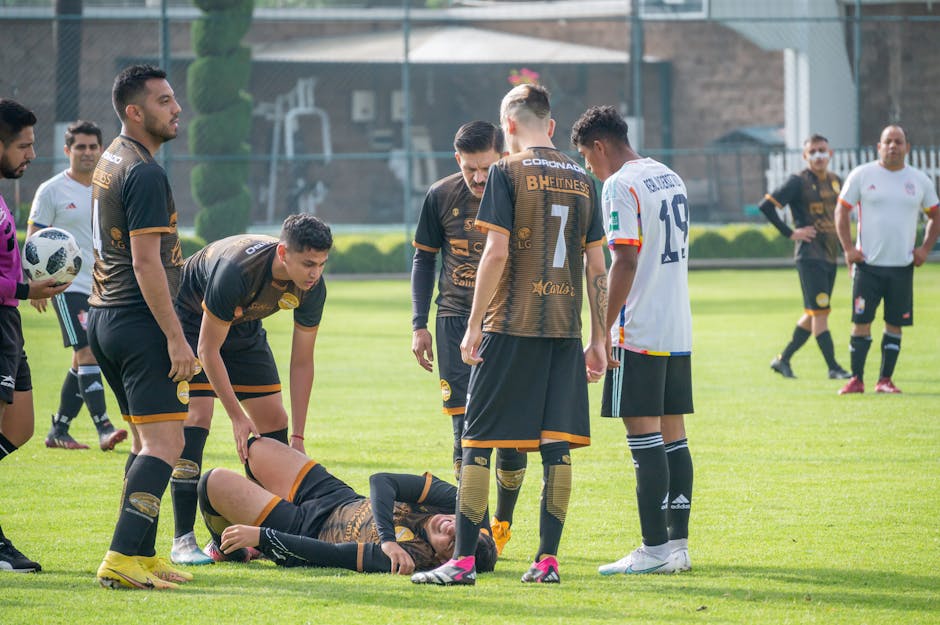
- Real Madrid is facing a severe injury crisis ahead of El Clásico, with seven first-team players ruled out.
- Key players such as Federico Valverde and Dani Carvajal are sidelined due to hamstring and lingering injuries, respectively.
- Eder Militão’s long-term ACL recovery is a significant blow to the team’s central defense, compounded by Ferland Mendy’s ongoing issues.
- Training sessions have become triage zones, with physios closely monitoring player fitness and providing medical support.
- Real Madrid’s aura of invincibility is under threat due to the team’s crumbling fitness roster and the cruel timing of injuries.
The Bernabéu stands hushed in the hours before battle, its usual thunder of anticipation replaced by a tense quiet, the kind that settles when uncertainty grips a dynasty. Outside, scarves bearing the names of Valverde, Carvajal, and Rodrygo flap in the Madrid wind like unanswered prayers. Inside, medical reports and MRI results circulate with the gravity of war dispatches. Real Madrid, perennial kings of European football, find themselves not just preparing for El Clásico, but fighting a war on two fronts—one against Barcelona, and another against their own crumbling fitness roster. Training sessions have become triage zones, with physios shadowing every sprint, every twist. The aura of invincibility, so carefully cultivated over decades, now flickers under the weight of strain, torn fibers, and the cruel timing of fate. This is not just a match approaching; it’s a reckoning.
Seven Players Out, One Star in Doubt

As of the final training session before the clash, Real Madrid confirmed that seven first-team players will miss El Clásico at Camp Nou. Federico Valverde, vital in both midfield control and defensive cover, is sidelined with a hamstring injury sustained against Bayern Munich. Right-back Dani Carvajal, already nursing a lingering issue, failed to recover in time, leaving a critical void on the flank. Eder Militão’s absence—a long-term ACL recovery—remains a season-defining loss in central defense, compounded by Ferland Mendy’s ongoing muscular problems. Rodrygo, a consistent offensive spark, is out with a thigh strain. Daniel Ceballos and young Turkish midfielder Arda Guler also remain in the treatment room. Most concerning, however, is the uncertain status of Kylian Mbappé. Though officially listed as a doubt with a minor ankle concern, his limited training participation has raised alarms within the medical staff and coaching setup.
The Road to This Breaking Point

This crisis didn’t erupt overnight. It’s the culmination of a grueling campaign marked by relentless fixtures, Champions League commitments, and a summer of transition. Since Real Madrid’s 2022 Champions League triumph, the squad has aged, and the physical burden on core players has intensified. Carvajal and Luka Modrić, both over 30, have seen their minutes spike due to limited rotation. The club’s transfer strategy—focusing on future stars like Bellingham and Mbappé—left gaps in immediate depth, particularly in full-back and central midfield. Eder Militão’s absence since October 2023 has exposed defensive fragility, forcing Ancelotti to deploy makeshift pairings. The January window brought no reinforcements, banking instead on returns from injury. But with Valverde and Rodrygo now joining the list, that gamble has backfired. The team’s reliance on a narrow core has become its Achilles’ heel, laid bare at the worst possible moment.
The Men Steering Through the Storm

At the helm, Carlo Ancelotti remains the calm amid the chaos, his experience guiding a locker room under siege. Known for his man-management and tactical flexibility, Ancelotti now faces one of his most testing assignments. His staff has scrambled to simulate game scenarios with reserve players, elevating youth-team talents like Miguel Gutiérrez and Antonio Blanco for training with the first team. Behind the scenes, club doctors and fitness coaches are under unprecedented pressure, balancing recovery timelines with the urgency of El Clásico. Meanwhile, team captain Nacho Fernández has emerged as a vocal leader, stepping into central defense despite his own advancing years. Youngsters like Jude Bellingham and Vinícius Júnior are being asked to carry more creative and emotional weight, transforming from stars into pillars. Their response could define not just the match, but the season.
Stakes Beyond the Scoreboard

The consequences of this injury wave ripple far beyond 90 minutes at Camp Nou. A loss could cede control of La Liga to Barcelona, especially with both teams navigating tight title races. Tactically, Ancelotti may be forced into uncharacteristic formations—perhaps a 4-4-2 with Bellingham and Camavinga anchoring midfield, or a back three to compensate for full-back shortages. The psychological toll is equally dangerous: young players thrust into high-pressure roles risk lasting confidence issues if overwhelmed. For the medical department, this crisis raises questions about load management and prehabilitation protocols. Commercially, the absence of stars like Mbappé and Valverde diminishes global viewership and sponsorship impact. And if Madrid falters, the summer transfer strategy could face severe scrutiny—especially if depth isn’t addressed.
The Bigger Picture
This moment transcends Real Madrid. It reflects a broader tension in modern football: the unsustainable pace of elite competition. Across Europe, clubs are grappling with fixture congestion, from domestic leagues to expanded Champions League formats. The human cost is mounting, with soft-tissue injuries rising year after year. FIFA’s calendar, long criticized by players and managers alike, continues to prioritize revenue over athlete welfare. Real Madrid’s crisis is not unique—it’s a symptom. As the sport accelerates, the margin for error shrinks. Teams with superior depth and medical infrastructure will thrive; others, even giants, may falter. El Clásico, in this light, becomes more than a rivalry—it’s a stress test for the sport’s future.
What comes next may hinge on resilience as much as talent. Real Madrid must rally around its wounded, trusting in preparation, leadership, and sheer will to survive the night. Whether through a gritty draw or a miraculous win, the aftermath will demand introspection. Injuries are inevitable, but systemic vulnerability is not. The road to recovery begins long before the players return to the pitch—it starts with how the club chooses to rebuild, restructure, and recommit to sustainable excellence in an unforgiving game.
Source: Marca