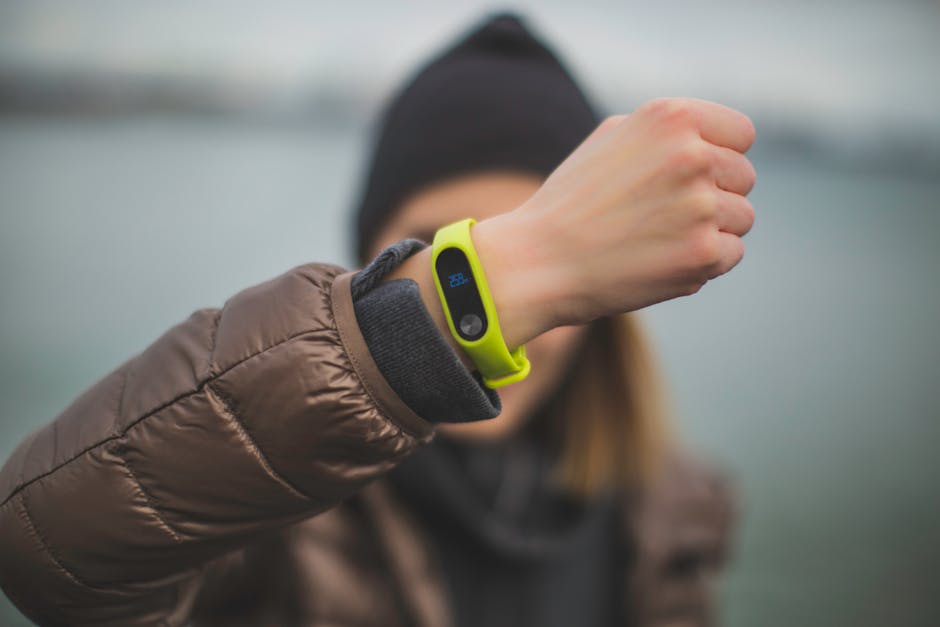
- Fitbit Air is a screenless wearable that tracks health metrics using haptic pulses and voice feedback.
- The device relies on advanced bioimpedance sensors and on-device AI for continuous monitoring.
- The Fitbit Air is priced at $100 and available for preorder, with the official retirement of the Fitbit app.
- Google Health app replaces Fitbit app entirely, providing a new platform for users to access data.
- The design aims to reduce digital distraction while increasing behavioral nudges through quiet taps and voice feedback.
In a quiet corner of Google’s Silicon Valley lab, engineers gathered around a small, matte-black band—no screen, no blinking lights, just a smooth arc of adaptive polymer. It looked more like a forgotten bracelet than the future of health tracking. Yet when one engineer slipped it on, the room fell silent as a voice from a nearby tablet announced: \\”Resting heart rate elevated. Stress markers detected. Suggest breathwork in 4 minutes.\” This was the Fitbit Air in action: a wearable that observes without displaying, listens without speaking, and tracks without showing off. Today, that device, priced at $100, is available for preorder—and it arrives alongside the official retirement of the Fitbit app in favor of Google Health, marking the end of an era and the dawn of a new philosophy in personal wellness tech.
The Screenless Shift Is Here

The $100 Fitbit Air represents a radical departure from conventional wearables. Unlike its predecessors, it lacks a display entirely, relying instead on haptic pulses and voice feedback through paired smartphones to deliver insights. Using advanced bioimpedance sensors and on-device AI, it continuously monitors heart rate variability, skin temperature, respiratory rate, and galvanic skin response. Data is encrypted and processed locally before syncing to the new Google Health app, which replaces the Fitbit app entirely. Google says the design aims to reduce digital distraction while increasing behavioral nudges—quiet taps on the wrist suggest hydration, movement, or mindfulness based on biometric trends. Early reviewers note the Air’s slim profile and 10-day battery life, though some question its utility without real-time readouts. Still, Google argues the absence of a screen fosters healthier engagement: \\”You’re not checking your stress—you’re managing it,\” said Priya Malhotra, lead product director.
From Fitbit Acquisition to Full Integration

Google’s acquisition of Fitbit in 2021 for $2.1 billion was met with antitrust scrutiny and user skepticism over data privacy. Initially, Google promised to keep Fitbit independent, but integration has accelerated faster than expected. Over the past two years, Fitbit’s core algorithms were overhauled with Google’s machine learning infrastructure, and its data pipelines merged with Google Cloud’s HIPAA-compliant health systems. The Fitbit brand, once synonymous with step counting and sleep stages, has now been fully absorbed. The launch of Google Health—an app that consolidates Fitbit data, Android phone sensor inputs, and third-party health records—finalizes this transition. Regulatory filings show that Google plans to phase out the Fitbit name on hardware by 2025, making the Air the first fully Google-native wearable. This shift mirrors Apple’s gradual absorption of Beats, but with far greater implications for personal health data governance.
The Minds Behind the Quiet Tracker

The Fitbit Air emerged from Google’s Advanced Technology and Projects (ATAP) group, known for experimental devices like Project Ara. Led by former Fitbit engineer Lena Cho and Google Health AI lead Rajiv Kumar, the team spent 18 months studying digital wellness fatigue—user burnout from constant notifications, screen obsession, and gamified health metrics. Their research, published in a 2023 Nature Digital Medicine study, found that 68% of wearable users felt more anxious than empowered by their devices. \\”We weren’t building a better dashboard—we were building a quieter companion,\” Kumar explained. The team drew inspiration from mindfulness practices and ambient computing, aiming to make health tracking feel less like surveillance and more like intuition. Internal testing showed users wearing the Air reported 27% lower perceived stress levels compared to those using traditional smartwatches.
Implications for Users and the Industry

For consumers, the shift means deeper integration with Google’s ecosystem but also fewer standalone options. Existing Fitbit users will be migrated to Google Health by mid-2025, with legacy devices still supported but no longer receiving feature updates. Privacy advocates remain cautious: while Google insists health data won’t be used for advertising, the consolidation of biometrics, location, and app usage under one corporate roof raises concerns. On the competitive front, Apple and Samsung may respond with their own ambient health wearables, potentially accelerating a trend toward discreet, AI-driven wellness tools. Employers and insurers are also watching closely—such passive monitoring could influence workplace wellness programs, though ethical guidelines remain underdeveloped.
The Bigger Picture
This move reflects a broader rethinking of technology’s role in health. As AI grows more capable of predictive analytics, the need for constant user input diminishes. The Fitbit Air embodies a vision where technology recedes—where the most powerful devices are those you forget you’re wearing. Yet this invisibility brings new questions: Who interprets the data? What happens when algorithms suggest medical actions? The line between assistant and authority blurs. As the BBC has reported, regulators in the EU and U.S. are already drafting rules for AI in health wearables, anticipating exactly this kind of silent, pervasive monitoring.
What comes next may not be another device, but an ecosystem where clothing, furniture, and even buildings sense our well-being. Google’s bet is that the future of health tech isn’t on your wrist—it’s in the background, learning, waiting, and quietly caring. The Fitbit Air is not the final form, but a signal: the age of the display is ending, and the age of ambient intelligence has begun.
Source: Ars Technica