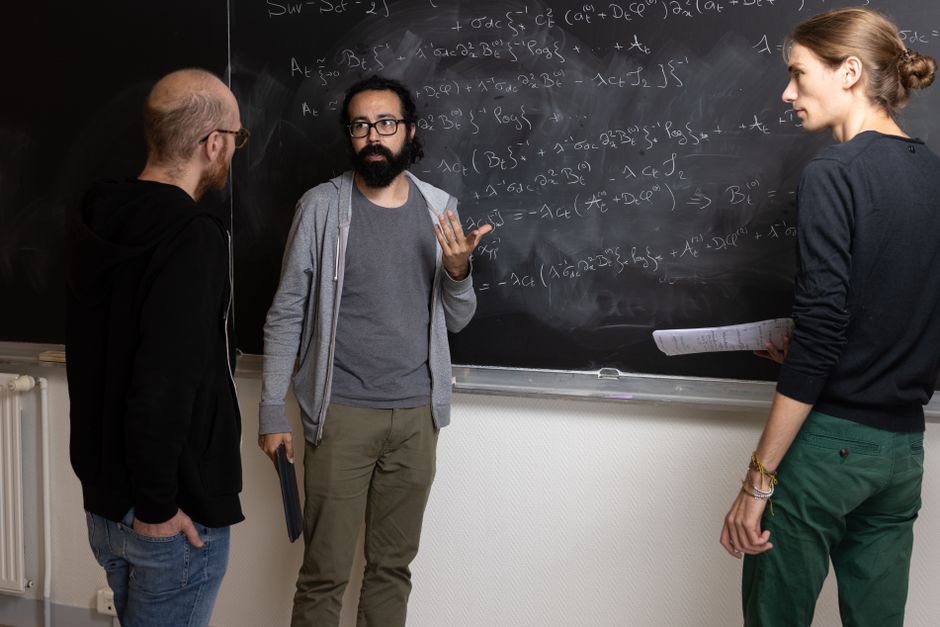
- Young mathematicians are facing increased competition from AI in solving complex math problems.
- Recent advancements in machine learning algorithms and large datasets have enabled AI to tackle problems previously exclusive to humans.
- AI can learn from datasets and make new discoveries at a faster pace than human researchers.
- The trend of AI surpassing human mathematicians is likely to continue, with significant implications for the math community.
- The shift towards AI-driven math research is changing the landscape of math careers and career development.
A team of young mathematicians spent years working on a complex math problem, only to be scooped by an artificial intelligence system that solved it in a fraction of the time. This incident is not an isolated one, as AI is increasingly mastering the kinds of projects that have long helped to build the careers of young mathematicians. The implications are significant, and the math community is left wondering what this means for the future of their field.
The Rise of AI in Math Research

The use of AI in math research is not new, but recent advancements have made it possible for machines to tackle complex problems that were previously the exclusive domain of human mathematicians. This shift is being driven by improvements in machine learning algorithms and the increasing availability of large datasets. As a result, AI is now able to learn from these datasets and make new discoveries, often at a faster pace than human researchers. According to a recent article in the New York Times, this trend is likely to continue, with significant implications for the math community.
Key Players and Developments

The team of young mathematicians who were scooped by AI were working on a problem in number theory, a field that has long been a staple of math research. The problem, which involved the distribution of prime numbers, was one that had been tackled by many mathematicians before, but the team had made significant progress and were on the verge of a breakthrough. However, before they could publish their results, an AI system developed by a team of researchers at a top university solved the problem, rendering the young mathematicians’ work redundant. The AI system, which was trained on a large dataset of math papers, was able to learn from the patterns and structures in the data and make new discoveries, including the solution to the problem.
Analysis and Implications

The fact that AI is now able to solve complex math problems has significant implications for the field of mathematics. On the one hand, it has the potential to accelerate progress and lead to new breakthroughs, as machines are able to process large amounts of data and identify patterns that may have gone unnoticed by human researchers. On the other hand, it raises questions about the role of human mathematicians in the future. Will they be replaced by machines, or will they be able to work alongside them to make new discoveries? As Wikipedia notes, the relationship between humans and machines is complex, and it will likely take time to fully understand the implications of this trend.
Broader Consequences

The impact of AI on math research will be felt far beyond the math community. As machines become increasingly capable of solving complex problems, it has the potential to disrupt a wide range of fields, from science and engineering to finance and economics. The ability of AI to process large amounts of data and identify patterns will make it an essential tool in many areas of research, and it will likely lead to new breakthroughs and discoveries. However, it also raises questions about the role of human researchers and the potential for job displacement.
Expert Perspectives
Experts in the field of mathematics have mixed views on the impact of AI on their field. Some see it as a positive development, one that will accelerate progress and lead to new breakthroughs. Others are more cautious, warning that the increasing reliance on machines could lead to a loss of human intuition and creativity. According to a recent article in Nature, the key to success will be finding a way to balance the use of machines with the need for human insight and creativity.
As the math community looks to the future, one thing is clear: the rise of AI will require a significant adjustment. Mathematicians will need to learn to work alongside machines, using them as tools to aid in their research. They will also need to develop new skills, such as the ability to train and interpret machine learning models. It is a challenging but exciting time for the field of mathematics, and one that will likely lead to new breakthroughs and discoveries in the years to come.
Source: The New York Times