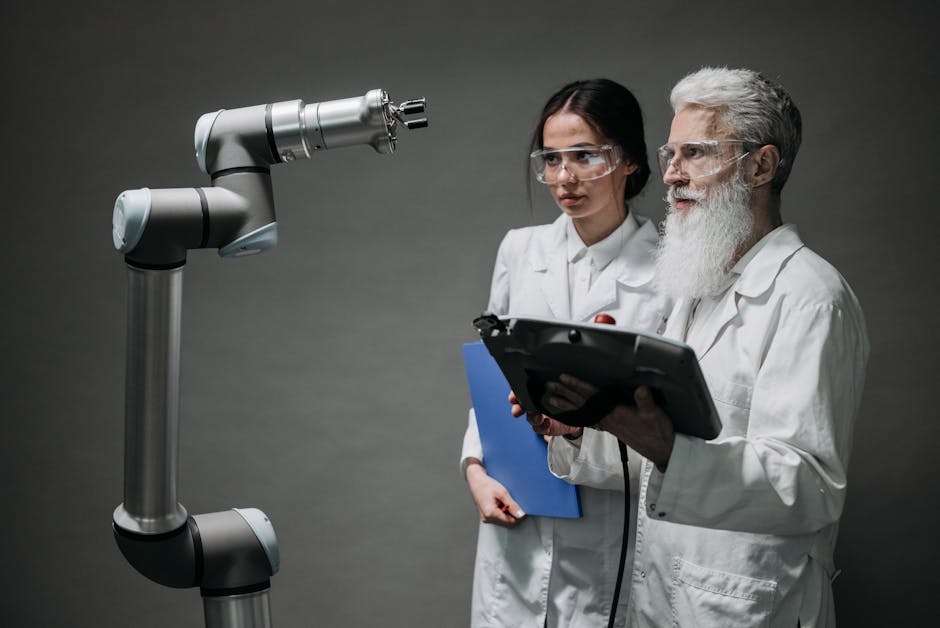
- Humans will continue to play a vital role in directing scientific research due to their ability to pose complex questions and make ethical decisions.
- Machines excel at processing data and performing repetitive tasks, but lack human creativity, intuition, and critical thinking.
- Human researchers bring innovation and critical thinking to scientific inquiry, complementing machine efficiency.
- The interplay between human creativity and machine efficiency will be crucial in advancing scientific knowledge.
- Humans will remain indispensable in scientific research, particularly in fields where ethics and interpretation are crucial.
As technology advances and artificial intelligence becomes more prevalent, a question arises: what role will humans play in the future of scientific research? The answer lies in understanding how human capabilities complement machine learning and data analysis, making them indispensable in certain aspects of scientific inquiry. With the ability to pose complex questions, interpret results, and make ethical decisions, humans will continue to be vital in directing the course of scientific research, ensuring that it remains aligned with societal needs and values.
The Core Question: Can Machines Replace Human Scientists?

Directly addressing the question of whether machines can replace human scientists, the answer is a nuanced no. While machines excel at processing vast amounts of data and performing repetitive tasks with precision, they lack the creativity, intuition, and critical thinking that human scientists bring to the table. Human researchers are capable of formulating innovative hypotheses, designing experiments that test these hypotheses, and interpreting the results in a broader context, including considering the ethical implications of their findings. This interplay between human creativity and machine efficiency will be crucial in advancing scientific knowledge.
Evidence from the Field

Supporting evidence for the continued importance of humans in science comes from various fields, including medicine, astronomy, and climate science. For instance, in medicine, human researchers are necessary for understanding the complexities of disease mechanisms, developing new treatments, and conducting clinical trials. Nature has published numerous studies highlighting the role of human scientists in breakthroughs, such as the development of vaccines and personalized medicine. Furthermore, initiatives like the CDC\’s efforts to combat infectious diseases demonstrate the critical need for human expertise in science.
Counter-Perspectives: The Rise of Automated Science

Despite the importance of humans, there are counter-perspectives that argue for the increasing role of automation in science. Proponents of automated science suggest that machines can perform certain scientific tasks faster and more accurately than humans, potentially leading to breakthroughs that might elude human researchers. However, skeptics argue that while automation can assist in data collection and analysis, it lacks the depth of understanding and the ability to ask follow-up questions that are essential for true scientific discovery. This debate underscores the evolving nature of scientific research, where humans and machines are likely to collaborate rather than compete.
Real-World Impact: Collaboration and Innovation

The real-world impact of humans in scientific research is evident in the collaborative efforts between human scientists and machines. For example, in astronomy, humans use machines to analyze vast amounts of data from telescopes, leading to discoveries like exoplanets and understanding the expansion of the universe. The NASA missions, which often involve human scientists working alongside advanced technology, demonstrate how this collaboration can lead to groundbreaking findings and a deeper understanding of our universe. This synergy between humans and machines is not only advancing our knowledge but also inspiring future generations of scientists and engineers.
What This Means For You
In practical terms, the continued role of humans in scientific research means that as society, we must invest in STEM education and encourage diversity in the scientific community to bring a wide range of perspectives and ideas to the forefront. By doing so, we can harness the full potential of human creativity and machine efficiency, leading to innovations that improve lives and address global challenges. As individuals, being informed about the latest scientific advancements and understanding the role humans play in these developments can empower us to make better decisions about our health, environment, and future.
Looking ahead, an open question remains: how will the balance between human and machine contributions to science evolve? As technology continues to advance, it will be crucial to monitor this balance and ensure that the unique capabilities of humans are utilized effectively, alongside the power of machines, to drive scientific progress and solve the complex problems facing our world.
Source: BBC