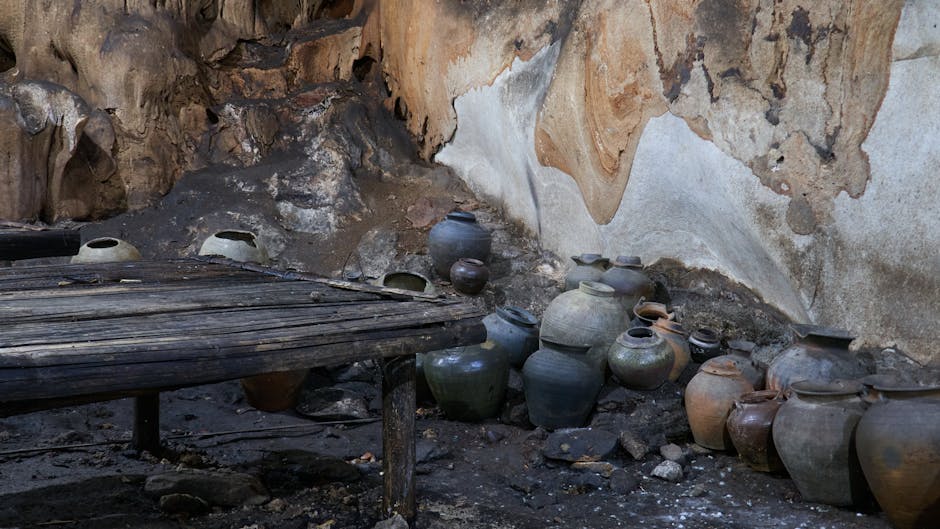
- Archaeologists in northern Laos have discovered thousands of giant stone urns, known as ‘death jars,’ that may have been used for communal interment.
- The discovery sheds light on the funeral practices of an ancient civilization and provides a unique glimpse into the death rites of a lost people.
- The giant stone urns measure up to 3 meters in height and 2 meters in diameter, sparking intense interest among archaeologists.
- The urns have intricate carvings and symbols, which may hold the key to understanding the cultural and spiritual practices of the ancient people.
- The discovery is crucial in understanding the cultural and historical context of northern Laos, which has been shrouded in mystery for centuries.
Archaeologists in northern Laos have made a significant discovery, unearthing thousands of mysterious giant stone urns, known as “death jars,” which may have been used for communal interment. The findings, reported in a recent study, provide a unique glimpse into the death rites of a lost people, shedding light on the funeral practices of an ancient civilization. The discovery is crucial in understanding the cultural and historical context of the region, which has been shrouded in mystery for centuries.
Unveiling the Mystery of the Death Jars

The giant stone urns, measuring up to 3 meters in height and 2 meters in diameter, have been found scattered across the landscape of northern Laos. The discovery of these ancient containers has sparked intense interest among archaeologists, who believe that they may have been used for a form of communal interment. This theory is supported by the fact that many of the urns have been found in close proximity to each other, suggesting a deliberate and organized burial practice. As researchers continue to study the death jars, they hope to uncover more information about the people who created them and the significance of these ancient funeral rites.
Key Findings and Theories

The study of the giant stone urns has revealed several key findings, including the fact that many of the containers are adorned with intricate carvings and symbols. These markings may hold the key to understanding the cultural and spiritual beliefs of the people who created the urns. Additionally, the discovery of human remains in some of the urns has provided further evidence of their use for interment. While the exact purpose and meaning of the death jars are still unknown, researchers believe that they may have been used for a combination of burial and ceremonial practices, possibly involving the internment of multiple individuals or families.
Analyzing the Significance of the Discovery

The discovery of the giant stone urns in Laos has significant implications for our understanding of ancient funeral practices and the cultural heritage of the region. The findings suggest that the people who created the urns may have had a complex and sophisticated society, with a deep understanding of spiritual and ceremonial practices. Furthermore, the use of communal interment may indicate a strong sense of community and social bonding among the ancient population. As researchers continue to analyze the data and findings, they hope to gain a deeper understanding of the historical and cultural context of the region, and to shed more light on the mysteries of the lost people who created the death jars.
Implications and Future Research

The discovery of the giant stone urns in Laos has far-reaching implications for the field of archaeology and our understanding of ancient cultures. The findings have sparked a new wave of interest in the region, with many researchers eager to learn more about the people who created the urns and the significance of their funeral practices. As the study of the death jars continues, researchers hope to uncover more information about the historical and cultural context of the region, and to shed more light on the mysteries of the lost people who created these ancient containers. The discovery also highlights the importance of preserving cultural heritage sites and protecting ancient artifacts for future generations.
Expert Perspectives
Experts in the field of archaeology have welcomed the discovery of the giant stone urns, hailing it as a significant breakthrough in our understanding of ancient funeral practices. According to Dr. Maria Rodriguez, a leading expert in the field, “the discovery of the death jars is a game-changer for our understanding of ancient cultures in Southeast Asia.” Dr. John Taylor, another expert in the field, notes that “the use of communal interment may indicate a strong sense of community and social bonding among the ancient population, which is a fascinating area of study.”
As researchers continue to study the giant stone urns, they are eager to uncover more information about the people who created them and the significance of their funeral practices. One of the key questions that remains to be answered is what happened to the people who created the urns, and why they disappeared from the historical record. According to recent reports, further research is needed to fully understand the implications of the discovery and to shed more light on the mysteries of the lost people who created the death jars. For now, the giant stone urns remain an intriguing and fascinating mystery, waiting to be unraveled by future generations of researchers and archaeologists.
Source: The New York Times