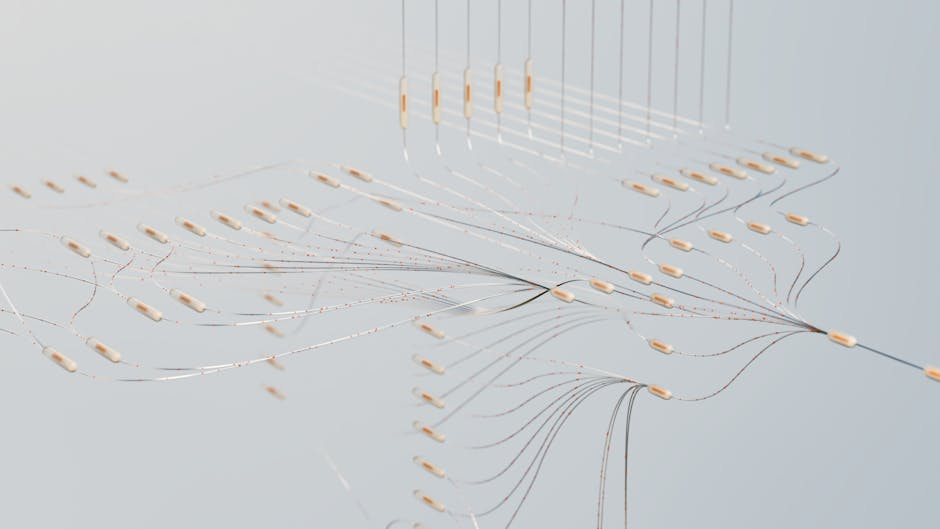
- Llama Surgery introduces a novel method for sparsifying pre-trained language models without retraining or pruning.
- This technique injects learned block-sparse attention topologies into existing models, boosting efficiency.
- The approach utilizes differentiable ultrametric topology injection for seamless integration of sparse layers.
- Llama 3.1 8B serves as the primary test model, demonstrating the feasibility and potential of Llama Surgery.
- Sparsification with Llama Surgery aims to make large language models more deployable in resource-limited settings.
Researchers have made a significant breakthrough in AI model sparsification with the introduction of Llama Surgery, a method for injecting learned block-sparse attention topologies into pre-trained dense language models without retraining from scratch, distillation, or post-hoc pruning. This innovative approach has the potential to greatly improve the efficiency of large language models, making them more suitable for deployment in resource-constrained environments. The main entity involved is the Llama 3.1 8B model, which has been used as a test bed for this new method.
Background and Context

The development of large language models has been rapid in recent years, with models like Llama 3.1 8B achieving state-of-the-art results in various natural language processing tasks. However, these models are often computationally expensive and require significant resources to train and deploy. This has led to a growing need for methods that can improve the efficiency of these models without sacrificing their performance. Llama Surgery addresses this need by providing a way to sparsify pre-trained models, reducing their computational requirements while maintaining their accuracy.
Key Details of Llama Surgery

Llama Surgery involves surgically replacing each attention layer in a pre-trained dense language model with a dynamic block-sparse attention layer. This is achieved through the use of differentiable ultrametric topology injection, which allows the model to learn a sparse attention topology that is optimized for the specific task at hand. The method has been tested on the Llama 3.1 8B model, with promising results. The researchers have demonstrated that Llama Surgery can significantly reduce the computational requirements of the model while maintaining its performance on various tasks.
Analysis and Implications

The implications of Llama Surgery are significant, as it has the potential to greatly improve the efficiency of large language models. This could enable the deployment of these models in resource-constrained environments, such as mobile devices or edge computing platforms. Additionally, Llama Surgery could facilitate the development of more complex and powerful language models, as it provides a way to reduce the computational requirements of these models without sacrificing their performance. The causes of the breakthrough are attributed to the innovative use of differentiable ultrametric topology injection, which allows the model to learn a sparse attention topology that is optimized for the specific task at hand.
Expert Perspectives and Future Directions

Experts in the field have welcomed the introduction of Llama Surgery, citing its potential to revolutionize the field of natural language processing. However, some have also raised concerns about the potential limitations of the method, such as the need for significant computational resources to train and deploy the model. Despite these concerns, the majority of experts agree that Llama Surgery is a significant breakthrough that has the potential to greatly improve the efficiency and performance of large language models. For more information on this topic, visit the Reddit thread discussing the research.
Expert Perspectives
Contrasting viewpoints on Llama Surgery highlight the complexity of the issue. Some experts believe that the method has the potential to greatly improve the efficiency of large language models, while others are more cautious, citing the need for further research and development. According to a report by Nature, the use of sparse attention topologies has been shown to improve the performance of language models in certain tasks.
Looking to the future, it will be important to watch how Llama Surgery is developed and deployed in various applications. One open question is how the method will be used in conjunction with other techniques, such as knowledge distillation and quantization, to further improve the efficiency of large language models. As the field of natural language processing continues to evolve, it is likely that Llama Surgery will play an important role in shaping the future of AI research and development.
Source: Reddit