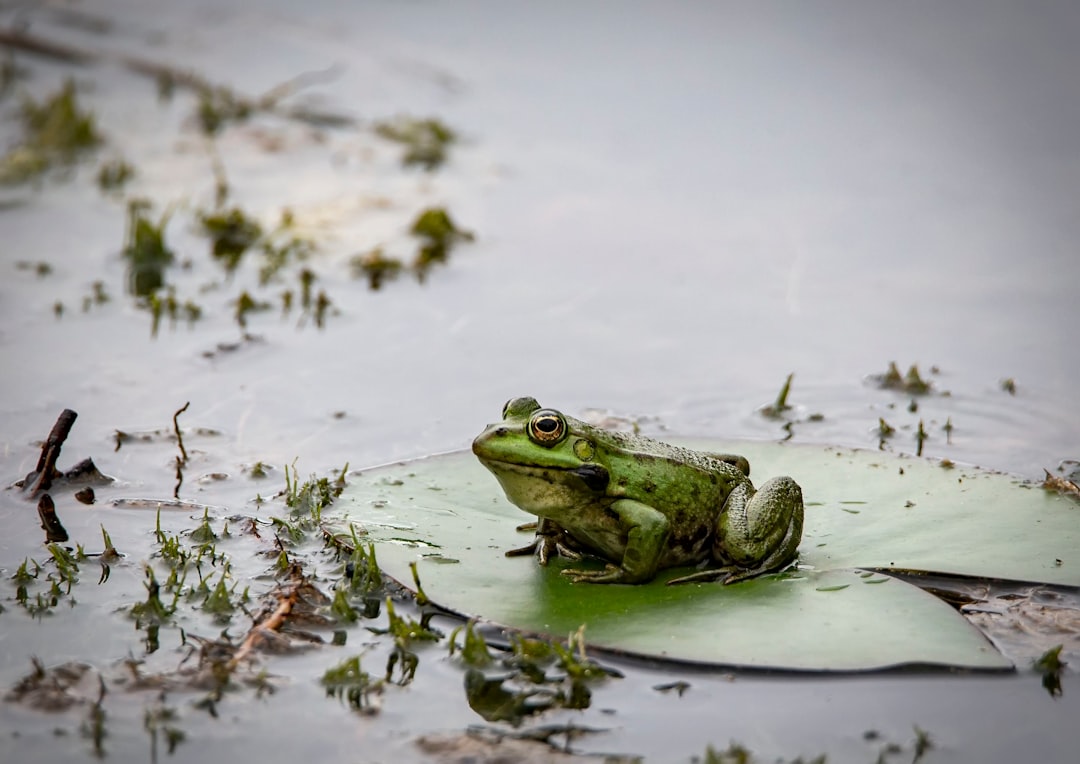
- A robotic tadpole developed by Billie Goolsby helps scientists study frog communication in natural habitats with greater accuracy.
- The device mimics larval amphibian behavior, recording high-fidelity audio and vibrational data from adult frogs.
- Goolsby’s innovation allows researchers to eavesdrop on frog conversations in real-time, overcoming human hearing limitations and environmental noise.
- The robotic tadpole is equipped with directional hydrophones and micro-vibrational sensors to detect both airborne and waterborne signals.
- This technology has the potential to improve our understanding of amphibian social dynamics and aid in monitoring biodiversity.
Billie Goolsby, a bioacoustics researcher at the University of Queensland, has developed a robotic tadpole that is revolutionizing the study of frog communication in natural habitats. Deployed in wetlands across Australia, the device mimics larval amphibian behavior while recording high-fidelity audio and vibrational data from adult frogs. This innovation allows scientists to eavesdrop on frog conversations in ways previously hindered by human hearing limitations and environmental noise. Goolsby’s work, published in Nature on May 25, 2026, marks a leap forward in understanding amphibian social dynamics and offers new tools for monitoring biodiversity. Her personal experience with progressive hearing loss not only inspired the project but also shaped its design, making it one of the first bioacoustic tools developed with auditory accessibility at its core.
Frog Conversations, Captured in Real Time

Using the robotic tadpole, researchers can now isolate and analyze individual frog calls within dense choruses, a longstanding challenge in field biology. The device, about the size of a large tadpole, is equipped with directional hydrophones and micro-vibrational sensors that detect both airborne and waterborne signals. It blends into aquatic environments, avoiding disruption to natural behaviors. In recent field tests in the Sunshine Coast wetlands, the robot recorded over 300 distinct call sequences from the endangered wallum sedge frog (Litoria olongburensis). These calls, previously dismissed as random noise, revealed structured patterns resembling rudimentary syntax. The data suggest frogs may use call sequences to signal territory, mating readiness, or predator warnings — a level of complexity not widely recognized before. Because the robot operates autonomously for up to 72 hours, it captures nocturnal and crepuscular vocalizations that human observers often miss.
The Origins of a Bioacoustic Breakthrough

The idea for the robotic tadpole emerged from Goolsby’s dual identity as a scientist and someone navigating hearing loss. During her PhD fieldwork in 2019, she struggled to distinguish overlapping frog calls using standard recording equipment, a problem compounded by her own auditory processing challenges. Rather than see this as a limitation, she reframed it as a design opportunity: if human hearing couldn’t parse complex amphibian soundscapes, perhaps machines could be built to do it better. Drawing on principles from biomimicry and machine learning, she began prototyping a submersible sensor platform that could ‘listen’ like a frog larva — sensitive to low-frequency vibrations and capable of directional sound localization. After six years of development, supported by grants from the Australian Research Council and collaborations with engineers at Queensland University of Technology, the first fully operational model was deployed in 2025. Its success has prompted interest from conservation groups and bioacoustics labs worldwide.
The Scientist Behind the Robot

Billie Goolsby’s journey reflects a growing trend of inclusive innovation in science, where lived experience drives technological advancement. Diagnosed with sensorineural hearing loss at age 28, she initially feared it would end her fieldwork career. Instead, it led her to question entrenched assumptions in bioacoustics — particularly the reliance on human auditory perception as the gold standard for interpreting animal sounds. “We’ve been filtering nature through human ears for too long,” Goolsby said in a recent interview with Nature. “But frogs don’t hear like we do. Why should our tools?” Her motivation extends beyond personal adaptation; she aims to democratize field biology for researchers with sensory disabilities. The open-source design of the robotic tadpole invites global collaboration, with plans to adapt it for studying crickets, fish, and even soil-dwelling insects.
Impacts on Conservation and Research

The robotic tadpole’s ability to decode frog communication has immediate implications for conservation. Amphibians are among the most threatened vertebrates, with over 40% of species in decline due to habitat loss, climate change, and disease. Traditional monitoring relies on visual surveys or basic audio recordings, which often fail to capture behavioral nuances. With the new robot, ecologists can detect stress signals, breeding disruptions, or changes in social structure before population declines become irreversible. In pilot programs, the device has already identified abnormal call patterns in frog populations exposed to agricultural runoff, suggesting sub-lethal effects of pesticides. Wildlife agencies in New South Wales and Victoria are now integrating the technology into their monitoring protocols. Moreover, the project is inspiring a new generation of bio-inspired sensors, from robotic insects to AI-powered sound traps.
The Bigger Picture
Goolsby’s work underscores a broader shift in science: the recognition that diversity in researchers leads to innovation in methods. By designing tools that account for non-human perception and human disability alike, she challenges the notion that objectivity in science requires uniformity in experience. The robotic tadpole is not just a monitoring device — it’s a statement about who gets to observe nature and how. As climate change accelerates biodiversity loss, such tools will be critical for detecting ecological shifts in real time. They also raise ethical questions about machine mediation in wildlife observation and the balance between technological intervention and natural behavior.
What comes next? Goolsby and her team are refining the robot’s machine learning algorithms to identify individual frogs by voiceprint, a capability that could enable long-term behavioral tracking. They’re also developing a network of solar-powered robotic tadpoles that communicate with each other to map acoustic territories in real time. As this technology spreads, it may not only decode frog conversations but also help save them — one call at a time.
Source: Nature