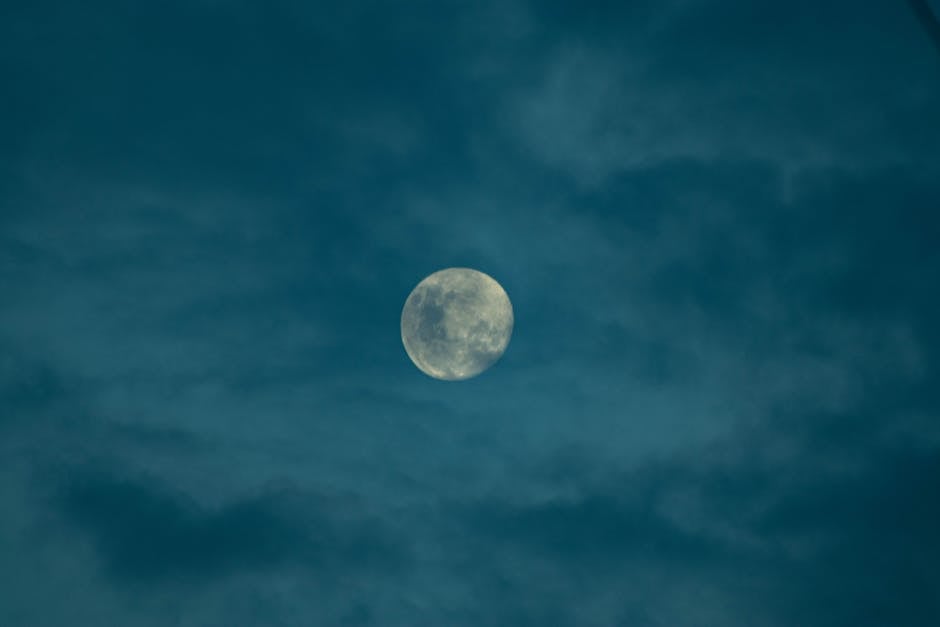
- A blue moon occurs when two full moons appear in the same calendar month due to the mismatch between the lunar cycle and the Gregorian calendar.
- The Gregorian calendar’s solar-based system keeps seasons stable but creates quirks like blue moons, illustrating the compromise behind our timekeeping.
- Blue moons occur roughly every 2.7 years due to the lunar cycle’s 29.5-day duration and the calendar’s 30.4-day average month length.
- The term ‘blue moon’ originated in the mid-20th century and is not related to the moon’s color, but rather its timing within a calendar month.
- Understanding blue moons helps clarify the interaction between cultural and scientific time systems and celestial events.
This week’s full moon on 31 May 2026 is a so-called blue moon—the second full moon in a single calendar month—highlighting the mismatch between our human-made calendar and the moon’s 29.5-day cycle. Because the Gregorian calendar is based on the solar year rather than lunar months, months don’t align precisely with lunar phases, occasionally squeezing two full moons into one month. This rare event, occurring roughly every 2.7 years, underscores the astronomical compromise behind our timekeeping: while solar-based calendars keep seasons stable, they create quirks like blue moons. Understanding this phenomenon helps clarify how cultural and scientific time systems interact, and why celestial events can seem out of sync with our monthly structure.
What Makes a Full Moon ‘Blue’?

A blue moon is not defined by color but by timing: it occurs when two full moons appear in the same calendar month. Since the lunar cycle lasts approximately 29.5 days, slightly shorter than most calendar months, it’s possible—though uncommon—for a month to capture two full moons. The first full moon typically falls near the start of the month, and if the cycle is short enough, the next one can occur before the month ends. This happens because the Gregorian calendar averages 30.4 days per month, creating enough overlap to allow such anomalies. The term “blue moon” originated in the mid-20th century, popularized by a 1946 article in Sky & Telescope, though it was based on a misinterpretation of earlier Maine Farmer’s Almanac references. Despite the name, the moon does not appear blue; atmospheric conditions, such as smoke or dust from volcanic eruptions, are required for that rare visual effect.
How Often Do Blue Moons Occur—and Why?

Blue moons occur roughly once every 2.7 years due to the misalignment between the lunar cycle and the solar calendar. Over a 19-year Metonic cycle—a period after which lunar phases realign with the same calendar dates—there are typically seven blue moons. This periodicity reflects the deeper astronomical tension between lunar and solar timekeeping. Civilizations have long grappled with this discrepancy: lunar calendars, like the Islamic Hijri calendar, drift through the seasons by about 11 days each year, while lunisolar systems, such as the Hebrew or Chinese calendars, insert leap months to maintain seasonal alignment. The Gregorian calendar, adopted globally for civil use, prioritizes solar consistency to preserve agricultural and climatic predictability, even at the cost of lunar irregularities. As explained by NASA’s lunar scientist Dr. Noah Petro, “Our calendar is solar-first, so lunar events like blue moons are artifacts of that choice” NASA’s Moon page.
Are There Other Definitions of a Blue Moon?

Yes—there is an older, less common definition of a blue moon that complicates public understanding. In some almanac traditions, a blue moon refers to the third full moon in a season that contains four full moons, rather than the usual three. This “seasonal blue moon” occurs when the equinox-to-equinox year, divided into four seasons, has an extra lunar phase due to the same calendar mismatch. This definition predates the modern “calendar blue moon” but is rarely used today outside of specialized astronomical circles. The confusion between the two definitions stems from a 1946 editorial error that misinterpreted the almanac’s seasonal rule, inadvertently popularizing the current version. Some astronomers, like those at the Time and Date observatory, argue that this illustrates how cultural narratives can override technical accuracy in science communication.
What Are the Real-World Impacts of Calendar-Moon Misalignment?

While blue moons have no direct physical effect on Earth, they highlight broader challenges in harmonizing human timekeeping with natural cycles. Religious and cultural events tied to lunar calendars—such as Ramadan, Passover, or Easter—require constant recalibration to remain seasonally relevant. Easter, for instance, is set as the first Sunday after the first full moon following the vernal equinox, illustrating the complex interplay between solar and lunar markers. The blue moon also affects amateur astronomy and public outreach, offering a teachable moment about orbital mechanics and calendar design. In education, it serves as a gateway to discussing axial tilt, orbital periods, and the history of time measurement. Moreover, as discussions grow about calendar reform—such as proposals for a “Hanke-Baltes” perpetual calendar—events like the blue moon underscore the trade-offs between simplicity, astronomical accuracy, and cultural tradition.
What This Means For You
The blue moon on 31 May 2026 isn’t just a curiosity—it’s a reminder that our measurement of time is a human construct shaped by practical and astronomical compromises. By understanding why blue moons happen, you gain insight into how science, culture, and history intersect in everyday systems like the calendar. The next time you mark a date, remember that it reflects a solar-centric choice that keeps our seasons stable but occasionally distorts lunar rhythms.
As global coordination increases, could future societies adopt hybrid or reformed calendars that better align lunar and solar cycles? And if so, how would that affect cultural, religious, and scientific practices worldwide? The blue moon invites us to question not just when time passes, but how we choose to define it.
Source: The Guardian