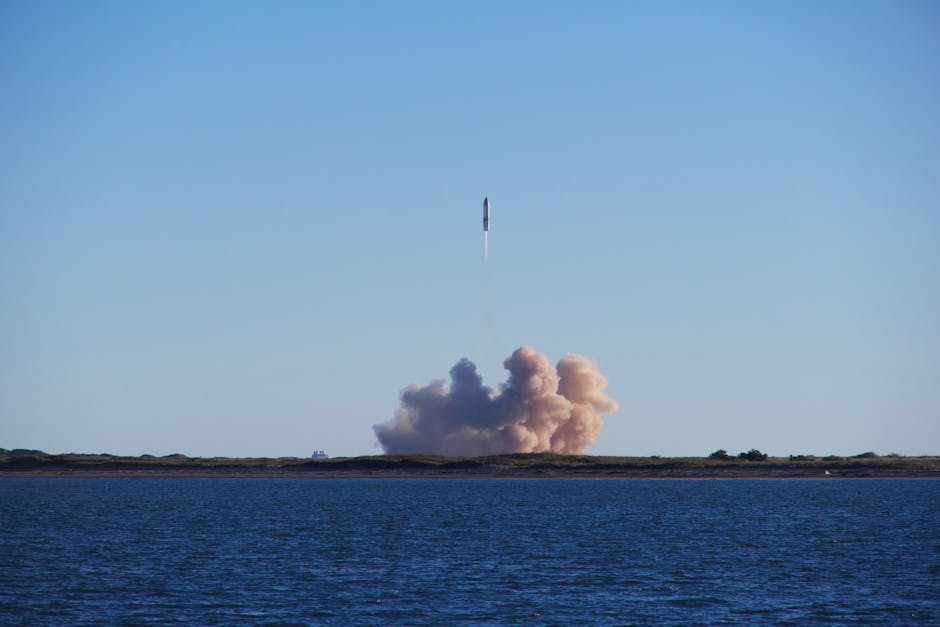
- SpaceX’s Starship, the most powerful rocket ever flown, exploded over the Indian Ocean after a test flight, ending in a violent detonation.
- The fourth integrated test flight of Starship achieved most of its primary objectives, including successful stage separation and reentry.
- The vehicle disintegrated just above the surface of the ocean during the final descent and attempted soft landing.
- Starship reentered Earth’s atmosphere at speeds exceeding Mach 25, testing its heat shield tiles and flaps.
- The incident marks a setback for SpaceX’s Starship program, which aims to send humans to the lunar surface and beyond.
Under a pale Texas dawn, the massive stainless-steel silhouette of SpaceX’s Starship loomed at Starbase, its 39 Raptor engines igniting in a synchronized roar that shook the dunes of Boca Chica. A plume of fire and smoke surged skyward as the 120-meter-tall vehicle—now the most powerful rocket ever flown—cleaved through the atmosphere, ascending with a precision that belied its experimental nature. For eight intense minutes, the flight proceeded almost flawlessly: stage separation occurred on time, the Super Heavy booster executed its flip maneuver, and Starship soared toward orbital velocity. But thousands of miles away, in the remote expanse of the Indian Ocean, the mission ended not with a quiet splashdown but a violent detonation—broadcast via SpaceX’s live feed as a sudden flash on a dark, rolling sea.
Starship’s Final Moments Over the Indian Ocean

The fourth integrated test flight of Starship, designated IFT-4, achieved most of its primary objectives, including successful stage separation, coast phase, and reignition of the ship’s engines for deorbit. According to SpaceX, Starship reentered Earth’s atmosphere at speeds exceeding Mach 25, enduring extreme heat and pressure that tested its heat shield tiles and flaps. Telemetry indicated stable aerodynamic control throughout reentry, a critical milestone for future crewed missions. However, during the final descent and attempted soft ocean landing, the vehicle suddenly disintegrated just above the surface. SpaceX confirmed an anomaly in the propulsion system during the landing burn, leading to a catastrophic failure. The explosion occurred in a pre-designated hazard zone, and no injuries or damage were reported. Despite the loss of the vehicle, company officials hailed the flight as a major success due to the volume of data collected.
The Path to Reentry: A History of Explosions and Iteration

SpaceX’s approach to rocket development has always favored rapid prototyping over traditional caution. Since 2019, the Starship program has cycled through dozens of test vehicles—each iteration learning from the fiery demise of the last. Early prototypes like Starhopper and Mk1 demonstrated vertical takeoff and landing, but subsequent high-altitude tests often ended in midair explosions or hard impacts. The first orbital attempt in April 2023 failed seconds after liftoff due to insufficient engine ignition, triggering an automatic flight termination. Each failure prompted design refinements: upgraded Raptor engines, enhanced flight software, and stronger heat shield materials. By IFT-3 in March 2024, Starship achieved orbital insertion and completed a full hot-staging maneuver. The progression reflects Elon Musk’s philosophy of ‘fail fast, fix fast’—a strategy that has drawn both admiration and scrutiny from aerospace regulators and competitors alike.
The Engineers, Visionaries, and Regulators Behind Starship

At the heart of Starship’s development is a team of engineers based in Brownsville, Texas, working under the relentless pace set by CEO Elon Musk. Known for his ambitious timelines—once predicting Starship would land humans on Mars by 2029—Musk has pushed his teams to innovate at breakneck speed. Yet the project also involves close coordination with NASA, which has invested over $4 billion in Starship as the lunar lander for the Artemis III mission. Regulatory oversight from the Federal Aviation Administration (FAA) adds another layer, as each launch requires environmental review and public safety certification. While SpaceX celebrates progress, some internal voices have expressed concern over burnout and risk tolerance. Former employees have cited a culture where speed often trumps caution, though current leadership insists that safety margins are improving with each flight.
Implications for NASA, Mars, and the Future of Spaceflight

The explosion during splashdown may delay the next test flight as SpaceX investigates the propulsion anomaly, potentially pushing back NASA’s lunar landing schedule. Artemis III, intended to return astronauts to the Moon’s surface by late 2026, depends on a fully operational Starship Human Landing System. Any prolonged grounding could force NASA to reconsider alternatives or extend timelines. Beyond government contracts, the incident affects SpaceX’s broader ambitions: satellite deployment, orbital refueling, and interplanetary travel. Investors and partners are watching closely, aware that reliability is as crucial as innovation. The loss also underscores the inherent danger in pushing technological boundaries—especially when the ultimate goal includes carrying human passengers through deep space.
The Bigger Picture
Starship represents more than a rocket; it’s a bet on a new paradigm of space exploration—one where cost, scale, and reusability converge to make deep space accessible. If successful, it could revolutionize how humanity accesses orbit, builds space stations, and eventually reaches Mars. But the recent explosion is a sobering reminder that mastery of Earth’s upper atmosphere and reentry dynamics remains elusive, even for the world’s most advanced private space company. As global interest in space grows—from commercial ventures to geopolitical competition—SpaceX’s struggles and triumphs are increasingly a proxy for the limits of modern engineering.
What comes next is more data, more analysis, and almost certainly, another launch. SpaceX has already begun assembling the next Starship prototype, stacking rings in the open-air gantry at Starbase. Engineers will pore over terabytes of telemetry to pinpoint the cause of the splashdown failure. When the next flight occurs—likely within months—the world will be watching not just for liftoff, but for a safe return. Until then, the image of Starship’s final flash over the Indian Ocean lingers: a brilliant, fleeting testament to ambition in the face of unforgiving physics.
Source: Euronews